Get Full Government Meeting Transcripts, Videos, & Alerts Forever!
Get email alerts on the Housing topic
No spam. Unsubscribe anytime.
Thornton Council agrees to participate in DRCOG regional housing needs assessment
Summary
The Thornton City Council voted unanimously to accept and participate in the Denver Regional Council of Governments' regional housing needs assessment, a staff-supported step toward complying with Colorado's new housing-assessment requirements and coordinating regional housing policy.
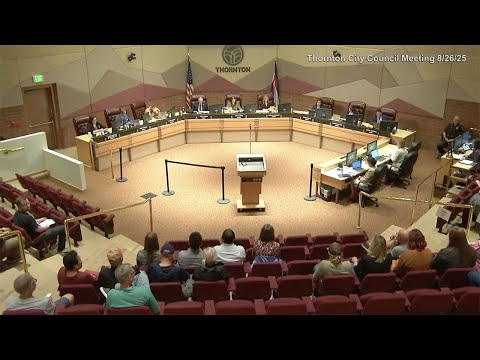
The Thornton City Council voted unanimously at the meeting to accept and authorize the city to participate in the Denver Regional Council of Governments (DRCOG) Regional Housing Needs Assessment.
City staff said participation will provide a regional data set and cross-jurisdictional perspective that can speed compliance with the state's new housing‑assessment requirements and support the city's forthcoming housing action plan. "It provides a regional perspective on the Denver Metro Area's housing needs and a network of cross-governmental collaboration," Cheryl Steinberg, housing supervisor, told the council during the public hearing.
Steinberg reviewed both the state requirement and the two assessments. She said the state law (described in staff materials as the Sustainable Affordable Housing Assistance law) requires local governments to complete a housing needs assessment that conforms to DOLA methodologies by Dec. 31, 2026, but jurisdictions can be exempted if they participate in a qualifying regional assessment. DRCOG's analysis, staff said, estimates the Denver metro region will need roughly half a million housing units over coming decades; DRCOG's projection for Thornton over the next 10 years is 6,440 units. Thornton's local housing needs assessment, prepared by city staff, calculates a substantially larger need — roughly 11,500 to 12,000 units in the same period — because the city's local analysis used additional local data and projections.
Steinberg highlighted affordability findings from DRCOG's draft: about 6 of every 10 additional units the region needs should be affordable to households making less than 50% of area median income, and growing numbers of smaller households and older residents will require more diverse housing types. She recommended the city "accept" DRCOG's regional assessment and continue to use its more detailed local assessment as the primary planning document.
Council members asked how staff planned to use both documents. Council Member Martinez said he supported participating because the regional assessment can help secure funding and align interjurisdictional policy while Thornton's own assessment would remain the city’s detailed source. Council Member Sandgren said he supported having more information but cautioned that some housing supply problems — for example, construction defects that limit condo building — require state-level remedies in addition to local land-use changes.
After the public hearing closed with no in‑person speakers and one online registration that did not appear, Martinez moved the resolution accepting and authorizing Thornton’s participation in DRCOG’s Regional Housing Needs Assessment; the motion passed unanimously.
The council packet and staff presentation, Steinberg said, note that participation does not supersede the city's housing needs assessment and does not obligate Thornton to fund or adopt DRCOG policy; rather, participation supplies shared data and a regional context for Thornton’s housing action plan and DOLA compliance.