Get Full Government Meeting Transcripts, Videos, & Alerts Forever!
Get email alerts on the Walmart Fueling Station topic
No spam. Unsubscribe anytime.
Indio planning commission approves Walmart fuel station with mural condition after public health concerns
Summary
The Indio City Planning Commission voted to recommend approval of a conditional use permit for a Walmart fuel station at 82391 Avenue 42, adding conditions on exterior color and an art/mural element after public comment about air quality and local station density.
The Indio City Planning Commission voted to recommend approval of a conditional use permit for a Walmart fuel station at 82391 Avenue 42, approving Resolution Nos. 2110 and 2111 with conditions that include substituting pure white with an off-white color and adding a mural or art element to large blank facades.
The commission’s action follows a staff presentation describing a proposed 1.4-acre fueling and convenience market within the existing Walmart Supercenter parcel and public comment raising air-quality and climate-policy concerns. The commission’s decision was a conditional approval rather than an amendment to the general plan or municipal code.
Why it matters: The project would add a 6,300-square-foot fuel canopy with 10 islands (20 fueling positions) and a roughly 1,600-square-foot convenience store to the Palm Shopping Center at Avenue 42 and Monroe Street. Opponents told the commission the location sits near multiple existing gas stations and raised worries about local air quality and the city’s climate-action goals; staff and the applicant said environmental technical studies and regulatory controls would limit impacts.
Staff presentation and project details Nicolas Withron, assistant planner with the Community Development Department, told the commission the 1.4-acre fueling station site is within the regional commercial zoning and the City of Indio’s General Plan 2040 land-use designation. Withron said the project includes a 1,600-square-foot convenience market, a 6,300-square-foot canopy with 10 islands providing 20 fueling positions, and landscape coverage of about 38 percent of the site—exceeding the city’s 10 percent minimum. Five mature non-fruiting palm trees on the north end of the site were conditioned to remain.
Withron said staff completed a CEQA consistency checklist under the programmatic/environmental documents for the general plan (referenced in the staff presentation as a consistency review under section 15183) and recommended conditional approval. Staff recommended a color substitution (off-white instead of pure white) to match the Walmart campus and included other standard conditions of approval.
Environmental, technical and regulatory reviews Tracy Zinn, the project’s CEQA consultant, said technical studies were prepared to support the checklist and to confirm the project would not cause greater environmental impacts than those disclosed in the general-plan-level environmental review. Zinn listed air-quality, health-risk, paleontological, cultural resources, geotechnical, greenhouse-gas, water-quality, noise and traffic technical analyses as attachments supporting the checklist and said many mitigation measures are embedded in city code or in regional/state regulatory programs.
Zinn reported the health-risk assessment showed diesel particulate matter impacts of 0.06 per 1,000,000 for nearby sensitive receptors—well under the South Coast Air Quality Management District’s threshold cited in the presentation (10 per 1,000,000). She also noted the project must comply with applicable South Coast AQMD rules, including vapor-recovery requirements at the pumps and odor-control rules.
Traffic, parking and circulation Robert Vu, the traffic engineer, told commissioners the traffic study included level-of-service, vehicle-miles-traveled screening, and queuing analyses and that no significant traffic deficiencies were identified for the project’s horizon year. Vu said the project was screened out of detailed VMT analysis due to its size and local-serving retail designation and that planned frontage improvements and a revised circulation layout were designed to prevent truck queuing and circulation conflicts during deliveries.
Applicant response and EV capacity The applicant’s attorney, Tracy Inscore, and project civil engineer Jennifer Perkins (CEI Engineering) described the fuel station as part of the Walmart campus that captures existing customer trips and provides consolidated shopping and fueling in one location. Perkins said Walmart has plans to install EV chargers at some sites and that the project will provide two EV-ready stalls to meet local green-code requirements; additional EV infrastructure would be implemented when required or as part of future site work. The city’s report estimated annual electrical demand for the project at about 255,754 kilowatt-hours per year and said a transformer would be installed on the west side of the proposed convenience building.
Public comment and concerns Ash Vega, a resident of Indio, urged the commission to deny approval, arguing the city already has numerous fueling stations nearby and that a new station would run counter to state climate goals cited in public comment (AB 197 and SB 32 and California Air Resources Board regulations were referenced). Vega also urged the commission to support the city’s 2019 Climate Action Plan goals for alternative fuels and charging infrastructure instead of expanding fueling infrastructure.
Commission deliberations, conditions and vote Commissioners and staff discussed community concerns about station density, localized air-quality effects, VMT screening limits, and whether the project would primarily serve freeway traffic. Commissioners emphasized that the planning commission’s land-use review must follow the municipal code, the general plan, and CEQA screening. Commissioners stated the city is conducting a concurrent study about gas-station density and policies and that any policy or code changes would require a separate process and possible council direction.
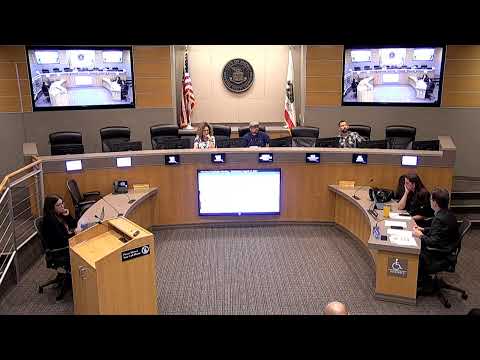
Commissioner Frantz moved to recommend approval of Resolution Nos. 2110 and 2111 with the staff-recommended color substitution condition and an added condition requiring the applicant to work with staff (and the art commission, as appropriate) to add a mural or art treatment to the large blank masonry surfaces. Commissioner Santos seconded the motion. The record shows Commissioner Santos and Vice Chairperson Frantz voted in favor; the motion carried. Two commissioners (Scarborough Echo and Ortiz) were recorded absent for the meeting.
Key conditions and clarifications - Color: Substitute pure white with off-white or a color consistent with the Walmart color scheme. - Art: Applicant to work with staff and the arts commission on a mural or other art treatment for large blank building façades, or pay the in-lieu art fee if appropriate. - Landscape: Replace any removed trees on a 1:1 basis with 24-inch-box trees; retain five non-fruiting palms noted along Showcase Parkway. - Technical compliance: Project must comply with all applicable city code requirements and South Coast AQMD rules (including vapor-recovery systems and other pump-related controls), and must satisfy plan-check requirements from building and fire review prior to construction. - EV readiness: Two parking stalls will be EV-ready per the local green code; the applicant indicates plans to add EV chargers at a future date but no schedule was specified.
What remains unresolved Commissioners and staff agreed to advance a separate study of gas-station density, VMT screening for corridor-serving sites, and community outreach before any code or general-plan amendments. Several commissioners asked staff to present initial research at the next planning commission meeting and to pursue broader outreach to capture resident feedback.
Background and next steps The site is inside the Palm Shopping Center and zoned regional commercial; fueling stations are listed as conditionally permitted uses in that zone. Because the project was found consistent with the programmatic environmental review for the general plan (via the checklist cited by staff), the commission’s action was a conditional-use recommendation rather than a new EIR. The commission’s recommendation will be reflected in the administrative record for subsequent plan check, permitting, and any city-council actions if the council is later asked to consider code changes. Construction, plan review and final permitting steps remain subject to separate approvals.
For the record, the commission was told the applicant’s environmental and technical reports are part of the project record and that if archaeological, paleontological or other discoveries occur during construction, the project must stop work and notify the appropriate archaeological or Native American monitors as required by city and state rules.