Get Full Government Meeting Transcripts, Videos, & Alerts Forever!
Get email alerts on the Comprehensive Plan Revision topic
No spam. Unsubscribe anytime.
Valley County planning commission narrows comp‑plan changes; staff directed to require groundwater monitoring and strengthen impact‑fee language
Summary
Valley County planning commissioners on Sept. 5 directed staff to strengthen draft comprehensive‑plan language so developments help produce groundwater monitoring data and so the county more actively uses capital‑planning and impact‑fee tools; staff will return a revised draft for a public hearing Oct. 23.
Valley County planning commissioners on Sept. 5 moved to strengthen language in the county’s draft comprehensive plan to require new developments to help generate groundwater monitoring data and to press the county’s tools — capital improvement programs, development agreements and impact fees — into use rather than simply “considering” them.
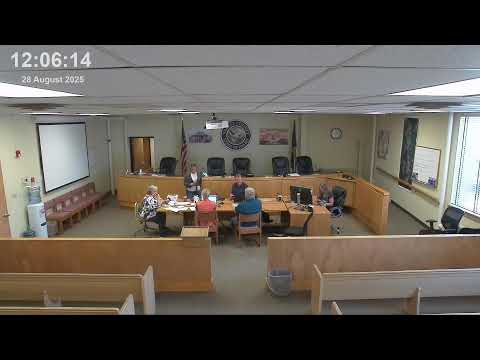
The commission spent the bulk of a work session reviewing draft chapters and suggested edits that staff will fold into a revised document for a public hearing set for Oct. 23 at 4 p.m. The session ranged over groundwater monitoring and nitrates, elevated phosphorus and cyanobacteria in lakes, impact fees and who pays for roads and utilities, affordable housing ideas, short‑term rental policy, wildfire and driveway/fire department access, and future land‑use map tweaks.
Why it matters: Commissioners said the county lacks enough monitoring to judge how individual new wells or clusters of wells affect deep and shallow groundwater. Several members argued the draft plan should put responsibility on developments to determine impacts and to contribute monitoring wells and data rather than merely “promote” voluntary monitoring.
On groundwater, planning staff reported limited existing monitoring and cited the county’s reliance on state agencies for formal designations (for example, Idaho Department of Environmental Quality high‑priority nitrate areas). Commissioners directed staff to change Objective 1.c (natural resources chapter) from “promote a well monitoring system” to language that would require monitoring wells for specified new developments; precise thresholds for when the requirement will apply will be set later in ordinance language. Commissioners discussed treating monitoring much like traffic or stormwater studies: site‑specific, tied to a minimum scope or threshold, and supported by ordinance implementation rather than only by the comprehensive plan.
On water quality, commissioners flagged elevated phosphorus and cyanobacteria in local lakes, including Lake Cascade and Payette Lake, and asked staff to broaden lake‑quality language. Commissioners asked staff to consult DEQ monitoring results and to list other chemicals that have appeared in past reports; staff will compile DEQ findings and return revised background text and objectives intended to reduce nutrient loading and address visible algal blooms.
Infrastructure and who pays: Commissioners debated stronger language about getting new development “near existing infrastructure” versus requiring hookups to central sewer and water. Several members urged the plan to move from “consider” to “implement” or “utilize” capital improvement programs, development agreements and impact fees so growth does not shift costs to current residents. The group discussed existing fire impact fees already collected at building permit and noted those fees range roughly from $1,500 to $3,000 per unit for fire protection, but members questioned whether those amounts cover full capital and maintenance costs. No change to the fee schedule was adopted at the meeting; commissioners asked staff to tighten policy language and prepare ordinance options for later review.
Affordable housing and short‑term rentals: Commissioners discussed whether the county should explore funding tools tied to second homes and non‑owner‑occupied units (examples discussed included a one‑time fee or leveraging lodging taxes), and noted many statutory limits exist at the state level. Planning staff and commissioners agreed to add stronger language about pursuing affordable housing and to include goals on deed‑restricted units, increased density in service areas, and options the county can legally pursue. Short‑term rentals were discussed as a pressure on housing supply; commissioners asked staff to include language urging state‑level changes and exploring local strategies such as licensing, taxation options where allowed, and encouraging deed restrictions in new subdivisions.
Wildfire and roads: Commissioners and staff discussed wildland‑urban interface concerns and near‑term, implementable measures. Staff said they will work with the county engineer and fire agencies to draft standards that can be used as conditions for subdivision approvals or building permits (for example, driveway access and clearance standards, defensible space practices and other Firewise measures). The commission did not adopt a new county‑wide overlay at the meeting but prioritized ‘‘practical’’ items staff can include quickly in ordinance drafts.
Maps and future land use: Commissioners reviewed updated future‑land‑use maps and suggested targeted adjustments in places where active agriculture remains (for example, areas north of Finch Church and portions south of West Mountain Road). They emphasized the map is advisory and brush‑strokes indicate likely direction rather than a zoning map.
Next steps and hearing: Staff will revise the draft comprehensive plan language to (1) change Objective 1.c in the natural‑resources chapter to require well monitoring systems (implementation details to be set in ordinance changes), (2) strengthen capital improvement / impact‑fee language to reflect current county practice and encourage adoption of an impact‑fee ordinance, (3) expand lake and water‑quality background and objectives to reference DEQ monitoring and concerns about phosphorus and cyanobacteria, and (4) incorporate initial wildfire/driveway standards for review with the county engineer and fire agencies. The commission scheduled a public hearing for Oct. 23 at 4 p.m. to consider the revised plan and a staff recommendation to forward it to the Board of County Commissioners for adoption or further action.
There were no formal votes recorded on policy changes during the work session; commissioners approved the hearing date and directed staff to bring revised text and draft ordinance language back for review prior to the hearing.