Get Full Government Meeting Transcripts, Videos, & Alerts Forever!
Get email alerts on the Building Codes topic
No spam. Unsubscribe anytime.
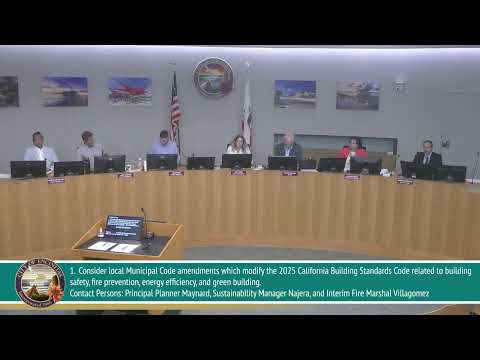
Encinitas council unanimously readopts local reach codes before state moratorium
Summary
The Encinitas City Council voted unanimously to readopt existing local building, fire, energy and green building code amendments before an October 1 moratorium created by AB 130, preserving the city's reach codes tied to its Climate Action Plan while directing staff to explore extending measures to taller multifamily buildings.
The Encinitas City Council voted unanimously to readopt the city's existing local building, fire, energy and green-building code amendments before an October 1, 2025, moratorium created by Assembly Bill 130.
City staff presented three options: (1) readopt all existing local amendments before October 1; (2) readopt selected amendments before October 1 and defer others; or (3) postpone readoption and rely on limited exceptions in AB 130 to adopt residential amendments after October 1. Crystal (city staff presenter) and Ryan Lampkin (sustainability analyst) told council staff recommended option 1 as the least legally risky approach because AB 130 is new and state guidance on its six exceptions is not yet available.
The council's action preserves four sets of local amendments the staff identified as already in effect under the 2022 code and proposed for readoption under the 2025 code: Ordinance No. 2022-12 (building and fire code amendments including definitions, fees, vegetation/fuel-management and flammable gas restrictions), Ordinance No. 2022-13 (2022 energy code amendments, expanded retrofit options, and nonresidential/high-rise solar requirements), Ordinance No. 2022-14 (building code amendments including graywater pre-plumbing and EV-charging requirements), and Ordinance No. 2024-04 (high-performance energy-efficiency requirement for single-family and low-rise multifamily). Staff noted two reach-code measures remain pending required cost-effectiveness studies: the high-performance energy-efficiency standard (potentially widening to additional building types) and a solar PV requirement for large-scale nonresidential/multifamily remodels.
Why it mattered: AB 130 bars cities from adopting residential building-code amendments between October 1, 2025, and June 1, 2031, except in limited circumstances (for example, standards substantially equivalent to those in effect as of Sept. 30, 2025; emergency standards; home-hardening or fire-safety measures; adoption to implement an approved general plan aligned greenhouse gas reduction strategy; or administrative changes). Staff warned the statute and the implementing agency guidance remain unclear, which, they said, raises legal uncertainty for relying on post‑October 1 exceptions. Crystal advised, “the safest approach to protect local control over the building code is to readopt what we can before 10/01/2025.”
Key provisions preserved by the readoption include: - EV readiness for new single-family homes (conduit and outlet/space planned for garage EV charging) and a requirement that nonresidential remodels valued at $500,000 or greater provide Level 2 EV chargers for 8% of parking spaces. - An electric-readiness reach code for single-family homes that requires preparing the exterior pad and a drain line for future heat-pump replacement. - An existing-building energy-efficiency reach code requiring single-family and multifamily remodels with a permit valuation of $50,000 or greater to install at least one energy-efficiency measure (staff noted the water-heating package is the lowest-cost measure at about $230 upfront with an estimated $30 annual utility saving). - A graywater pre-plumb requirement for new single-family homes that requires pre‑plumbing plus a two‑way valve to permit future diversion of suitable wastewater for landscape irrigation (staff clarified the current proposal requires pre‑plumbing and the valve; additional schematic dashed elements on a slide are not part of the requirement).
Public comment: Eleven speakers, representing local environmental groups and residents, urged the council to readopt the existing reach codes. Anne Feeney of the San Diego Building Electrification Coalition said, “I urge you tonight to readopt all the relevant existing reach code amendments before 10/01/2025.” Other speakers — including representatives from the Sierra Club of San Diego and Climate Action Campaign and multiple Encinitas residents — emphasized that the reach codes underpin the city's Climate Action Plan and urged preserving them to maintain local climate leadership.
Council deliberations and directions: Councilmember Schaeffer moved to approve option 1; the motion was seconded (second not specifically named in the record) and carried unanimously. Councilmembers noted concerns about the speed of the state's rule change and the lack of agency guidance. Deputy Mayor Lyons secured a friendly amendment accepted by the mover to direct staff to investigate extending energy-efficiency reach-code measures to four-story-plus multifamily buildings pending the statewide cost-effectiveness study and agency guidance. Councilmembers also discussed pursuing state clarification through joint requests with other cities or via the statewide reach-codes program, but no separate formal motion to the state was recorded during the meeting.
Implementation notes and legal context: Staff and the consultants on the call (including Misty Bruseri from the statewide reach-codes program and Neil Desnow) explained that AB 130 does not affect nonresidential code amendments; those can be adopted at any time. Staff repeatedly cautioned that reliance on AB 130 exceptions carries legal uncertainty until the California Building Standards Commission and California Energy Commission issue specific guidance or legal precedent is established. The state 2025 California Building Standards Code takes effect Jan. 1, 2026, and the city's next triannual code update will be in the 2028 cycle.
Votes at a glance: The council approved option 1 — to readopt all listed local code amendments before Oct. 1, 2025 — by a unanimous vote of the five members present (Mayor Ehlers; Deputy Mayor Lyons; Councilmembers Schaeffer, O'Hara, and San Antonio). Staff retained authority to later amend or retract any local amendment by subsequent ordinance.
What comes next: Staff will (a) proceed with readoption of the draft ordinances listed in the staff packet to ensure the local amendments remain in effect when the 2025 state code becomes effective; and (b) follow up on the council direction to further examine extending certain energy-efficiency measures to four‑story-plus multifamily buildings as cost-effectiveness data and statewide analyses become available. Councilmembers and staff said they will monitor forthcoming guidance from state agencies and the statewide reach-codes program.