Get Full Government Meeting Transcripts, Videos, & Alerts Forever!
Get email alerts on the Neighborhood Improvement topic
No spam. Unsubscribe anytime.
Neighborhood Improvement Task Force outlines short- and long-term fixes for litter, encampments and lighting
Summary
City staff described how the multi‑department Neighborhood Improvement Task Force prioritizes short‑term fixes and longer projects using community reports and the SB Connect app, and highlighted recent work in West Montecito, Bath Street and other neighborhoods.
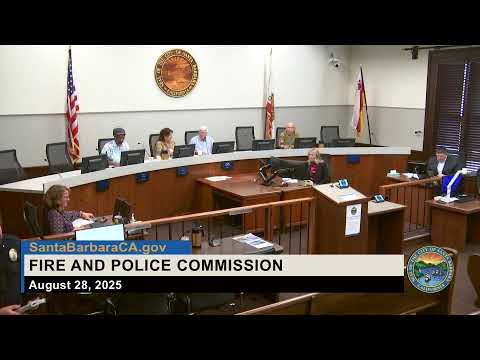
Chris Clark, an environmental services specialist in the city’s Sustainability and Resilience Department, told the Santa Barbara Fire and Police Commission that the Neighborhood Improvement Task Force (NITF) coordinates city departments to address neighborhood‑level concerns such as litter, illegal dumping, encampments, lighting and pedestrian safety.
"The NITF is a city of Santa Barbara multi departmental working group tasked with finding solutions to neighborhood level public concerns related to cleanliness, safety, and enhancement opportunities," Clark said. He described a two‑track approach that uses existing departmental resources for short‑term fixes while identifying funding and planning for longer projects.
The task force evaluates each concern against three primary categories—clean, safe and enhanced—and scores candidates using factors that include frequency of reports, estimated cost and community input. Clark said the NITF often does site visits and assigns action items to departments when an issue can be handled by a single unit; multi‑department problems are elevated to the task force for coordinated response.
Short‑term actions, Clark said, are items the city can complete within existing resources, generally within six months. Longer projects require funding and planning; he identified Community Development Block Grant (CDBG) funds and matching city general funds as typical funding sources for multi‑year work.
Clark showed maps compiled from two years of reports submitted through the SB Connect app and internal staff reports. He said darker map dots indicate higher densities of reports and pointed to Oak Park, the Westside, the Eastside and downtown as areas with elevated concern counts. "We respond to and address every single complaint that we get," he said, describing the department’s effort to close the loop on public reports.
Clark reviewed recent NITF projects the task force considers successes: cleanup, lighting repairs and added trash receptacles at Casique and the Lease House; a temporary closure and cleanup to restore a day‑labor site on Ision and Ali streets; access restriction and cleanup at Dartmouth Field and Dwight Murphy Ballpark; fencing installed in partnership with Caltrans near the Castillo underpass; lighting fixes on Euclid Avenue and removal of an abandoned water pipe that had provided access into a creek area; and ongoing outreach and power‑washing on West Montecito Street and the Bath Street cul‑de‑sac. He said the task force is also coordinating gateway improvements around the Amtrak station.
The group, Clark said, includes representatives from Public Works, Sustainability and Resilience, Community Development, Parks and Recreation, Police, Fire and the City Administrator’s Office; the City Attorney’s Office and other partners join specific projects as needed. Clark said NITF action items are tracked in a matrix that is reviewed at monthly meetings.
Commissioners asked about the scoring and prioritization. Commissioner Jones asked whether all scoring factors must be met for a project to be selected; Clark replied that a candidate needs to touch at least one of the clean/safe/enhancement categories and that priority ranking is determined by the task force’s scoring matrix. Commissioners also asked whether the map normalizes reports by population; Clark said the map shows reports by geographic neighborhood and does not normalize by population.
Clark encouraged public use of the SB Connect app, which accepts anonymous reports and allows users to see report statuses; he said the department maintains a public dashboard with versions of the map and work updates. He also said the NITF is aligning with the Neighborhood Advisory Council: the council has 13 seats, 10 are filled, and it meets monthly at 6 p.m., rotating between the Louise Lowery Davis Center and the Franklin Center.
The presentation concluded with commissioners thanking staff and an open question period; Clark said staff remain open to project recommendations and will continue to prioritize work by the task force’s scoring criteria.