Get Full Government Meeting Transcripts, Videos, & Alerts Forever!
Get email alerts on the School Finance topic
No spam. Unsubscribe anytime.
Regional finance committee debates E&D level and special-education stabilization account
Summary
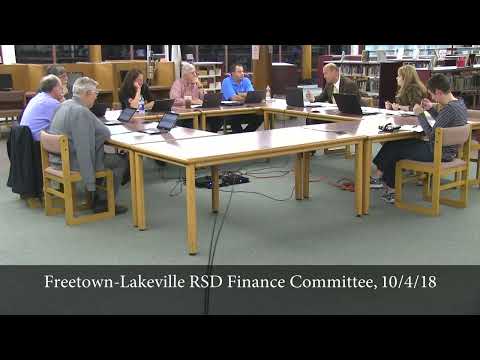
Members of the regional finance committee discussed the closeout of FY18, projections for FY19, the effect of increased state circuit-breaker reimbursement and whether to create a special-education stabilization/revolving account to reduce the need for midyear requests to the towns.
Members of the Regional Finance Committee reviewed a FY18 closeout and spent the bulk of the meeting discussing how much to hold in Excess and Deficiency (E&D) and whether to establish a separate stabilization or revolving account specifically for special-education costs.
The committee was told FY18 closed with a modest general-fund surplus that was rolled into E&D and that roughly $218,000 was being processed for certification. Committee members also heard that roughly $151,000 in maintenance and program costs were charged back to special-revenue/revolving funds rather than the general fund, which contributed to the surplus.
The discussion centered on two practical problems: (1) how large an E&D balance the district should keep for one-time emergencies and ordinary unanticipated expenses, and (2) how to handle highly variable, recurring special-education costs that have driven large E&D withdrawals in prior years. Members noted that, by law, regional districts must apply anything over 5 percent of their budget that remains in E&D back to the operating budget; speakers agreed that 5 percent is a statutory threshold that constrains options.
Committee members and administration offered figures and trade-offs rather than a final numeric target. The business office presented a working projection for FY19 that shows E&D could close the year at roughly $732,000 (projection), but speakers emphasized that figure is still subject to state actions and final certification. The group flagged several items that affect that projection: an increase in the state’s circuit-breaker reimbursement rate from an expected 65 percent to 72 percent (producing roughly $58,000 in additional circuit-breaker revenue in the reported period), and a lower-than-projected school-choice census (70 students versus the 75 budgeted, a roughly $25,000 revenue shortfall to date).
Several members raised the past-year special-education withdrawals as the primary driver of E&D depletion. The committee discussed creating a separate, earmarked special-education stabilization or revolving account so that large outlays tied to students’ ongoing services would not force midyear requests to the towns. Proponents said a dedicated account—initially funded with certified one-time revenues (for example, fall town free cash)—would reduce the likelihood of a disruptive special-town request if out-of-district placements or other spikes reoccur. Others said the committee should first agree on a comfortable E&D floor before allocating one-time funds to a separate special-education account.
Members recommended further work: administration will prepare a clear list of recurring versus one-time items that historically drew on E&D; the committee asked for proposals showing the ranges (floor/ceiling) for both E&D and a possible special-education stabilization account and a timeline for initial funding (the fall town-meeting cycle was discussed). Committee members signaled a preference to avoid using E&D for recurring operational costs and to prioritize capital and one-time needs for one-time revenues.
The meeting closed without a final numeric policy change; committee members agreed to return the subject to a future agenda with the administration’s detail work and a recommended funding approach ahead of the fall town meetings.