Get Full Government Meeting Transcripts, Videos, & Alerts Forever!
Get email alerts on the Stormwater topic
No spam. Unsubscribe anytime.
Conservation commission requires revised plans, soil testing and pollutant controls for 160 Bedford Street project
Summary
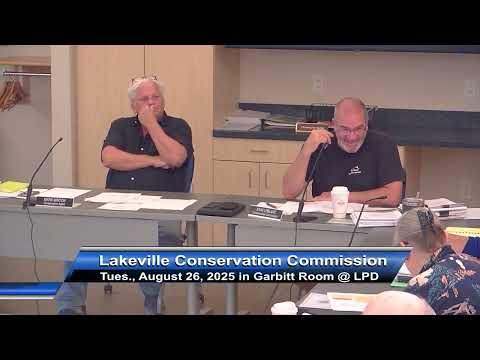
The Lakeville Conservation Commission on Aug. 26 closed the public hearing for a proposed redevelopment at 160 Bedford Street and voted to require a revised, consolidated plan and a set of prior-to-construction conditions after peer-review comments were addressed.
The Lakeville Conservation Commission on Aug. 26 closed the public hearing for a proposed redevelopment at 160 Bedford Street and voted to require a revised, consolidated plan and a set of prior-to-construction conditions after peer-review comments were addressed.
The commission’s peer reviewer, Deb Keller, told the panel the applicant adjusted the design after her review so the detention basin discharges into a depression that feeds an adjacent wetland, rather than bypassing it. “We made that change. We basically redirected our pipe to that area,” an applicant engineer said during the hearing. Keller and the commission also required soil testing inside the infiltration chamber and constructed-wet-basin areas, with groundwater elevations to be verified and any design revisions resubmitted to the commission for approval.
Why it matters: The project is sited near an Outstanding Resource Water and wetlands. Commissioners and the peer reviewer emphasized treatment and recharge of stormwater on-site, and expressed concern about nearby private wells, materials stored on the site, and operations that could release pollutants into the wetland system.
Key conditions approved or clarified during the hearing include: - A clean, consolidated set of revised plans addressing all peer-review comments must be provided to the commission and peer reviewer prior to the commencement of any work. - Soil testing to confirm seasonal high groundwater shall be conducted within the proposed infiltration chamber system and the constructed wet basin; tests must be witnessed by a town representative. If soil or groundwater conditions require redesign, a revised plan must return to the commission for review. - Erosion controls must be installed before construction activity and inspected by the commission or its agent; the commission asked that compost-filter socks (rather than straw wattles) be used in the plan details. - The applicant must obtain and provide a copy of the EPA Construction General Permit (and associated SWPPP) before work begins. - The permanent stormwater operation and maintenance plan must be recorded with the order of conditions so it runs with the property and any future owner. - Any future work beyond the scope of the approved plans will be treated as new development and will require a new Notice of Intent and full stormwater review under the DEP stormwater management regulations in effect at that time. - Unsecured or uncovered construction materials shall not be stockpiled overnight in the buffer zone. Any building material that enters the pond shall be removed immediately. - A Licensed Site Professional (LSP) inspection was requested and the commission asked for a written statement confirming whether hazardous materials or uncontained pollutants are being stored in the resource area; if so, these items must be removed before construction.
Project specifics and peer-review changes presented at the hearing included: redirecting the basin outlet to maintain wetland hydrology, creation of a broad vegetated swale with check dams to provide pre-treatment before infiltration, subsurface chamber recharge sized to meet recharge requirements (peer reviewer calculated recharge met the standard assuming recycled asphalt was treated as impervious), revised outlet orifice details for the constructed wet basin and a clarified limit for the recycled-asphalt surface beyond which no expansion is permitted without a new filing.
Commissioners asked the applicant to clearly show and label the neighbor and on-site well locations on the revised plan. The applicant’s engineer confirmed a recent survey crew located the wells and said the next plan revision would show them.
The commission moved to close the hearing and to have staff and peer review finalize a rewritten order of conditions that stages the required steps before staking and construction. The motion passed on a roll-call vote with John LeBlanc, Michelle Bouchard, Nancy Yates and Joseph Chamberlain recorded as voting yes.
Next steps: The commission will not allow staking of limits of work or placement of erosion controls until the consolidated, peer-reviewed plans, the soil testing results witnessed by a town representative, and the required permit documentation (EPA CGP/SWPPP) are submitted and accepted. Any subsequent substantive change will require a new filing.