Get Full Government Meeting Transcripts, Videos, & Alerts Forever!
Get email alerts on the Public Health Assessment topic
No spam. Unsubscribe anytime.
North Suffolk health assessment: Revere respondents report housing, mental health and access-to-care as top concerns
Summary
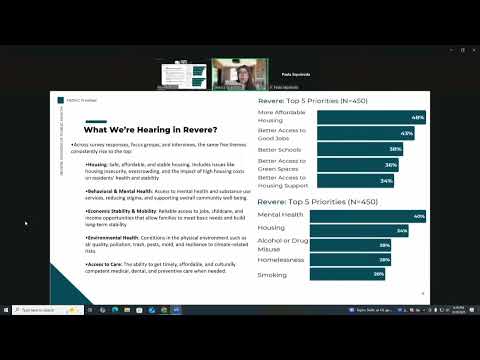
A regional community health assessment presented to the Revere Board of Health found housing affordability, behavioral and mental health, economic stability, environmental health and access to care were the five priority areas; the survey reached about 450 respondents from Revere and exceeded the statistical threshold for representativeness.
Vanessa Gordado Menhevar, regional epidemiologist for the North Suffolk Public Health Collaborative, presented preliminary findings from the collaborative’s 2024–25 community health assessment to the Revere Board of Health on an August public meeting.
The assessment drew about 450 Revere respondents — above the roughly 382 responses required to be statistically representative for a population of about 62,000 — and identified five priority themes: housing, behavioral and mental health, economic stability and mobility, environmental health, and access to care. “We are really trying to ensure that we’re reaching populations that are often underrepresented,” Gordado Menhevar said, noting outreach included in-person events to improve representation.
Why this matters: the community health assessment will feed a multi-year strategic community health improvement plan (SHIP) used by municipalities and partner organizations to set priorities and guide programs. Gordado Menhevar said the full report is in draft and an interactive ArcGIS story map is planned to be released in the fall to make findings accessible to residents and stakeholders.
Key local findings for Revere in the presentation included: about 48% of respondents listed more affordable housing as a desired improvement; roughly 40% listed behavioral and mental health among top health concerns and 34% listed housing; about 32% of respondents reported difficulty paying rent or mortgage; nearly 48% identified affordable housing as a top concern when asked to choose priorities; almost 40% of respondents identified environmental health issues such as air quality, trash, and flooding; and about 23% reported difficulty accessing care in the past year, with language access, transportation and affordability cited as primary barriers. Gordado Menhevar said Hispanic respondents comprised about 46% of the survey sample (compared with roughly 39% in census data) and Black or African American respondents about 15% (compared with roughly 4% in census data).
Gordado Menhevar tied these findings to health outcomes: housing instability and poor housing conditions can heighten chronic stress and respiratory illnesses; environmental issues such as flooding and reduced tree canopy can increase heat and flood vulnerability; and limited access to culturally competent providers, long wait lists and transportation barriers reduce preventive care use and worsen management of chronic diseases.
Board member Kathleen Savage asked how Revere’s outcomes compared with neighboring communities. Gordado Menhevar replied Chelsea and Revere showed similar patterns, while Winthrop’s findings skewed toward seniors given demographic differences.
Next steps: Gordado Menhevar said the draft report is being finalized for steering-committee review and the interactive story map and full report will be released later in 2025. She offered to share the draft with board members for feedback prior to final publication.
The presentation combined survey data, interviews and focus-group findings; Gordado Menhevar said the final deliverable will include a codebook and stratified indicators by age, race, ethnicity and gender.