Get Full Government Meeting Transcripts, Videos, & Alerts Forever!
Get email alerts on the Housing Policy topic
No spam. Unsubscribe anytime.
Providence staff presents annual moderate‑income housing report; inventory shows 343 entitled residential units and rising ADU counts
Summary
City planner Scarlett Connor presented Providence’s annual moderate‑income housing report, reporting 343 entitled residential units as of May 1, 2025 (183 recorded final‑plat vacant lots plus 160 vacant parcels), an estimated eight active internal ADUs and ten detached ADUs, and a land inventory tied to the city general plan and recent rezonings.
Providence City staff presented the city’s annual moderate‑income housing report to the Planning Commission on Aug. 26, summarizing an inventory of entitled units, accessory dwelling unit activity and zoning maps used to meet state reporting requirements.
Scarlett Connor, the city planner, told the commission the state requested data as of May 1, 2025; that cut‑off produced an inventory of 183 recorded final‑plat vacant lots plus 160 vacant parcels in residential zones that had not requested building permits, for a total of 343 entitled units. Connor noted the distinction between "entitled" units (lots with recorded plats or legal parcels able to receive a permit) and parcels still in preliminary stages: "The way Providence City interpreted that... at that point in time, Providence City had a 183 recorded final plat vacant lots... and a 160 vacant parcels with various residential zoning that have not requested a building permit for a total of 343 units."
Connor summarized accessory dwelling unit (ADU) activity. Providence allows internal ADUs and detached ADUs and offers a $100 incentive to record an owner‑occupancy deed restriction to help the city report ADUs to the state; only two property owners used that incentive during the reporting period. Connor said the city estimates eight active internal ADUs and ten detached ADUs as of July 31, 2025, and reported three new ADU zoning clearances that also received building permits within the reporting period.
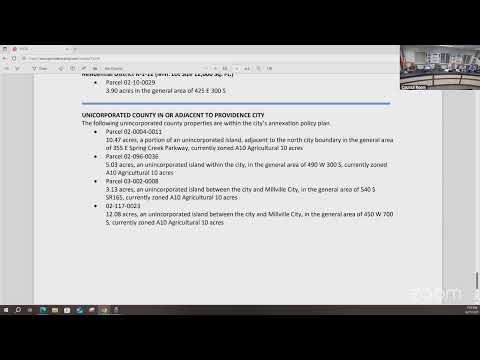
The report included a land inventory and maps comparing existing zoning to the adopted 2020 general plan. Connor highlighted several active residential developments (Fox Hollow Townhomes phases, Homes on the Knoll, Providence Highlands, Shoreline phases, Vineyard phases) with their recorded lots, phases under construction and permitting status. She also reported a recent city council action rezoning about 6.15 acres (the Gastaveson property) to R‑16 on Aug. 20; that rezoning followed a developer‑proposed purchase agreement and raised discussion because the planning commission had recommended against the rezone.
Connor reviewed affordability context: using Cache County median income and standard mortgage assumptions (10% down, 30‑year fixed, example rate cited from a market calculator), she showed that a household at the county median could afford roughly a $365,000 house under conservative borrowing assumptions; lower median incomes reduce affordability thresholds to about $285,000 in some scenarios. Connor also used local county assessment and Zillow checks to show the current supply: county appraisals list 818 units in Providence valued at $400,000 or less across several housing types, while active listings with price caps showed fewer options, particularly for single‑family homes.
Commissioners asked about deed restrictions, tax consequences and the state’s evolving reporting format. Connor said the state has been shifting its reporting to include more standardized numeric measures and that the city will keep the narrative context but will need to track counts and values over time. She recommended commissioners review the zoning maps and the city’s adopted strategies drawn from Utah Code 10‑9a‑403 to decide if the commission wants to revise the city’s chosen strategies. "If you feel like we don't need to rezone for density or if we don't feel like we can do that, then we need to pick another strategy," Connor said.
Connor asked the commission to review the posted maps and the detailed packet; staff plans to keep the online inventory current and to return with follow‑up workshops or ordinance changes if the commission requests them. The presentation closed with staff noting the report meets the state's annual reporting requirement and that staff will pursue any commission‑directed code changes or strategy updates.
Next steps: staff will post the detailed maps and dataset online, continue to refine the entitled‑unit inventory and ADU counts, and bring back any recommended code amendments or strategy changes for commission discussion and public hearings as needed.