Get Full Government Meeting Transcripts, Videos, & Alerts Forever!
Get email alerts on the Geoengineering Public Comments topic
No spam. Unsubscribe anytime.
Residents urge legislature to investigate geoengineering and ‘chemtrails’; scientists and municipal leaders disagree on evidence and priorities
Summary
Residents who described grid‑pattern trails and unusual particles in snow urged the committee to ban or investigate large‑scale geoengineering and stratospheric aerosol releases; municipal water managers and program scientists said cloud seeding is a distinct, targeted activity and recommended third‑party testing and peer‑reviewed evaluation.
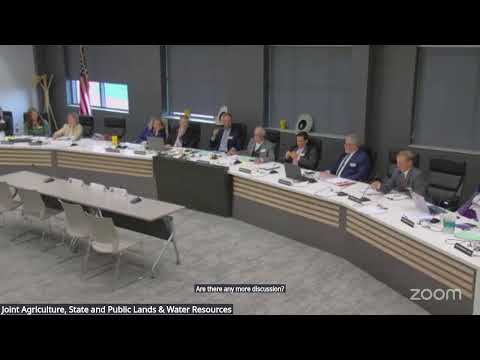
CHEYENNE — During a public‑comment portion of the Agriculture, State & Public Lands & Water Resources Committee meeting, several residents urged the Legislature to investigate and prohibit what they described as large‑scale atmospheric geoengineering and unreported aerial spraying. Those speakers used the shorthand terms “chemtrails” and “stratospheric aerosol injection” in urging state action; others at the hearing cautioned that these claims are not the same as the state’s cloud seeding program and that policy responses should be evidence‑based.
Tony Locke of Casper told the committee he was asking legislators to “take action against… high altitude aerosol injection of chemicals and metals into the atmosphere over Wyoming,” saying he had observed grid‑like patterns and persistent haze. Jamie Locke, also of Casper, described the activity as “geoengineering” and urged legislation, and multiple other commenters asserted they had laboratory or microscopy evidence of unusual particles in snow, soil or human biological samples.
Maria Crisler, who identified herself as an independent clinical research scientist and microscope user, said she had analyzed Wyoming snow samples and reported seeing elemental particles including silicon nanoparticles, yttrium, platinum, strontium, tellurium and thallium. Crisler and others asked the committee to fund state testing, to prohibit unauthorized dispersals and to seek transparency from federal agencies.
Speakers who support cloud seeding and municipal water managers disagreed about how to interpret those public claims. Brad Brooks, director of Cheyenne’s Board of Public Utilities, and Brian Seppi of the Green River Rock Springs‑Sweetwater County Joint Powers Water Board told the committee they view cloud seeding as a potential low‑cost tool to augment scarce water supplies and asked that the Legislature consider funding. Brooks said the city has spent nearly $500,000 over eight years on seeding participation and argued program support helps protect municipal water supplies in the event of Colorado River curtailments.
Several commenters urged the committee to distinguish cloud seeding — small, targeted releases of seeding agents intended to increase precipitation over particular mountain ranges — from alleged global or stratospheric aerosol programs. Committee members asked staff and witnesses whether independent, third‑party testing and a state‑level research effort could clarify what is being observed in Wyoming skies.
The Government Accountability Office’s December 2024 cloud‑seeding report was referenced by a public commenter who said the GAO found cloud seeding effectiveness remains uncertain in many cases; speakers on both sides urged the committee to rely on peer‑reviewed science and to commission independent environmental testing if legislators want more data.
Ending: The committee agreed to accept further written material and directed staff to take the public record into account as lawmakers consider a set of potential draft measures. The public testimony made clear there is community concern and disagreement about what is visible in Wyoming skies and what, if anything, the state should regulate.