Get Full Government Meeting Transcripts, Videos, & Alerts Forever!
Get email alerts on the Charter School Cte topic
No spam. Unsubscribe anytime.
Tennessee Public Charter School Commission upholds Metro Nashville denial of Forge School application
Summary
After public comment and lengthy debate, the commission voted 5–3 to uphold Metro Nashville Public Schools’ denial of the Forge School’s New Start amended application, citing gaps in enrollment projections, operational readiness and special‑education supports.
The Tennessee Public Charter School Commission on Aug. 27 voted 5–3 to uphold Metro Nashville Public Schools’ decision to deny the Forge School’s New Start amended charter application, concluding the record did not demonstrate the application met the Department of Education’s scoring rubric and was not clearly ready to open in August 2026.
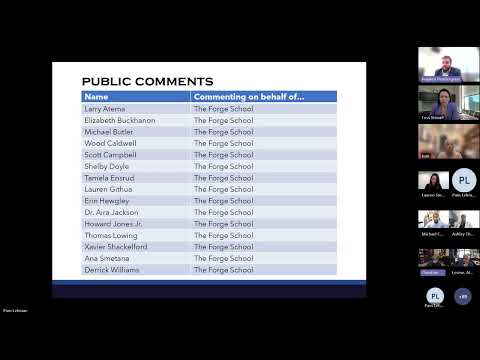
The commission’s decision follows a public comment period during which more than 160 written comments and 15 registered speakers—parents, industry partners and charter supporters—urged approval. The Forge School’s founders and community partners said the school would provide career and technical education (CTE) pathways in architecture, construction and engineering for rising sixth- and ninth-grade students across Nashville.
Commission staff, led by Executive Director Tess Stovall, recommended upholding the district denial. Stovall told commissioners the commission’s review found the application “partially meets” rubric standards across academics, operations and finance and identified specific risks: ambitious enrollment projections for an initial two-grade opening (the application projected 240 students in year one), reliance on substantial but not fully secured philanthropic support, and unclear staffing and special-education plans that left questions about fidelity of implementation.
Sharika Roby Grant, Metro Nashville’s executive director of charter schools, urged the commission to affirm the district’s denial, saying the academic plan “lacked innovation and failed to distinguish itself” from existing MNPS CTE programs and cited concerns about leadership experience for a CTE model and an “unrealistic” transportation plan.
Proponents disputed that assessment in statements to the commission. Sarah Tuttle, the proposed executive director of the Forge School, said the application reflected community demand—she cited “405 Davidson County families” who had signed expressions of interest and 53 partner organizations—and pledged to scale staffing and operations if approved. Derek Williams, the school’s director of community partnerships and operations, said 109 rising sixth- and ninth-grade students had signed intent-to-enroll forms.
Several commissioners said they were persuaded by the staff analysis. Chair Tara Richards, citing the commission’s statutory charge to perform a de novo, on-the-record review and the legal limitation against conditional approvals, said the record lacked sufficient detail on special populations, internal financial controls and the proposed leadership’s CTE experience. Commissioner Michael Carter and others said they appreciated the application’s promise but agreed it was not yet ready.
Commissioner Allen LaVine, Commissioner Alan Levine and Commissioner Lauren Smith voiced support for the application, arguing the model represents useful innovation in CTE and that philanthropic support and board strength suggested the school could succeed if given time to refine plans. Levine said he would have preferred a path that preserved momentum while staff and applicants addressed gaps, but legal constraints prevented conditional approvals.
The roll call on the motion to adopt the resolution to uphold the MNPS denial produced the following votes: Commissioners Carter, Griscom, Lairman, Patterson and Richards voted yes; Commissioners LaVine, LaVine (recorded as LaVine/LaVine ambiguity resolved to LaVine), Eddie Smith and Lawrence Smith voted no. The motion carried 5–3, and the denial stands.
The commission encouraged the Forge team to reapply in the next cycle and noted staff will continue to provide the same publicly available guidance to applicants; applicants may submit a new application in the next cycle and will be evaluated on the fresh record. Several commissioners urged the Forge organizers to address the commission’s written concerns—particularly staffing with CTE experience, clearer contingency plans tied to enrollment shortfalls, and more explicit special-education and English-learner supports—before returning.
Votes at a glance: Uphold denial of Forge School — adopted, 5–3.
Ending: The commission said it expects to hear remaining appeals at its October meeting and reiterated that it cannot issue conditional approvals; any future approval must be based on the application as presented in the formal record.