Get Full Government Meeting Transcripts, Videos, & Alerts Forever!
Get email alerts on the Public Safety topic
No spam. Unsubscribe anytime.
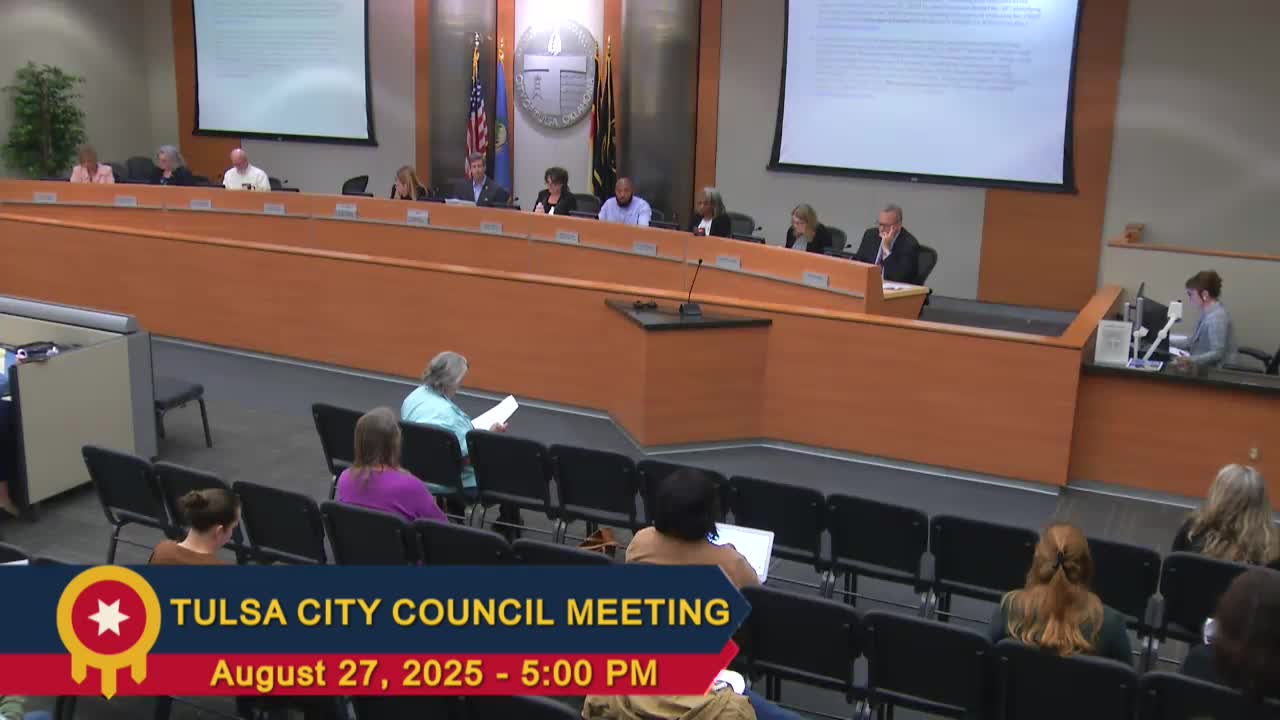
Tulsa City Council approves ordinance limiting standing on roadway medians; emergency clause fails
Summary
The Tulsa City Council passed an ordinance restricting sitting, standing or lying on roadway medians and establishing an 18-inch buffer from travel lanes. The measure drew hours of public comment and debate; an emergency clause that would have made the rule immediate failed to get the six votes required.
The Tulsa City Council on Aug. 15 passed an ordinance amending the Tulsa Revised Traffic Code to prohibit sitting, standing or lying on roadway medians within a minimum horizontal clearance of traffic, and to set an 18-inch buffer from the roadway.
The council took the vote after an extended public comment period and more than two hours of debate among councilors about pedestrian safety, enforcement and the potential effect on people experiencing homelessness. The ordinance passed in a recorded roll call divided largely along concern for immediate safety versus worries about enforcement and equity. The council later voted down an emergency clause that would have made the ordinance effective immediately.
Supporters said the measure is intended to reduce pedestrian injuries and deaths by keeping people out of narrow medians and close to high-speed traffic. “A single distraction, a single slip of the foot, and tragedy happens in an instant,” said Christy Rawlings during public comment, describing a recent near-miss she witnessed when a child stumbled into the street. Evan Taylor, another speaker, said medians had become “safety buffer zones for cars” and argued drivers — not people on sidewalks — were creating risk but that medians themselves presented a unique hazard.
Opponents raised constitutional and enforcement concerns. Tony Bethel urged the council to delay and rewrite the measure, asking how officers would reliably measure an 18-inch offset and calling the proposed $150 fine “way too much.” Several speakers and councilors warned the ordinance could disproportionately affect people experiencing homelessness and other vulnerable residents. “This ordinance is harmful to public safety, irresponsible given our lack of pedestrian infrastructure and punitive to our most vulnerable residents,” said Samuel Robson, a resident of District 1.
Several speakers with technical experience urged a more data-driven approach. Ellen Ray, who identified herself as director of planning and zoning for Housing Forward (speaking as a private citizen), cited NHTSA data and said vehicle behavior — failure to yield, speed and impairment — is the leading factor in pedestrian fatalities, while behaviors such as standing in the roadway account for a smaller share. Ray warned a single uniform 18-inch standard may not suit the wide variety of Tulsa street designs.
Council discussion referenced specific crash sites and equity concerns. Councilor Lincoln, who led the discussion, said the ordinance was aimed at narrow medians where people are within inches of moving vehicles and cited prior fatal incidents: “If this ordinance had been in place, if they were following the law, those people wouldn't have been out in the median.” Councilor Dutton and others urged caution about enforcement and impacts on marginalized communities; Councilor Lakin, Councilor Bush, Councilor Gilbert and Councilor Bangle spoke in favor of the ordinance as a public-safety measure.
The final recorded vote on the ordinance was: Yes — Councilor Bush, Councilor Archie, Councilor Gilbert, Councilor Bangle, Councilor Lakin; No — Councilor Hall Harper, Councilor Dutton, Councilor Doctor Wright. The ordinance passed. A subsequent roll call on an emergency clause failed because it did not receive the six votes required, meaning the new restrictions will take effect on the schedule set in the ordinance rather than immediately.
Councilors and staff said they will use the next 30 days to clarify enforcement rules and public outreach. Councilor Kelsey Bingle said the council plans community meetings in the coming weeks to explain what the ordinance does and does not change.
The ordinance amends Tulsa Revised Ordinances, Title 37 (Tulsa Revised Traffic Code, Chapter 11); the ordinance text cites the Manual on Uniform Traffic Control Devices (federal guidance) as a design reference. The council and public also discussed how the rule intersects with existing right-of-way obstruction laws and Americans with Disabilities Act access requirements.
The council’s approval completes the legislative step; details about enforcement policy and outreach will be determined by the city in the weeks before the rule becomes effective.