
Toledo committee debates forgiving NeighborWorks’ HOME loans; administration warns repayments fund housing programs
Get AI-powered insights, summaries, and transcripts
Sign Up Free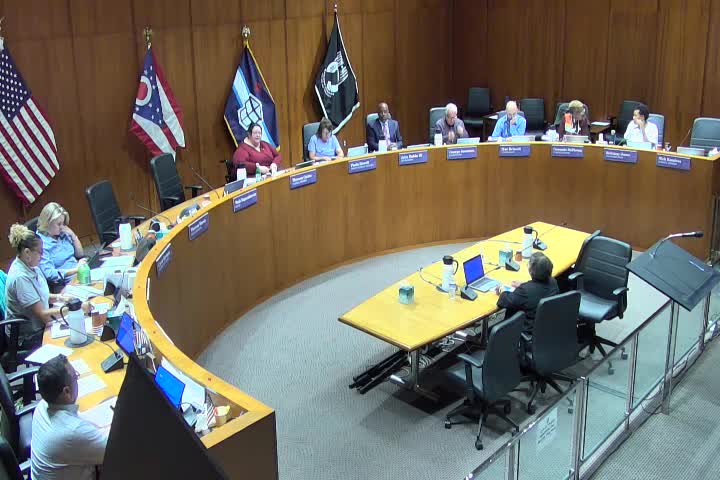
Summary
At a meeting of the Toledo City Council Housing & Community Development Committee on Aug. 28, councilmembers, department staff and NeighborWorks representatives debated whether the city should forgive HOME‑program mortgage debt on four scattered‑site rental portfolios, with the administration urging repayment to sustain local housing programs and NeighborWorks pressing for relief to promote sales to tenants.
Council members and housing staff debated on Aug. 28 whether to forgive HOME‑program mortgage debt tied to several low‑income scattered‑site portfolios owned or managed by Neighborhoods Toledo Region (commonly called NeighborWorks). The discussion focused on four portfolios: United North School Homes 1 and 2, and Southeast Toledo Homes 1 and 2.
Colleen Ali, deputy director of the City of Toledo Department of Housing and Community Development, explained the department’s position that HOME funds are federal block grants appropriated through the U.S. Department of Housing and Urban Development (HUD) and that repayment of city HOME loans becomes program income that the city recycles into housing programs. “The loans should, in fact, be paid back,” Ali said during the committee meeting, adding that the department has collected more than $1.2 million in loan repayments from 2022 through 2025 and that the city’s outstanding HOME‑loan portfolio shows just over $10 million in current loans (department figures presented at the meeting).
Ali told the committee that HOME allocations to Toledo have fluctuated and that the department saw a drop of $652,765.24 in HOME funding in 2024 compared with prior years; she also noted the presidential budget proposal at that time listed $0 for HOME in 2026 (she characterized that as the administration’s allocation and said congressional action could differ). The department argued that recycled program income is needed to preserve and rehabilitate troubled properties (Ali cited Ashland Manor and the Thurgood Marshall adaptive‑reuse project as examples) and to maintain program support for Home at Last and Home Rescue services.
NeighborWorks’ CEO William (Bill) Farnsworth urged full debt release for the four portfolios and said forgiveness would allow the nonprofit to convert more rental tenants into homeowners and reinvest sale proceeds into repairs and preservation. “The release of this debt will enable NeighborWorks to take back a note mortgage for somebody that doesn't have a 700 credit score,” Farnsworth said, explaining that some prospective buyers need seller financing or extended counseling rather than conventional bank loans.
Councilmembers and staff raised several technical and policy questions during the discussion. Deputy Director Ali presented an illustrative spreadsheet using Zillow estimates (the department noted it had excluded properties without an estimate from that illustration) showing a scenario in which sales at Zillow estimates could generate roughly $1.6 million in program income to the city while leaving NeighborWorks with several million dollars of net proceeds; the department emphasized those figures were illustrative and depend on actual market sales and timing. Councilmembers asked for independent market appraisals, clarification on earlier negotiated loan modifications (some past modifications reduced interest to 0% and forgave portions of accrued interest on other portfolios), and whether other city loans (for example, NSP or additional city loans) are included in forgiveness proposals.
Public commenters and partners spoke in favor of forgiveness as a community investment. Tom Cromwell of LISC said loan forgiveness is a recognized approach to recycle soft debt into neighborhood reinvestment; Gary Lenhart, a longtime East Toledo resident, and Joyce Anderson, a former NeighborWorks board member, urged forgiveness to stabilize disinvested neighborhoods. Michael Jones, a resident, told the committee he had completed homebuyer education and said he had experienced difficulty getting follow‑up and access to purchase options for a North River home he had occupied.
No formal vote or ordinance was recorded during the committee meeting. Councilmembers discussed possible compromise approaches — for example, negotiated modifications that reduce interest, partial mortgage releases, restrictive covenants on resale, or conditional forgiveness tied to remediation and resale timelines — and asked staff to provide more complete loan ledgers (including NSP and other city loans) and independent valuation work to help evaluate options.
What was asked: Councilwoman Williams introduced the request for loan relief and framed the proposal as an equity and neighborhood stabilization measure, particularly for North Toledo. Administration staff said they would continue to pursue repayment where feasible and demonstrated how program income supports other city housing initiatives.
Next steps: Committee members requested additional information from Housing and Community Development, including copies of outstanding loan documents, independent appraisals or market analysis, a complete accounting of all city loans attached to the portfolios, and suggested terms for conditional or partial forgiveness if council wished to pursue that path. No ordinance or motion was passed at the Aug. 28 meeting.