Get Full Government Meeting Transcripts, Videos, & Alerts Forever!
Get email alerts on the Transportation Cip topic
No spam. Unsubscribe anytime.
Delaware City engineers highlight $6M‑plus corridor needs, pursue grants for resurfacing, safety and neighborhood projects
Summary
City engineering staff outlined major transportation projects in the five‑year CIP — an unfunded high‑priority east‑side corridor needing about $6 million, a competitive ODOT resurfacing regime, planned sidewalks/shared‑path grants, and targeted neighborhood revitalization grant applications.
City Engineer Jonathan Owen told the Finance Committee on Aug. 28 that the city’s 5‑year capital improvement program includes several large transportation projects, some funded and some unfunded, and that many will rely on competitive state and federal grants.
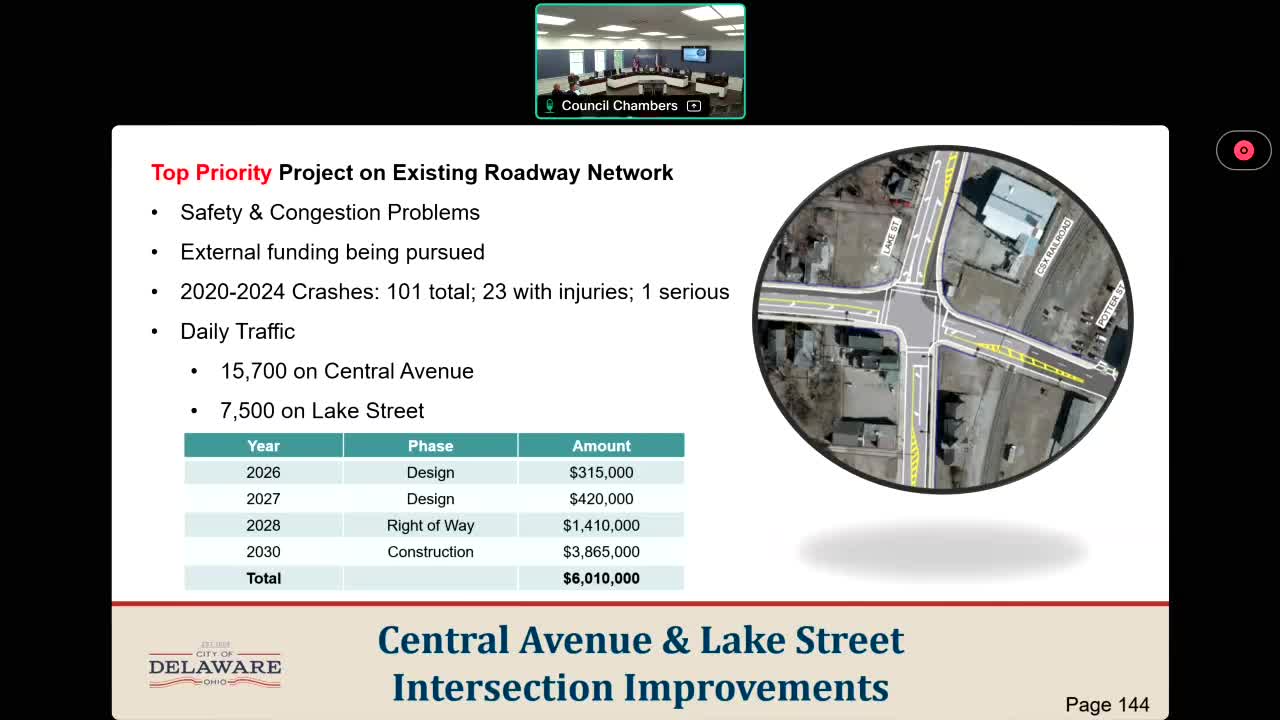
“I call that our top priority project on the existing roadway network,” Owen said, describing an east‑side corridor project that staff estimated at just over $6,000,000 and flagged because the corridor logged more than 100 crashes in the prior five years and 23 crashes with injuries.
Owen outlined both funded resurfacing work and a set of higher‑cost projects staff want to advance. The annual resurfacing program in the CIP relies heavily on outside grants and local matches — the five‑year totals range from about $700,000 to $2.1 million per year in the plan — and the Ohio Department of Transportation District 6 has shifted its urban resurfacing program to a competitive application process while maintaining an 80% typical contribution, Owen said.
Among funded or largely funded items, Owen said the city won a safety‑program grant (ODOT pedestrian/systemic program) that can provide more than $2,000,000 — roughly 90% grant funding — to fill gaps in shared use paths and sidewalks on corridors including West William Street, South Sandusky Street, London Road, East William Street and Lake Street; staff expect construction in 2027.
The city will also pursue a Community Development Block Grant (CDBG) application for a Columbus Avenue neighborhood revitalization package that would combine water main replacements, drainage work, a restroom building replacement at Blue Limestone Park and shared‑path connectivity; the CDBG program can award up to $750,000, staff said.
Owen described an actively planned Glen Parkway railroad overpass design funded from a TIF fund balance the city has been accumulating; staff said the fund balance is sizeable and could be used to start design and right‑of‑way acquisition while the city pursues state and federal grants targeted at removing at‑grade rail crossings.
The meeting also revisited the longstanding West Central (State Route 37) CSX bridge clearance problem — the locally nicknamed “can opener” project. Owen said recently completed preliminary engineering shows the road can be lowered to reach required clearance without replacing the railroad bridge, and he estimated a total project cost of about $6,000,000. He said the project has repeatedly failed to qualify for the large state programs that would fully fund it, leaving options that include locally funding the lowering or pursuing interim safety improvements.
Owen said the Merrick Boulevard extension is on track — the extension from Cambridge to Troy Road is slated for construction next year with an estimated construction cost of about $8.3 million; a later phase including a railroad overpass and connection to Addison Farms is estimated at about $15.7 million and would be supported by debt service paid from TIF revenues and development‑related funds.
The East Central Avenue reconstruction from the point project to the east is under design with a public meeting planned; Owen said MORPC (Mid‑Ohio Regional Planning Commission) funding covers approximately 35% of the project and staff plan to pursue OPWC and other grants to fill the remainder. Construction timing would be 2028 if the city moves forward on the current schedule.
Owen closed with a brief list of additional CIP projects, from bridge/river path work with ODOT to developer‑driven intersection work near 30 Sixth and Section Line Road, and noted that some projects will only advance with accompanying development or successful grant competitions.
No formal appropriations were approved at the meeting; staff asked the committee to consider the funding gaps and said they will return with more concrete appropriation requests if and when grant awards are received or funding strategies are finalized.