
Conroe council postpones final adoption of FY 2026 budget after public hearing on tax scenarios
Get AI-powered insights, summaries, and transcripts
Sign Up Free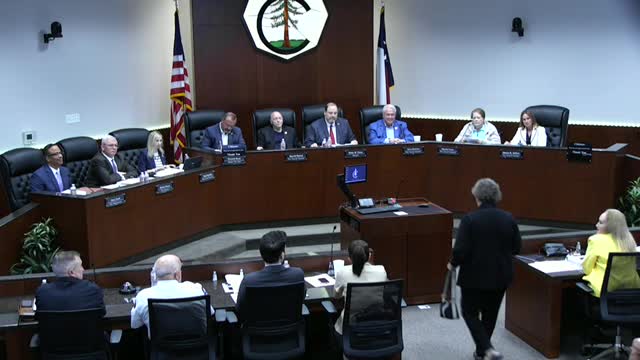
Summary
After a public hearing with residents calling for more public safety funding and debate over proposed tax-rate options, the Conroe City Council voted to postpone final adoption of the FY 2026 operating budget so members can review alternative tax scenarios and modeling ahead of a Sept. 11 meeting.
Conroe City Council on Aug. 28, 2025, postponed final adoption of the fiscal year 2026 operating budget after a public hearing in which residents urged the council to prioritize public safety and clearer tax-rate modeling.
The public hearing drew several speakers who urged different approaches to funding. Sarah Frolano, who said she has worked for the city for about 24 years and lives in the Grand Central Park neighborhood, told the council: "In Grand Central Park, stop signs are suggestions and speed limits do not exist after 8 p. M." She said traffic enforcement and visible patrols are a public-safety concern for her neighborhood.
Resident Doug Frankhauser urged the council to "take the maximum that's possible," arguing that "public safety and our infrastructure are number 1." Another resident, identified in the record as Mr. Sellers, warned the proposed top tax rate would be historic: "this proposed tax rate at 0.4613 would substantially be the entire in the entire history of Conroe, the single greatest increase in taxes year over year," he said and urged voter approval of a larger increase.
Why it matters: the council is weighing three tax-rate scenarios presented by staff that change projected property-tax revenue and the city's ability to hire additional staff and maintain a healthy fund balance across multiple years. Staff outlined the scenarios on presentation slides referenced during the hearing: option 1 maintains the current tax rate at 0.4272; option 2 raises the rate to 0.4488; option 3 raises it to 0.4613 (the voter-approval rate). According to staff, using the voter-approval rate (0.4613) would increase the annual tax bill on the average taxable home value (listed by staff at $277,000) by $94.46; the 0.4488 scenario would increase the average bill by roughly $59–$60 and would raise property-tax revenue from about $47.8 million to about $51.0 million.
Staff also said their multi-year hiring assumptions under the scenarios are significant to budget projections: the modeling presented assumes hiring 15 additional staff in FY 2027, 10 additional staff in FY 2028 and five annually thereafter; the smaller immediate increase leaves much tighter margins in later years. The staff presenter (identified in the record as Michael) noted that under the unchanged rate revenues over expenses decline to a $779,000 surplus by FY 2028 under the assumptions used.
Council action: after discussion and requests for additional modeling, a motion to postpone final adoption of the FY 2026 budget passed by voice vote; the motion did not include a roll-call tally in the public record. Council members said they want additional scenario modeling and time to consider county tax-competition effects and other inputs before finalizing a tax rate. Council indicated the matter will return for consideration at the council meeting on Sept. 11, 2025.
What was not decided: the council did not adopt any of the three tax-rate options during this meeting. No final tax rate was set and no ordinance establishing rates was passed on Aug. 28.
Next steps: staff was asked to provide additional modeling and scenario comparisons ahead of the Sept. 11 meeting so council members can weigh revenue, hiring assumptions and the potential impact on residents' tax bills.