Get Full Government Meeting Transcripts, Videos, & Alerts Forever!
Get email alerts on the Lead Service Replacement topic
No spam. Unsubscribe anytime.
Wausau staff say DNR grants and principal forgiveness make rapid lead service-line replacement feasible; council asks for mid-term option analysis
Summary
Community Infrastructure Partners and city staff reported progress on Wausau’s lead service-line replacement program, highlighted DNR principal forgiveness opportunities and presented two financing schedules — a three-year accelerated plan and a 12-year compliance plan — while aldermen asked for five- and seven-year cost comparisons.
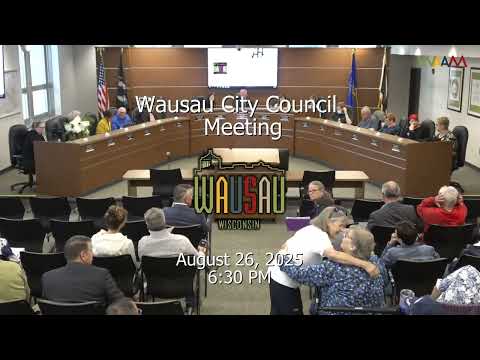
Community Infrastructure Partners (CIP) updated the Wausau Common Council on Aug. 26 about the city’s lead service-line replacement program and funding outlook, urging the council to weigh a three-year accelerated plan against a slower 12-year compliance schedule.
CIP said the city has received more than $11 million in DNR grants and that, to date, the program has leveraged roughly $20 million of water-main and service-line work for about $8 million of city funds. The presentation noted the city celebrated its thousandth private-side line removal in the first year of construction and that more than 3,000 right-of-entry permissions have been secured.
CIP laid out two options: a three-year accelerated replacement that would take advantage of anticipated principal forgiveness for private-side replacements in 2026 (CIP estimated about 1,700 lines across four census tracts could qualify for 100% principal forgiveness) and additional principal forgiveness allocations that could reduce net costs. CIP estimated doing the work over three years could be roughly $17 million cheaper than spreading it out over 12 years, largely because of inflation and greater access to principal forgiveness and very low interest financing early in the program.
Under CIP’s assumptions, Wausau still has roughly 5,700 homes needing replacement after work already completed and assessed unknowns on private sides. The presentation noted rock conditions in some neighborhoods increase construction costs, and staff emphasized the city will need to decide whether to use payment programs for homeowners whose installations do not qualify for full forgiveness.
Council members asked for additional analysis. Ald. Rasmussen asked whether five- or seven-year scenarios could be modeled; CIP replied the replacement schedule can be adjusted within the EPA-mandated 12-year window (with a minimum 10% replacement per year from the effective baseline) and that construction bundling affects per-unit prices. Staff said the DNR’s allocation for 2026 looked favorable and that award announcements are expected in November.
Ending — next steps: Council asked staff and CIP to return with mid-range (five- and seven-year) financing scenarios and cost projections so members can compare savings from accelerated principal forgiveness with the risks and cash-flow implications of a multi-year program.