Get Full Government Meeting Transcripts, Videos, & Alerts Forever!
Get email alerts on the Telecom Small Cells topic
No spam. Unsubscribe anytime.
Verizon small-cell installations draw technical questions at Cheektowaga hearings
Summary
The Town of Cheektowaga held public hearings on three Verizon applications for small-cell wireless equipment at 105 Susan Lane, 742 Beach Road and 539 Cleveland Drive; Verizon representatives described the poles, antenna size and RF compliance while residents and council members pressed for clearer wattage and interference data.
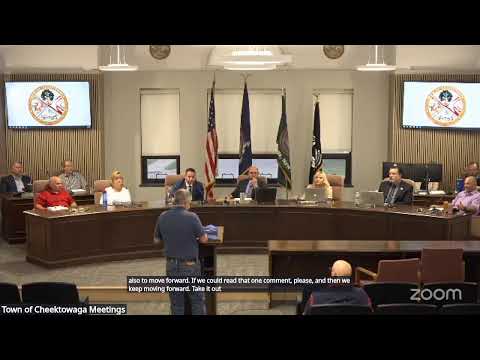
The Town of Cheektowaga held separate public hearings on three special-use permit applications from Verizon for small-cell wireless equipment proposed at 105 Susan Lane, 742 Beach Road and 539 Cleveland Drive.
Steve Fantuzo, an attorney representing Verizon, described the proposals as ‘‘small cells’’ — low‑power antennas and compact equipment cabinets attached to utility poles, typically 30–40 feet high with antennas near 31.5 feet and equipment units mounted lower on the pole. He said the poles are NYSEG facilities in the town right-of-way and that NYSEG sign-off and work orders are included in Verizon’s application package.
Board members and residents raised technical questions. Council members asked how the size of the antennas and equipment compare to pole-mounted transformers; Verizon’s representative said the antenna would be about 2 feet 8 inches in height and the equipment cabinet roughly 3 feet, likely smaller than a transformer. Members also pressed Verizon to provide the radio-frequency (RF) compliance exhibit from its application package (referred to as ‘‘Exhibit H’’).
Fantuzo said Verizon’s RF compliance materials show the installations operate at a fraction of FCC limits—‘‘less than 1% of what the FCC allows’’—and that federal law preempts local government from regulating facilities based on RF emission levels when they meet FCC thresholds. Council members asked that Verizon email the RF compliance section in plain language to the board so nontechnical members could review the figures. Verizon agreed to email the specific RF exhibits and to highlight the compliance numbers for board members.
A resident of 105 Susan Lane, who identified himself as an amateur radio operator, said he was concerned about receiver desensitization — a condition where a nearby transmitter can reduce the sensitivity of a radio receiver — and asked whether the small cell could interfere with amateur radio operations, over‑the‑air television or emergency communications. Fantuzo and the board said they would follow up with engineers to address desensitization concerns. The resident suggested moving the site one or two poles away; Verizon said they would follow up.
At the 539 Cleveland hearing the board read aloud an emailed objection from Carol Griskel, which expressed concern about interference with surrounding addresses, weather-related damage to pole-mounted devices, and questioned why carriers could not use existing infrastructure. Reverend Rick raised a related concern about potential interference with nearby volunteer fire department radio traffic; the board noted the Verizon representative for that application had already left the meeting and said they would try to obtain additional information.
No final approvals were granted at the meeting; each hearing was opened, public comment was taken where provided, and the hearings were closed. The town clerk reported no official written comments were received in some cases; the board will rely on materials in Verizon’s application package and requested that Verizon deliver clearer, highlighted RF compliance data by email for board review.
Board members also discussed routing the three applications as a ‘‘cluster’’ because they had similar equipment specifications and footprint. Fantuzo said the cells are intended to fill coverage and capacity gaps in higher-density areas and each small cell typically covers roughly a 100‑yard radius.
The hearings record shows the board opened the three hearings, accepted public comment, asked Verizon to provide follow-up technical materials, and closed the hearings. Any subsequent approvals or denials will be processed after staff review and any required regulatory checks.