Get Full Government Meeting Transcripts, Videos, & Alerts Forever!
Get email alerts on the Housing Short Term Rentals topic
No spam. Unsubscribe anytime.
Cheektowaga holds public hearing on proposed short-term rental law; residents urge moratorium
Summary
The town board opened and closed a public hearing on a draft local law to regulate short-term rentals (Airbnb/VRBO). Attorney Fowler described registration, safety inspections every three years and shutdown authority; residents urged a temporary moratorium and changes on house-numbering and commercial classification.
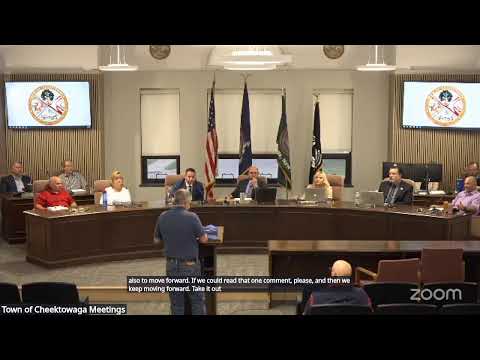
The Town of Cheektowaga on Aug. 26 opened and closed a public hearing on a draft local law that would require registration, periodic inspections and local controls for short-term rentals such as Airbnb and VRBO.
Town Attorney Fowler told the board the proposal would require owners to register with the town, submit to building inspections before permits are issued and again on a recurring schedule (the draft sets inspections about every three years). The draft includes provisions allowing the town to revoke or suspend permits for properties that violate safety or neighborhood standards, Fowler said.
The hearing drew a handful of residents. Ken Young and another resident urged the board to consider a moratorium on new short-term rentals while the code is finalized. ‘‘Why can’t we have a moratorium on Airbnbs at this time?’’ Ken Young said, asking the board to pause new permits until the town completes rules and enforcement procedures. Attorney Fowler replied that a moratorium would itself require a local law, public hearings and drafting — a process that could take longer than advancing the present regulation.
Council member Diane Benjkowski said she supported taking public comments into account and asked staff to review suggested wording changes submitted by Gary Borik (received by email and acknowledged by the board). Benjkowski noted one Borik suggestion: requiring house numbers to be posted at the road rather than only on the house, and cautioned that that requirement should be written to avoid ‘‘freehand’’ numbers that could look unsightly.
No final vote was taken. The board opened the hearing, heard public comments and closed the hearing; members said they would review written comments and consider minor stylistic and safety-related edits before bringing the local law back for adoption at a future meeting.
The public record shows no sign-ups on the clerk’s official list for some comments, but the board recognized emailed comments from Borik and fielded several in-person remarks. The town clerk reported no formal mail-in comments were received through the clerk’s office for posting to the record.
No timelines for final adoption were set at the meeting; board members said they expected at least one more review before adoption and urged residents to submit written feedback to the clerk prior to the next meeting.
A summary of procedural actions: the board moved to open the public hearing (motion seconded by Councilmember Pularski; voice vote Aye), took public comment, and then moved to close the hearing (motion seconded by Councilmember Thompson; voice vote Aye).