Get Full Government Meeting Transcripts, Videos, & Alerts Forever!
Get email alerts on the Udc Text Amendment Drive Thrus Adus topic
No spam. Unsubscribe anytime.
Council continues public hearing on UDC amendments for drive‑throughs and ADUs
Summary
The Meridian City Council continued a public hearing on Unified Development Code text amendment ZOA 2025-00001 after staff outlined proposed tiered rules for drive‑through establishments and clarified accessory dwelling unit (ADU) provisions including owner‑occupancy, size limits and parking treatment.
Meridian — The Meridian City Council continued a public hearing on a proposed Unified Development Code (UDC) text amendment, ZOA 2025-00001, after staff asked for more time to refine definitions and address council concerns about process and standards.
Planning staff presented two principal topic areas in the Aug. 26, 2025 public hearing: a tiered regulatory approach to drive‑through establishments and clarifications to ADU rules. Staff said the code changes were drafted to make approvals more predictable while preserving a route for public review where a project cannot meet the expressed standards.
Drive‑through proposal
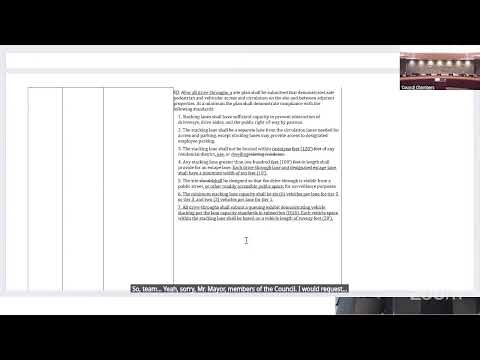
Staff described a three-tier approach intended to match intensity of operation with regulatory scrutiny. Under the draft: tier 1 covers simpler single‑lane pickup operations; tier 2 covers single‑lane restaurants that also handle mobile or online pickup; and tier 3 covers high‑capacity two‑lane drive‑throughs. The proposed text would add dimensional requirements, queuing (stacking) analyses and vehicle‑length assumptions to make staff decisions more objective.
Staff described the administrative process the city proposed: when a drive‑through design meets the expressed standards, staff would have authority to approve the application administratively and issue a certificate of zoning compliance; when standards are not met, an applicant could pursue a conditional‑use permit (CUP) and a public hearing before the planning commission. Staff noted that affected persons may appeal administrative director decisions under the UDC.
Council members asked for more clarity on several points, including how to treat mobile‑order pickup lanes that can resemble a second lane, whether proximity to existing drive‑throughs should automatically trigger CUP review, and whether a simple numerical trigger (for example, more than one lane or stacking over a threshold) should require a public hearing. Several council members recommended clearer definitions so residents can understand when public input will be available.
Accessory dwelling units (ADUs)
Staff outlined three ADU topics for council direction: owner occupancy of the primary unit, maximum size and bedroom count, and how to calculate parking requirements when an ADU is added.
- Owner‑occupancy: Current code requires the owner to reside on the property at least six months per year. Staff noted the Destination Downtown materials referenced owner‑occupied ADUs and said the requirement has been part of current code; council discussion ranged from keeping the requirement to removing it to allow more flexibility for owners. Several council members said they were reluctant to adopt owner‑occupancy as a permanent restriction because enforcement is difficult and accommodates cases (for example, extended travel) where an owner may be temporarily absent.
- Size and bedrooms: Staff noted the existing draft used a common local threshold (900 sq. ft. or up to 1,000 sq. ft. in some comparisons) and a two‑bedroom limit. Some council members supported keeping a modest size/bedroom cap to reduce neighborhood impacts; others said parking rules tied to bedroom counts (not an arbitrary cap) could be adequate.
- Parking: Staff explained parking calculations are based on bedroom count for residential uses; councilmembers discussed whether to rely on the existing table in the UDC and add a clarifying note about total bedroom counts to reduce ambiguity for mixed‑use or condominium projects.
Council direction and action
Council members requested additional refinements, clearer definitions and a plan for when administrative approval is appropriate versus when a CUP and public hearing should be required. Planning staff requested time to consult with industry focus‑group members and return with revised language and clearer triggers for public hearings.
A council motion to continue the item passed by voice vote; council did not record a roll‑call tally during the continuation vote. Staff will return with revised language and recommended triggers for administrative approval versus CUP review.
Votes at a glance
- Motion to continue public hearing on UDC text amendment ZOA 2025-00001: Motion seconded; outcome — continued (voice vote; ayes recorded).