Get Full Government Meeting Transcripts, Videos, & Alerts Forever!
Get email alerts on the Housing topic
No spam. Unsubscribe anytime.
Cranston planning commission advances housing element for state review, debates density and parking guidance
Summary
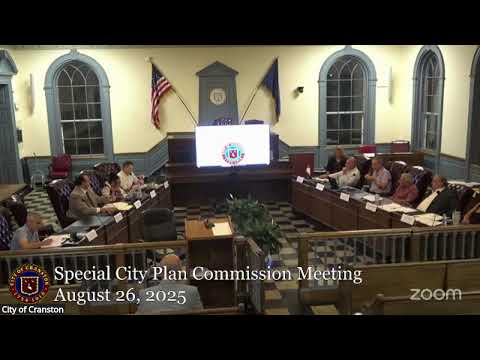
At an Aug. 27 Planning Commission workshop, commissioners and staff agreed to submit Cranston’s revised housing element and related draft ordinances to state reviewers while debating a target of “at least 15 units per acre,” parking minimums, and community engagement ahead of a Sept. 2 public hearing.
At an Aug. 27 Planning Commission workshop, the commission’s chair and planning staff said they will submit Cranston’s revised housing element — including a draft inclusionary zoning bylaw as an appendix — to state reviewers so the city can seek statewide approval required under recent state housing rules.
The proposed submission is intended to make Cranston eligible for a range of state review outcomes tied to the new Housing 2030 guidance from the Rhode Island Department of Housing, staff said. The chair told the commission, “our comprehensive plan has not been approved by the state. We need to submit it to the state,” and framed the filing as necessary to make the city’s affordable-housing policies count under state review.
Commissioners, staff and members of the public debated how detailed the submission should be and whether the city should finalize implementing ordinances before the state completes its review. The chair and planning director said the draft inclusionary zoning text will be submitted as part of the package but that final city council adoption could wait until after statewide planning’s comments are received.
Commissioners pressed staff on specific numeric and policy choices tied to statewide guidance. The chair and staff referenced the Department of Housing’s Housing 2030 menu and repeatedly discussed a baseline of “at least 15 units per acre” for transit-oriented zones. The chair said the draft should include that 15-unit figure so statewide reviewers would see the city’s intent; other commissioners warned that capping densities could make the city unable to meet its housing yield targets. Staff and one commissioner noted existing neighborhood centers that already exceed 15 units per acre and said the transit-oriented development (TOD) zone would need higher yields to meet the city’s housing targets.
Parking, pilots and affordable-housing mechanics were central points of debate. The draft housing policies propose reduced parking in some multifamily areas — language ranges from allowing one to 1.5 spaces per unit where transit service is available, to targeted pilot programs in Ward 3 that could consider lower on-site parking or on-street residential permit approaches. One commissioner asked for limitations and specificity: reduced parking should be used “in areas that are on a transit bus route or in close proximity,” not citywide.
Public commenters urged broader engagement and sharper numerical backing for the plan’s goals. Annette Born, 51 Community Drive, said she was concerned about the speed of the process: “I’m not sure I understand the reasons why this got rushed,” she told the commission and staff, asking for fuller ward-level outreach. Amy Raynone, who identified herself as a Rhode Island Housing employee speaking for herself and as a member of Cranston’s housing commission, echoed concerns about limited public and housing-commission engagement and said she would submit written comments after a fuller review.
Other public comments pushed different priorities. Christina Brown, a housing commission appointee, urged the commission to plan for smaller, accessible rental units and to consider municipal land for affordable housing. Developer and frequent commenter Bob Murray urged urgency and production: “The answer to more housing is to build more housing,” he said, while also warning the commission that permitting delays and staffing constraints slow projects from approval to construction.
Staff provided a range of clarifications and implementation details during the meeting: the housing element will be inserted into the locally approved comprehensive plan as the housing chapter and sent to statewide planning for review; the draft inclusionary zoning bylaw will be included in the submission package; and staff expect to return to the commission and the city council with revisions if statewide reviewers require changes. The planning director also noted earlier approvals in the city pipeline, saying the commission has approved about 600 units in prior actions, of which roughly 76 units are labeled as affordable at preliminary stages, and that more time and additional implementing ordinances are needed to convert approvals into built units.
Next steps and timing: staff said the package will be advertised for the public hearing already scheduled for Sept. 2, and commissioners encouraged written comments in advance. Commissioners also requested clearer implementation guidance from staff, including an inventory of municipal parcels for potential housing projects and a clearer breakdown of how the plan’s numeric goals would plausibly yield the stated unit counts.