Get Full Government Meeting Transcripts, Videos, & Alerts Forever!
Get email alerts on the Employee Health Insurance topic
No spam. Unsubscribe anytime.
Miami-Dade Commission approves Aetna to administer county health plan after split vote
Summary
The Miami-Dade County Commission voted 7-2 to award a contract to Aetna to provide administrative services for the county's self-insured health plan, following competing analyses from two outside consultants and debate over projected savings and discount rates.
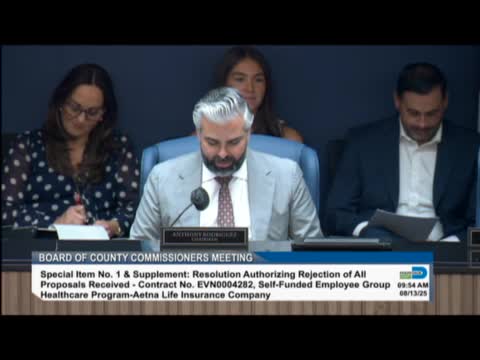
Miami-Dade County commissioners voted 7-2 to award Aetna the administrative-services contract for the county's self-insured employee health plan, the panel decided at a special meeting where outside consultants and competing bidders disputed the projected savings that drove the recommendation.
The vote, taken after more than three hours of presentations and questioning, followed an independent repricing analysis by Aon that concluded Aetna’s repriced medical claims and fees would be roughly $45,500,000 lower on an annualized basis than AvMed’s on the same claims data. AvMed disputed those findings, and its lead actuary warned commissioners that alternative calculations produced very different projections and that relying on the contested repricing could risk large costs over the life of the contract.
The matter mattered to commissioners because the contract covers tens of thousands of county employees and retirees and the county’s current five-year budget planning. Commissioners were also pressed by employees and some constitutional officers in the chamber who urged the commission to weigh network breadth and transition protections for members in active treatment.
Aon’s consultant, using the repriced claims that were included in the RFP package, told the commission the apples-to-apples repricing exercise produced the $45.5 million annual difference in favor of Aetna. Amanda Brooks and Emily Naples of Aon described the methodology as a line-by-line repricing of more than a million claim records the county provided, and said the firms’ repricings — not additional actuarial projection assumptions — were the most direct way to compare vendors’ likely 2026 cost exposure.
AvMed’s speakers, including its actuary Eric Johnson and counsel Mike Curente, told commissioners the repricing-based result was flawed for this procurement. AvMed said its actual discount experience for the county in recent reporting was about 69.9%, meaning the consultants’ repricing result (which Aon and Gallagher reported at roughly 65%) understated AvMed’s discounts and exaggerated potential savings to the county. AvMed argued that, if its higher discount rate were used in the repricing, the advertised savings would narrow substantially or largely disappear.
Commissioners pressed both consultants, Aon and Gallagher (the county’s long-standing adviser), and both vendors on the data and assumptions. The administration’s chief procurement officer, Namara Upal, said Aon had access to the same claims and RFP materials given to vendors and that Aon had spoken with both proposers while preparing its memo to the county. Chief Administrative Officer Carla Denise Edwards said the contract language includes guarantees and a payment corridor — contractual remedies the county can invoke if vendors fail to meet guaranteed performance or discount thresholds.
Several commissioners sought assurances about member continuity of care. Aetna representatives said they had a transition plan including a hotline, outreach to providers, and transition-of-care protections so members in active treatment (for example, cancer care or pregnancy) would not face disruption while the county and the new administrator executed provider outreach and contracting. The administration also reminded the commission that state transition-of-care rules apply to members during active treatment.
The commission’s action was narrow: award the county’s administrative services contract to Aetna and direct the administration to implement a transition plan and negotiate final contract terms. Commissioners also asked the administration to return with more detailed cost and implementation analyses on a handful of member concerns — including possible coverage or access changes for retirees, and later follow-ups requested by commissioners on items such as sedation for certain dental procedures and other benefit design questions raised during the meeting.
Votes at a glance: Motion to adopt the administration’s recommendation to award the administrative services contract to Aetna — Passed 7–2.
The commission directed county staff to proceed with contract execution and transition planning if legal prerequisites are satisfied and to provide additional details to the commission about transition milestones and any protections for members in active care.