Get Full Government Meeting Transcripts, Videos, & Alerts Forever!
Get email alerts on the Council Consideration Requests topic
No spam. Unsubscribe anytime.
San Antonio City Council debates changes to council-consideration request process; no ordinance vote
Summary
The San Antonio City Council met in a special session on Wednesday to debate a mayoral memo proposing procedural "enhancements" to the council-consideration request process, including earlier acknowledgement by the city manager and an earlier written legal review by the city attorney; no ordinance change was adopted.
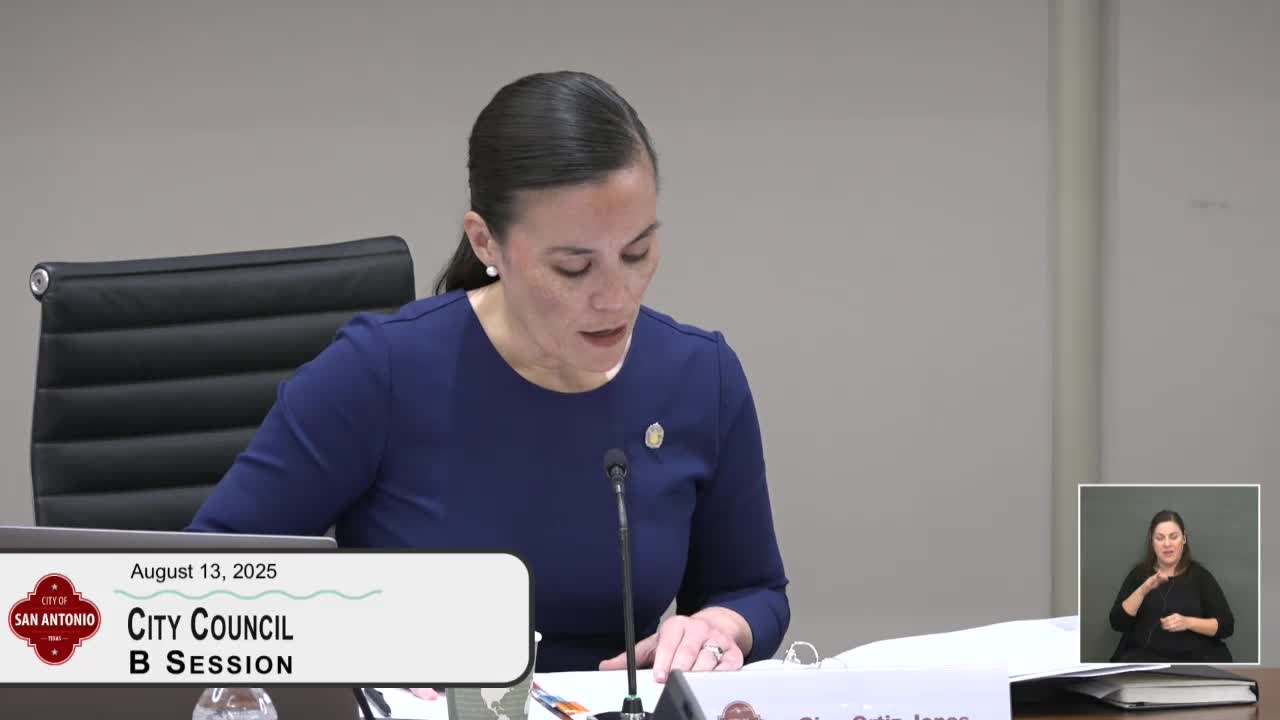
SAN ANTONIO — The San Antonio City Council met in a special session Wednesday, Aug. 13, to discuss a mayoral memorandum proposing procedural changes to the council-consideration request process, including requiring the city manager to acknowledge notification of a draft CCR and an early written legal review from the city attorneyThe meeting, convened as a briefing rather than an action item, produced extended debate but no ordinance change or formal vote; council members repeatedly said any amendment to the CCR ordinance should be considered and approved by the full council.
The mayor framed the proposed changes as simple operational enhancements intended to "make this all frankly, all that we do, efficient" and to "minimize legal risk to our community," including asking the city manager to initial a submitted CCR to verify notification and asking the city attorney to provide an initial legal review and, if concerns exist, to document them in writing within 96 hours.
Why it matters: Council-consideration requests are one of the primary tools council members use to advance policy ideas and constituent requests. Council members said changes to the process could affect how quickly items reach committee and whether sponsors and potential cosponsors have early legal and fiscal information about proposals, a concern in what council members described as a more litigious legal environment.
City attorney Andy (as identified in the briefing) told the council the mayor's listed enhancements are "not contradictory to anything in the ordinance" and described them as supplemental; he said the CCR ordinance presupposes a governance committee the mayor may chair or modify. The city manager, identified in the briefing as Eric, said the mechanics of notification have historically varied and that he is "always available" for whatever notification process the council chooses.
Several council members pushed back on the idea that the mayor could unilaterally impose procedural changes that, in their view, conflict with the council-adopted CCR ordinance adopted in 2024. Councilmember Castillo and Councilmember Mark White (as identified in the hearing) both said the ordinance sets the council's rules of procedure and that substantive changes to the CCR process should come before the full council in an A session and be adopted by ordinance. White said the ordinance specifically allows legal review to occur when the governance committee requests it and that the mayor's memo proposing an earlier mandatory review conflicts with current language.
Councilmembers who spoke described specific concerns and examples: some said notifying the city manager is already required by the ordinance but was not consistently happening in practice; others said requiring an initial or signature would provide assurance that the step actually occurred. The mayor and other supporters said early acknowledgement and rapid legal review would reduce wasted staff time, avoid public misstatements (the mayor referred to a prior incident that required a press-release retraction), and help sponsors understand whether a CCR would affect core services or budget planning ahead of the proposed FY26 budget discussion.
Several procedural details discussed at the briefing: the mayor proposed a 24-hour window for the city manager and the city attorney to acknowledge having been notified, and a 96-hour window for the city attorney to provide written legal concerns if any exist. The mayor also asked that sponsors include a one- or two-sentence statement in CCRs describing whether and how the request relates to a core city service. Supporters said those items are short, practical steps; opponents said they should be adopted only by ordinance after full council deliberation.
Multiple council members also raised the fate of CCRs filed under the previous council that "did not cross the finish line." The mayor said those CCRs should be resubmitted so the current council can decide whether to advance them; other members warned that resubmitting long-advanced items would waste prior staff work and urged the council to agree on a fair rule for how far back resubmissions must go.
Several speakers recommended further discussion in committee or an A session. Council members suggested options including: (1) leaving the current ordinance unchanged and tracking whether the notification improvement works operationally for a trial period; (2) if the body desires a binding change, returning to the full council to adopt an ordinance amendment; or (3) using electronic signature tools (e.g., DocuSign) to make any required acknowledgements efficient.
No formal motions or votes were taken in the briefing. The council recessed to an executive session citing Texas Government Code chapter 551 for consultations with the city attorney and other permitted matters; after the executive session the council reconvened and the mayor declared the meeting adjourned. City staff said no official action was taken in executive session.
The council will decide later whether to place an ordinance amendment or other formal action on a future A-session agenda. In the meantime, council members agreed they value legal clarity and operational efficiency but were divided on whether the mayor's memo represents an acceptable practice-level enhancement or an ordinance-level change requiring a vote of the full council.