Get Full Government Meeting Transcripts, Videos, & Alerts Forever!
Get email alerts on the Federal Policy topic
No spam. Unsubscribe anytime.
Lake County supervisors flag federal policy shifts — Medicaid, NEPA, FEMA grants — as local concerns
Summary
County supervisors reported on federal-level changes discussed at National Association of Counties meetings, warning of near-term Medicaid eligibility shifts, proposed NEPA reforms affecting data centers, and efforts to expand FEMA grant eligibility for fire-suppression infrastructure.
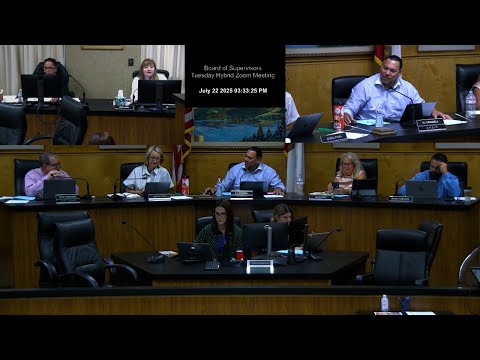
A Lake County supervisor and Supervisor Pysco told the Board of Supervisors on Tuesday that federal policy changes discussed at recent National Association of Counties (NACO) meetings could affect local health services, land-use oversight and disaster-response funding.
The county supervisor who attended NACO said the group is watching potential changes to Medicaid eligibility that could take effect in 2027 and 2028 and predicted near-term impacts to CalFresh and other programs. "We're seeing direct impacts to our CalFresh as it goes through the state of California... Then we'll see further cuts as we're moving forward in 2027 and 2028, when it comes to who will be covered and who can apply for Medicaid," the supervisor said.
Why it matters: The supervisor said changes to federal Medicaid rules and related state implementation could reduce coverage for groups previously included in county health planning, and that undocumented immigrants may no longer be eligible under proposed rules — a change the supervisor said could affect local hospitals and health systems.
At the same meeting, the supervisor raised concerns about proposed changes to the National Environmental Policy Act (NEPA) that could limit local review for some projects. "Data centers have a 10 year exception on NEPA, where they... don't have to follow local jurisdictional laws on where they will be placed," the supervisor said, adding that some proposals would allow project proponents to bypass local public comment if they pay 125 percent of estimated environmental costs.
Supervisor Pysco, who attended panels on wildfire, grid resilience and disaster-recovery reform at NACO, said the county-backed group adopted several resolutions in the county’s energy, environment and land-use policy committee. "One of them is that, currently, FEMA does not allow fire suppression infrastructure to be upgraded under their grant programs," Pysco said, and she expressed hope the NACO advocacy will persuade federal agencies to change grant eligibility.
Meeting participants described continuing federal advocacy. Pysco said legislation incorporating the task force's recommendations is going before Congress in August and that NACO plans additional advocacy meetings this fall. "There's potentially two more fly-ins, one in September and one in October... I at least hope to get to the final one in October, with our recommendations," she said.
Context and limits: The items discussed were reports from county representatives about their NACO committee work and federal advocacy; no Board of Supervisors motions or votes on these topics were recorded in the transcript. The supervisor who reported being named chair of NACO’s health committee cited appointment by NACO’s new president, JD Clark.
The supervisors urged continued attention as federal rulemaking and legislation proceed, and flagged the potential local impacts on health coverage, infrastructure siting, and access to disaster-mitigation funding.
Looking ahead: Supervisors said they will monitor rulemaking and federal legislation and bring follow-up information back to the board as details and timelines become clearer.