Get Full Government Meeting Transcripts, Videos, & Alerts Forever!
Get email alerts on the Telecom Rights Of Way Telesis topic
No spam. Unsubscribe anytime.
Council updates right‑of‑way agreement for subsea cable operator; residents question ecological and public benefit
Summary
The council adopted a rights‑of‑way agreement with Telesis Cable USA Inc. to update fees and formalize use of existing conduits, while residents asked whether submarine cable landings and new conduits provide direct benefit to city residents and raised concerns about environmental impacts.
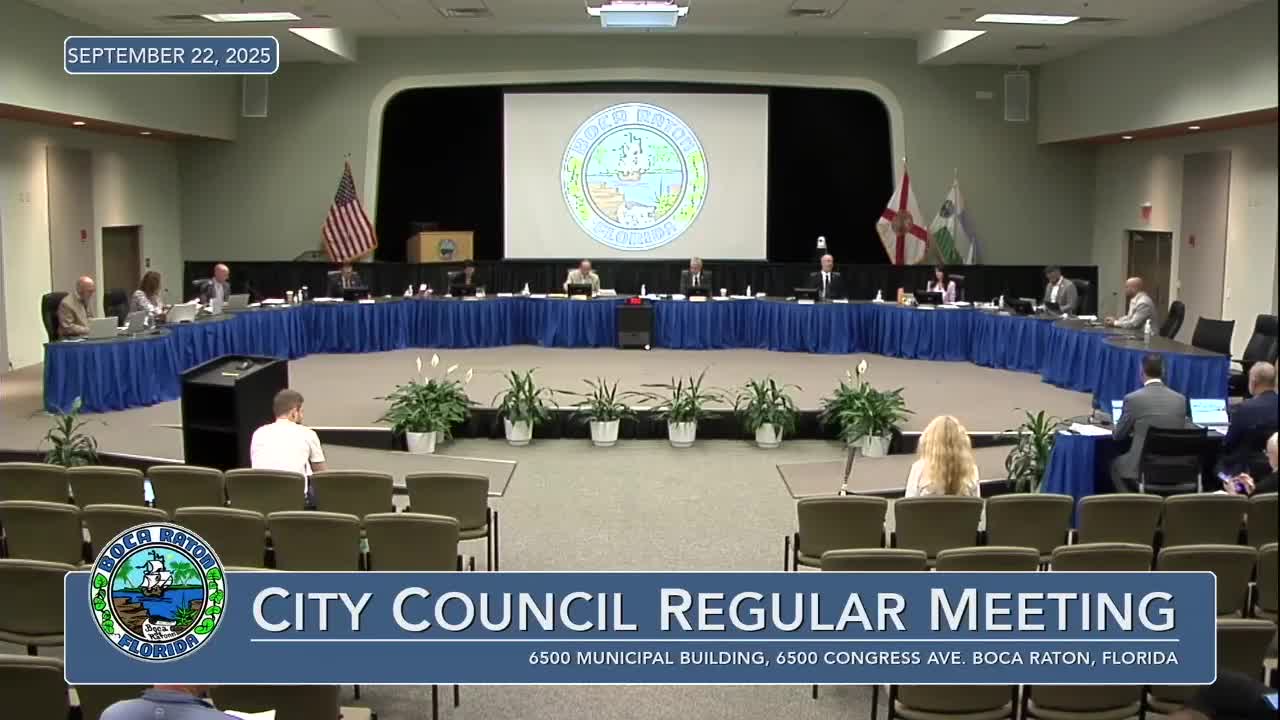
The Boca Raton City Council unanimously adopted a resolution authorizing an updated right‑of‑way use agreement with Telesis Cable USA Inc., which the city said will formalize use of existing conduits in city rights of way and update compensation rates. The vote was 5–0.
Zach Bier, Public Works and Engineering director, said the agreement updates the cost per linear foot for conduits that in some cases have been in place for decades. He described the current action as an update to an existing right‑of‑way arrangement for conduits placed historically and said staff had received an updated agreement from the applicant.
Public concerns and staff response John Perlman, a resident, asked whether the same company was responsible for a cable that was installed through Spanish River Park and questioned whether the project provided any direct service to Boca Raton residents: “This cable is servicing, hotels and infrastructure in in 1 of the, the islands in the Caribbean. And so this cable is not it's it there's no benefit.” Perlman also questioned whether the city should accept what he described as a one‑time payment given the city’s large cash reserves.
Bier and other staff clarified that multiple, separate easements and agreements exist: one easement over Spanish River Park (for which staff said an easement payment has already been remitted) and the separate right‑of‑way use agreement for conduits within the city street right‑of‑way. Bier explained that the submarine cables were landed decades ago and that horizontal directional drilling was used; he also said environmental permitting, including Army Corps and state reviews, had been completed for the submarine landing work. Regarding local benefits, Bier noted the city receives annual payments for conduit within right‑of‑way (staff cited approximately $65,000 annually for the right‑of‑way component) and said that, from an engineering perspective, the cables also support network paths used when residents communicate internationally, calling the system “time tested.”
Action and vote The council adopted Resolution No. 147‑2025 authorizing the city manager to execute the updated rights‑of‑way agreement; the motion passed 5–0.
Why it matters Residents expressed concerns about environmental disturbance where a submarine cable crosses coastal parkland and questioned whether conduit agreements primarily served private or nonresident users. Staff said federal, state and local environmental reviews had been completed for the submarine landing and that separate agreements cover the park easement and the city right‑of‑way; staff also confirmed the city had received at least one easement payment and that the right‑of‑way agreement yields modest annual revenue.