Get Full Government Meeting Transcripts, Videos, & Alerts Forever!
Get email alerts on the Airport Infrastructure topic
No spam. Unsubscribe anytime.
Guthrie Avenue Regional Airport outlines $5.7 million taxiway project, 8,000-foot fence as FAA-backed upgrades
Summary
Airport officials told a joint Edmond–airport board meeting that FAA grants would cover most of a $5.7 million taxiway replacement and LED lighting project and that an 8,000‑foot fencing project for wildlife exclusion will move forward; city contributions are comparatively small.
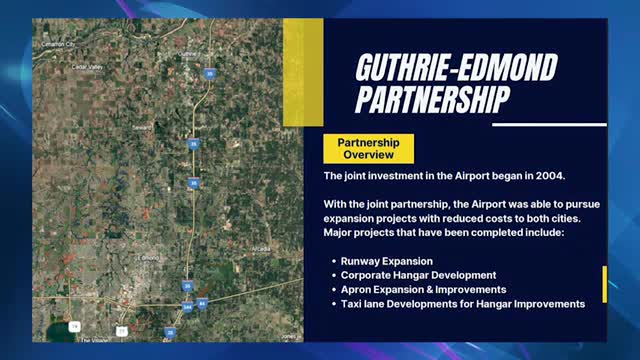
Officials from the Guthrie Avenue Regional Airport and city staff presented capital-improvement plans at a joint meeting with the City of Edmond and the airport board, saying federal grants will fund the bulk of immediate work while the cities provide modest local matches.
Airport staff said the next major project is replacement of about 3,000 feet of taxiway and installation of LED lighting, a project with a total cost of $5,700,000. According to the presentation, the Federal Aviation Administration supplies roughly 90–95 percent of eligible federal funds, and each city’s local contribution for the taxiway project would be about $142,000. Separately, the board plans an east-side fencing project of more than 8,000 linear feet to reduce wildlife (deer) strikes; total project cost was presented as $400,000 with each city’s share around $10,700.
Why it matters: airport staff framed the projects as safety and economic development investments that leverage relatively small municipal outlays to secure large federal grants. Presenters said hangar and ground-lease revenue make up a substantial portion of airport operating income, and that airport activity supports local jobs and businesses.
Airport overview and operations Airport staff reported the field has more than 60 hangar spaces and that hangar ground leases account for about 46 percent of airport revenue. Staff said the field’s annual economic output was presented at about $19,200,000 and that the airport currently produces enough operating revenue to be self-sustaining only a few months each year. The airport’s fixed-base operator changed after a long-term operator retired in 2023; the new FBO was identified in the presentation as Zia HEX Air Center. Staff said the airport hosts an annual community flying day with EAA participation and aviation-education activities.
Funding and grants Presenters emphasized reliance on FAA grant programs: the taxiway and lighting project was described as largely FAA-funded, with the municipal match relatively small in comparison. City contributions historically ranged from about $150,000–$200,000 per city annually, the presentation said, with a recent year’s contribution noted as roughly $300,000 per city while pursuing capital projects. The presenters also discussed state legislative support and one-off federal appropriations referenced in the talk; a speaker mentioned ARPA funds in broader aviation-sector context but did not connect a specific ARPA allocation directly to the airport projects discussed.
Constraints, long-term planning and equipment Panelists and outside aviation speakers discussed operational limits and long-term goals. They said the field is unlikely to become a commercial-service airport and that a control tower is not an immediate prospect; one speaker suggested a 15–20 year horizon before tower-level activity, if growth continues. Speakers discussed obstacles to runway lengthening — including nearby roads and residences that would need to be acquired to add significant runway length — and recommended focusing on achievable upgrades such as strengthening pavement, adding taxiways, hangar capacity and instrument approach capabilities where feasible.
Safety and navigational capabilities The airport’s all-weather capability and instrument approach options were raised as limiting factors for attracting certain business-aviation activity. Presenters said ground-based landing systems are expensive and that GPS-based approaches are commonly used at similar airports. Staff advised investigating obstruction issues (trees or terrain) at the north end of the field that limit approach minima, noting some improvements might be possible without large capital outlays if obstacles can be cleared.
Economic development, hangars and maintenance Speakers urged pursuing hangar construction and attracting maintenance, repair and overhaul (MRO) businesses and other aviation-support companies that fit the airport’s existing runway and pavement strengths. Presenters said hangar rent differentials (examples cited in the discussion were on the order of $1,000–$1,500 per month in revenue examples) influence basing decisions by aircraft owners and that developing affordable hangar space could draw aircraft now based at nearby reliever airports.
What was not decided The meeting recorded discussion and direction but no formal motions or votes on the projects. Several technical and funding questions were raised that staff said will require follow-up analysis, property-acquisition planning and continued grant application work.
Ending Airport staff and invited speakers asked the two governing bodies to continue supporting grant applications and land-acquisition efforts and to consider investments that match the airport’s operational capacity rather than pursuing commercial-service ambitions.