Get Full Government Meeting Transcripts, Videos, & Alerts Forever!
Get email alerts on the Opioid Settlement Grants topic
No spam. Unsubscribe anytime.
Bangor advisory committee, Penobscot County officials coordinate RFPs, set timeline for opioid settlement grants
Summary
The Opioid Settlement Funds Advisory Committee discussed coordinating applications and scoring with Penobscot County, confirmed an Oct. 1 application opening and Nov. 15 deadline, addressed a $1.2 million first funding pool and potential conflicts of interest and recusals among committee members.
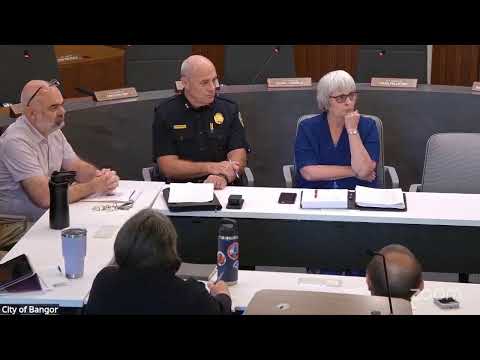
Bangor’s Opioid Settlement Funds Advisory Committee met Wednesday, Aug. 13, and discussed coordinating application processes and scoring with Penobscot County as the city prepares to distribute roughly $1.2 million in initial opioid-settlement funds.
Committee members said the city’s first recommended project — an HIV-related initiative the committee rated urgent — was approved by the City Council earlier this week and staff will move quickly to implement the next steps. “Our first project has gone in. It did get passed. It went through council Monday night,” a committee member said at the meeting.
The committee outlined a timetable for the first competitive round: staff plan to release a public application in mid-September, open formal submissions on Oct. 1 and set Nov. 15 as the submission deadline. The committee intends to notify award recipients by Dec. 31, using roughly $1,200,000 for this first set of planning awards, the committee was told.
The committee discussed grant-size tiers to spread awards across organizations. The draft tiers under consideration are: up to $10,000; $10,001–$25,000; and $25,001–$49,999 — staying just under the $50,000 threshold that would trigger additional state enrollment and reporting requirements. A committee member said the tier approach is intended to fund a larger set of organizations while keeping administrative burdens lower for smaller applicants.
Committee members said they will use a scoring rubric developed by the Moss Center and will ask Moss for the fillable scoring form the county and city can both use. “We did decide we would use the same scoring rubric that they have,” a committee member said. Staff said the committee will add application questions asking whether applicants have applied for opioid-settlement funds elsewhere and, if so, how much and for what purpose.
Panelists discussed logistics for coordination with Penobscot County, including sharing applicant counts after the deadline to identify overlapping proposals and opportunities for collaboration. Jamie Beck, representing Penobscot County’s opioid committee, described prevention and recovery priorities and urged the city committee to consider community conditions and stigma in scoring and priorities. “I represent prevention. I spend my days on prevention,” Beck said.
Members discussed platform options for collecting applications, noting that Google Forms is simpler and less costly than some commercial platforms. The meeting referenced the city’s existing Neighborly platform used for other grant programs but generally favored a lightweight approach for the initial round.
The committee also addressed conflicts of interest. Members agreed they will rely on individuals’ disclosures and consider forming a smaller subcommittee (two or three members) to perform initial reviews and scoring for applications where recusal risks exist. “We’ll just have to be really cautious of which ones we’re looking at, and you’re really gonna have to just be on your honor as to say, I probably shouldn’t look at this one,” a committee member said. Several members expressed unease about committee members or staff drafting the letter of intent or application language that could advantage organizations represented at the table; others said staff-drafted documents and a transparent process should limit that risk.
The committee discussed outreach steps: a public webinar in mid-September to review the application and a potential public-comment session later, structured to collect input from residents and people with lived experience. One participant who identified herself as Shelley described a personal stake: “Both of my children died in overdose,” she said, urging the committee to prioritize direct service and prevention supports.
Committee members said they will circulate a simplified draft letter of intent for review within 24–48 hours, solicit comments by email, and reconvene with county representatives and the city manager (referred to in the meeting as Wendy) for a fuller discussion. The committee plans to schedule follow-up meetings when applications begin arriving.
No formal motions, roll-call votes or ordinance numbers were recorded in the transcript beyond the committee’s account that the City Council approved the committee’s first recommended HIV-related project earlier in the week; details of the council vote and motion were not specified in the committee discussion.