Get Full Government Meeting Transcripts, Videos, & Alerts Forever!
Get email alerts on the Unified Development Code topic
No spam. Unsubscribe anytime.
Woodland Park commission agrees on 'multiple dwelling' naming in UDC update; staff to send polished draft to city attorney after 359 comments
Summary
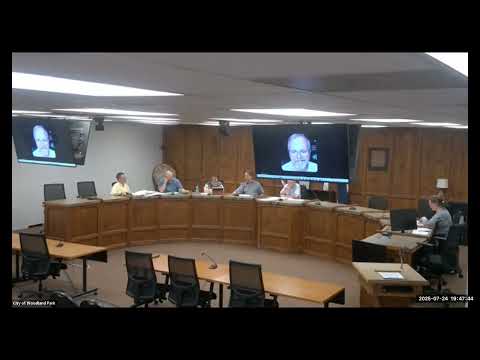
The Woodland Park Planning Commission on July 24 agreed on revised zone-district names for multiunit housing and confirmed staff will finalize a polished Unified Development Code draft for legal review after processing 359 public comments.
WOODLAND PARK, Colo. — The Woodland Park Planning Commission on July 24 reached agreement on revised names for multiunit residential zone districts and confirmed staff will package a polished Unified Development Code (UDC) draft for legal review after processing 359 public comments submitted to the Conveio platform.
Commissioners and staff discussed three linked topics: how to rename zone districts after the State of Colorado removed the word "family" from certain housing definitions; whether to use "manufactured home park" or "manufactured home community" for what had been called "Mobile Home Park"; and how to label multifamily districts so the code's wording is consistent and avoids confusing acronyms. Planning staff said the goal is consistency with state model code and minimal disruption for property owners and the zoning map.
Planning staff reported they had logged 359 public comments. "We were at 359," the staff member said, adding that staff and consultants were reviewing each comment and would return to commissioners with a redline showing what was incorporated and what was not. Staff estimated the city attorney would need three to four weeks for legal review and forecast returning a revised document to the commission in September.
Why it matters: the naming and definition changes follow a state-level change in housing terminology and will appear throughout the city's UDC. Language choices affect how uses are listed in the use table, the meaning of conditional-use requirements, and the clarity of the code for applicants, neighbors and staff during permit review.
Manufactured homes: staff recommended replacing the outdated "Mobile Home Park" label with "manufactured home park," retaining the MHP abbreviation to match modern terminology used in model state code and industry practice. Staff noted "manufactured home community" was suggested but said it could allow larger developers to build manufactured developments in standard residential districts and therefore might not be the best fit for a distinct zone district. The commission expressed support for using the state's terminology where possible.
Multifamily naming: the commission agreed to rename the existing "multifamily residential suburban" and "multifamily residential urban" districts to versions that place the word "residential" at the end for consistency with other district names. The final wording to be used in the UDC will read along the lines of "multiple dwelling suburban residential" and "multiple dwelling urban residential," abbreviated as MDS and MDU. Commissioners asked staff to clean up inconsistencies in the draft (some paragraphs and the table used different word order) before the legal review.
On building terminology, Dr. Emily Sabo emphasized the drafting distinction relevant to construction and definitions: "you don't build a household. You build a dwelling unit," she said, arguing for language that reflects common building standards and lending terminology.
Policy items staff left unchanged for now: the commission heard that some existing provisions, although arguably inconsistent with contemporary planning practice, are being retained in this round because they touch broader policy (and would require more public engagement). Examples staff cited include a conditional-use requirement for multifamily housing even in multifamily zoning districts and an existing density cap in the PUD zone that limits projects to "2 dwellings per acre." Staff said those items are being noted for future consideration rather than rewritten in this phase of the update.
Extensions and administrative practice: staff reminded the commission of the current approach to approvals and extensions: the first extension is handled administratively by planning staff, a second extension comes before the planning commission, and a potential third extension would be routed to the planning commission for recommendation and then to city council for decision. The draft code language included a maximum of three extensions of two years each, with three criteria: (1) the request is filed before the approval expires, (2) the applicant demonstrates substantial progress on the project, and (3) conditions at the time of original approval have not materially changed.
Public process and timeline: after legal review, staff said the commission's recommendation would be released to the broader community in an "unveiling" and orientation period of about 30 days so residents can review what the commission is proposing before hearings. Staff noted there were relatively few clustered, identical comments among the 359 submissions; most concerns were scattered and would be considered individually. The commission is scheduled to hear several August items, and staff said the UDC return would likely be in September after city attorney review.
Other notes: commissioners briefly discussed broader planning topics connected to the code update, including the role of the comprehensive plan in guiding zoning, market-driven decisions about commercial uses and sales-tax implications, and how the city balances aspiration language in the comp plan with regulatory code. Commissioners also thanked Team Rubicon for volunteer work on local open space; staff said signage and a master plan for the conservancy property are forthcoming.
The commission closed the work session after agreeing on the naming direction and next steps: staff will produce a cleaned, consistent UDC draft, continue processing the 359 public comments, submit the draft to the city attorney for legal review, and then prepare a community release and public hearings schedule.