Get Full Government Meeting Transcripts, Videos, & Alerts Forever!
Get email alerts on the Corrections topic
No spam. Unsubscribe anytime.
DOC outlines phased closure of MCF Stillwater; senators press on transparency, staffing and capacity
Summary
The Minnesota Department of Corrections told the Senate Judiciary and Public Safety Committee on Sept. 25 that phase 1 of the legislature-directed closure of the Minnesota Correctional Facility–Stillwater is implemented and that the agency is working to meet near‑term budget targets while moving staff and residents across the system.
St. Paul — The Minnesota Department of Corrections (DOC) told the Senate Judiciary and Public Safety Committee on Sept. 25 that it has implemented phase 1 of the legislature-directed phase closure of the Minnesota Correctional Facility–Stillwater and is working to meet a sequence of budget and operational targets through full closure expected by June 30, 2029.
The DOC said the closure is driven by a directive in 2025 legislation and accompanying budget targets. Commissioner Paul Schnell, commissioner of the Minnesota Department of Corrections, told the committee that the DOC submitted a strategic closure plan on July 31 and that the plan is intended to “minimize layoffs, maximize staff opportunities for transfer, communicate and engage with stakeholders, reduce disruption to incarcerated individuals, and ensure critical services like education, treatment, family visits, and case planning continues as smoothly as possible.”
Why it matters: The closure affects staffing, inmate placement across the state and near-term corrections budgeting. Senators on the committee pressed the DOC about how the closure was added to negotiations in the Legislature, how the agency is meeting short-term housing needs while renovations occur at other prisons, and whether the state has planned long-term capacity to absorb Stillwater’s population.
Key facts and timeline
- Legislative directive and plan: Committee testimony said 2025 legislative leaders agreed to a phased closure of MCF–Stillwater; the DOC submitted the required strategic closure plan on July 31, 2025. Full closure is expected by June 30, 2029.
- Budget targets and costs: The DOC said it must cut Stillwater’s operating budget by $20 million in fiscal year 2026 and absorb about $10 million in one-time closure-related costs (layoff-related payouts, certain security and transition expenses), for a combined near-term savings target of $30 million. Annual savings targets rise in later fiscal years, reaching about $48 million by fiscal year 2029, according to the DOC presentation.
- Staffing: At the end of the 2025 legislative session, DOC said Stillwater employed 567 staff. As part of phase 1 the department expected that number to fall to about 231 by Oct. 1. The agency reported having issued 32 layoff notices tied to the closure but said the number remains fluid as staff move into vacancies elsewhere and bumping rules are resolved. Schnell told the committee the DOC has retained more than 95% of Stillwater staff so far and that no uniformed staff in ranks from CO‑II through captain have been laid off as of the hearing.
- Transfers and retention supports: The DOC held meetings with labor partners and staff (the testimony cites about 93 meetings with labor since May 15 and 347 individual meetings in August for impacted employees). The agency ran three resource fairs, a career fair (attended by more than 100 staff), and five job clinics and negotiated memoranda of understanding (MOUs) with unions to allow transfers between facilities that otherwise operate as separate seniority units under AFSCME contracts.
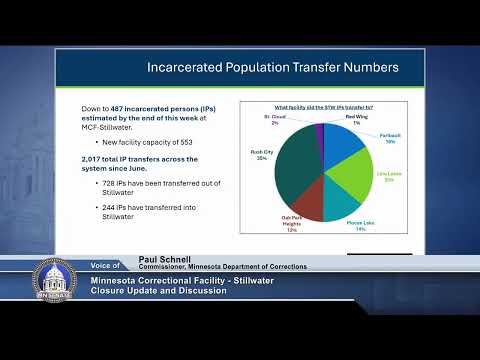
- Inmate population and placements: The DOC said it reduced Stillwater’s population by roughly 50% (from just under 1,200 in May to about 487 at the time of the hearing; facility capacity cited at 553). Since June the system completed more than 2,000 transfers, including 728 people moved out of Stillwater and 244 moved in. The DOC described a relocation rubric that prioritizes medical and mental health needs, then treatment and education, and uses a validated risk-assessment tool (RIN safety) to guide placements.
- Short-term county contract: Because of an overlapping fire-suppression renovation at the St. Cloud facility, the DOC said it entered a short-term contract with Washington County for up to 50 beds as a temporary transfer mechanism; the department reported 49 people then housed under that contract and said it planned to move those people into state facilities as renovations complete. The DOC said it pays counties roughly $80–$90 per inmate per day under that arrangement.
Programs and facility uses anticipated at Stillwater during transition
- Treatment and specialty beds: In phase 1 Stillwater will continue to host specialty housing. The DOC said it is nearly tripling the Atlantis inpatient substance‑use disorder treatment program from 36 to about 90 beds. The facility will also host earned living units (about 310 beds described by DOC leadership) and long‑term restrictive housing beds; individuals in restrictive housing are to return to their sending facilities after completing those terms and step‑down processes.
- Earned living units and staff input: Schnell and Warden Bill Bolin said the earned living units were modeled on programs observed by staff in other states and that DOC leaders involved corrections officers and union representatives in planning. The department said officers who visited exemplar programs in Missouri and Maine reported positive outcomes; the DOC acknowledged earned living units will be a learning process and said participant selection will be tightly controlled.
Issues raised by senators at the hearing
- Transparency and process: Several committee members, led by Senator Limmer, criticized the process by which the Stillwater closure was included in the conference committee report during the 2025 legislative session and called for greater earlier public discussion and committee hearings. Limmer said the public “got a short shrift” and called the process “amazing” in its lack of earlier committee-level hearings; Schnell replied that the inclusion took place in public conference‑committee action and that the DOC’s role is now to implement legislative direction while attempting to be transparent during implementation.
- Capacity and long-term planning: Senators pressed whether the state will have enough bed capacity after Stillwater closes if system populations rise. Schnell referenced historical population peaks (roughly 9,500 in 2019 and more than 10,500 in the early 2010s) and said current population (about 8,206 systemwide at the time of the hearing) gives room to manage transfers. He said the DOC is reviewing older OLA and facility studies and is preparing possible bonding requests to plan for future capacity needs, including potential projects at the St. Cloud campus; the DOC cited previous cost estimates in testimony (figures presented during the hearing included preliminary estimates in the hundreds of millions to more than $1 billion for major replacement/upgrade work, which the commissioner said the state should consider proactively).
- Use of county jails and costs: Senators asked how many inmates were in county beds and whether other counties were under contract. The DOC confirmed 49 people were in Washington County under a 50‑bed contract and reiterated that use of county beds is temporary and not unusual historically. The DOC said the per‑day county cost runs about $80–$90.
- Staffing impacts and relocation costs: Senators sought clearer numbers on expected layoffs, moving expenses and whether the state would cover relocation costs. Schnell said the 32 layoff notices are still being resolved through bumping and classification rules and that the DOC is working to minimize layoffs; he said some moving or relocation reimbursements are provided only to the extent labor agreements allow and that the agency had budgeted some one‑time closure costs to help address transitions.
- Canine program: Senators asked about the future of K‑9 teams assigned to Stillwater. Warden Bill Bolin told the committee that all four canine handlers at Stillwater will keep their dogs and that one canine officer will remain at Stillwater; three handlers have moved to positions at other facilities. The DOC said it will retain two single‑purpose drug detection dogs for systemwide deployment.
- Double bunking: Senators asked whether the DOC intends to increase double bunking. Schnell stated that double bunking is an existing, long‑standing practice in Minnesota prisons (used in facilities such as Rush City) and that the system will “maximize the use of our bed space” as needed, but that double bunking itself is not new to the closure.
What the DOC directed or decided at the hearing
- Implementation status: The DOC reported that phase 1 goals were met (population reduction, staff transfer efforts and MOUs in place) and that it will continue weekly communications with staff, inmates and stakeholders, and maintain a public webpage and briefings for legislators.
- Ongoing actions: The DOC said it will continue negotiating with labor partners on transfers and bumping issues, move Washington County placements into state facilities as renovation timelines permit, expand programming space where feasible, and further evaluate longer‑term bonding or capital proposals for system capacity.
Committee next steps and context
- Several senators asked for additional public hearings and follow‑up briefings. The committee chair said the other legislative body intends to hold a follow‑up public hearing before year’s end and that the DOC will continue to provide regular written updates and briefings to legislators.
Ending note: The DOC emphasized that the strategic plan is intended to prioritize safety, fairness and transparency during the multi‑year closure. Members of the committee repeatedly pressed for clearer early public process before the legislative inclusion and for continued data and detail on layoffs, relocation costs, county placements and long‑term capacity planning.