Get Full Government Meeting Transcripts, Videos, & Alerts Forever!
Get email alerts on the Budget topic
No spam. Unsubscribe anytime.
Flower Mound reviews tight FY26 budget; staff proposes utility, stormwater rate increases amid state bill concerns
Summary
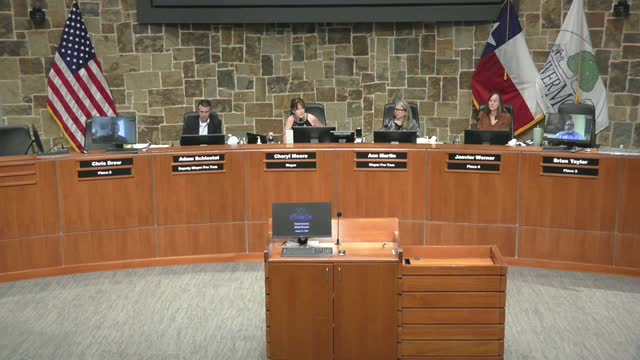
Town Manager James told the Flower Mound Town Council at a work session that the proposed Fiscal Year 2026 budget was the most difficult he has prepared in his tenure, driven by stagnant sales-tax receipts and a drop in certified property valuations.
Town Manager James told the Flower Mound Town Council at a work session that the proposed Fiscal Year 2026 budget was the most difficult he has prepared in his tenure, driven by stagnant sales-tax receipts and a drop in certified property valuations.
“The proposed budget is my budget as a town manager… This is the most difficult budget that I’ve had to put together,” James said, describing a revenue situation that narrowed staff flexibility and left more than $7 million in decision packages unfunded.
Staff said the proposed operating budget balances without cuts to current service levels by shifting some capital spending to sales-tax funds and by funding market and merit adjustments for employees. Meg, the town’s budget director, described the budget as both an operational and policy document, saying it “is truly what it takes, the resources required, to execute the policies that council has identified.”
On utilities, consultant Chris Eckert of NewGen told council he recommends a 5.25% overall increase in both water and wastewater rates for FY26. He said wholesale cost increases from regional providers and capital needs are the primary drivers of the proposal. "I am recommending a 5.25% overall increase in water and wastewater rates," Chris said, and staff presented sample customer impacts showing the typical single-family account in town (15,000 gallons water and 8,000 gallons wastewater) would see a monthly bill rise by about $9 under the proposed change.
Council and staff also discussed stormwater funding and a Cross Timbers drainage effort. Staff proposed raising the monthly residential stormwater fee to $6.50 and to charge nonresidential accounts based on impervious area, defined as an "equivalent residential unit" of 5,285 square feet. Staff said the impervious-area approach would better align fees with stormwater impacts from larger properties. Officials said the rate change would increase stormwater fund revenue to support drainage work, including an initial Cross Timbers program and targeted repairs; staff described the work as a mix of assessment, targeted maintenance and small capital actions rather than a broad planning-only study.
The budget presentation included a five-year capital improvement program. Dale and other staff outlined planned street reconstructions, water and wastewater plant projects, parks work tied to the recently approved bond, and facility projects including a performing-arts center and Fire Station No. 6. Staff said many capital projects are funded with a mix of bond proceeds, utility debt and developer reimbursements.
Council members and staff repeatedly raised concern about pending state legislation. James, the town manager, and John, the town chief financial officer, warned that proposed bills — including measures to lower the municipal revenue-cap (discussed as Senate Bill 10) and measures to limit municipal annual spending (discussed as House Bill 73 and related proposals) — could force Flower Mound to choose between deep service cuts, tax elections to exceed caps, or more limited spending. James said the town’s current planning assumes the 3.5% revenue cap enacted in 2019; he warned that lowering the cap to 2.5% or imposing an expenditure cap that applies to utilities and capital would make balancing future budgets far more difficult.
Staff did not present any formal motions or council votes during the session. Instead, the work session was used to receive direction and to signal changes staff will make before budget adoption at a public hearing scheduled for Sept. 15; staff said they will update the stormwater revenue estimate to reflect the $6.50 proposal and will adjust a transfer to debt service for fire-station debt before adoption.
Public comment included residents urging action on drainage in Cross Timbers and a request for prioritized sidewalk projects. Jeanne Ferrier, a Flower Mound resident, urged council to approve drainage analysis and work, saying residents have documented repeated flooding and property damage. Cody Smith, a Flower Mound skateboarder, asked the council to study sidewalk gaps on Long Prairie and Justin Road to improve safety for skateboarders and pedestrians.
Officials said next steps include finalizing figures and public notices, holding a public hearing on the proposed budget and tax rate, and returning for adoption on Sept. 15. Staff emphasized that the FY26 budget seeks to maintain current service levels while leaving a short list of unfunded departmental requests that may return for future consideration.
Ending: Council members thanked staff for the work on the condensed budget and directed staff to return with final numbers and any recommended amendments at the adoption hearing.