Get Full Government Meeting Transcripts, Videos, & Alerts Forever!
Get email alerts on the Leesburg Gateway Rezoning topic
No spam. Unsubscribe anytime.
Leesburg planners review proposal to reclassify 101.9 acres for data centers, industrial flex
Summary
The Leesburg Planning Commission on July 17 held a work session on a rezoning and plan‑amendment request known as the Leesburg Gateway that would allow data centers, industrial flex buildings and parkland on three parcels totaling 101.9 acres north of Route 7 and south of Potomac Station Drive.
The Leesburg Planning Commission on July 17 held a work session on a rezoning and plan‑amendment request known as the Leesburg Gateway that would allow data centers, industrial flex buildings and parkland on three parcels totaling 101.9 acres north of Route 7 and south of Potomac Station Drive.
Planning Project Manager Scott Parker summarized staff analysis and responses to questions raised at the public hearing and in prior commission meetings, saying the applicant proposes an alternative land‑use policy for the site that departs from the Eastern Gateway District Small Area Plan's mixed‑use vision and would permit data centers and industrial flex uses alongside parkland.
The proposal is concurrently being processed as a rezoning application, Parker said. Staff listed potential benefits — including increased parkland and tax revenue — and trade‑offs such as reduced housing capacity, aesthetic impacts, and higher energy demand. He told the commission the town code and zoning ordinance would regulate noise and that “there is a maximum continuous noise level of 55 dBA at the property line in this case.”
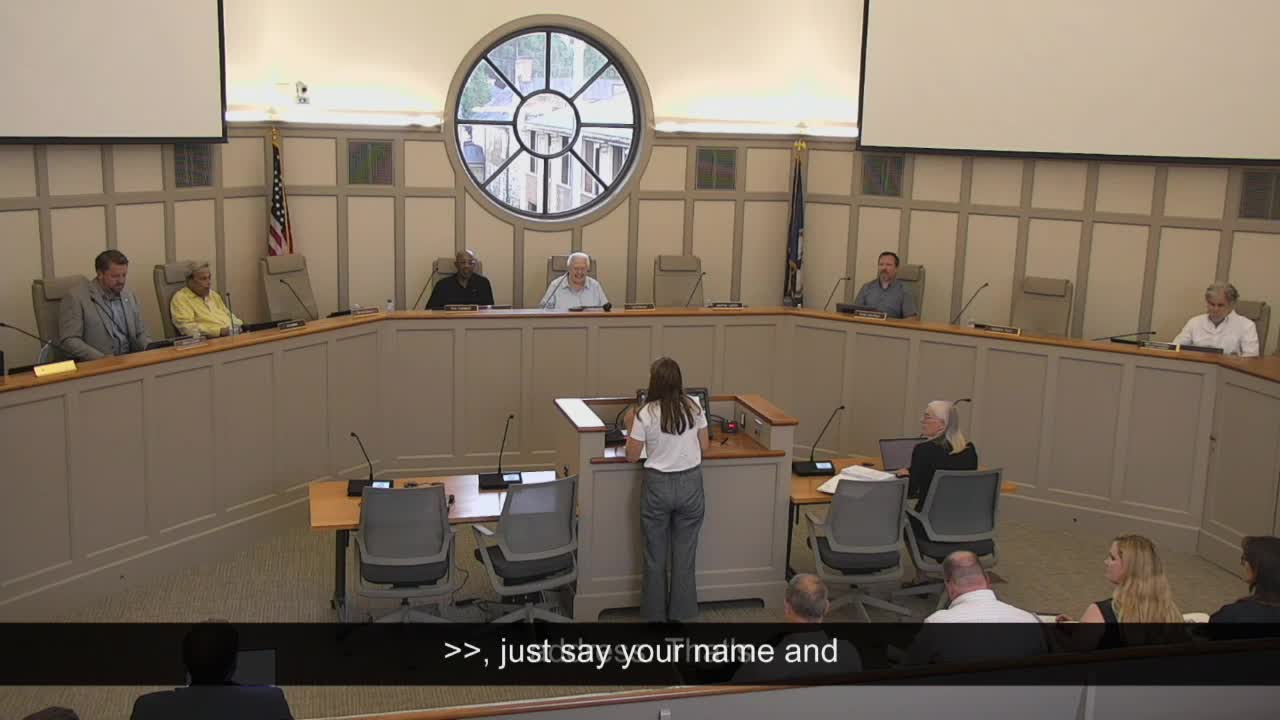
Nearby residents and environmental groups urged the commission to reject or more closely study the change. Olga Hanava, who identified herself as a resident of 18403 Rimrock Circle, told commissioners she opposed the development not because of the data center itself but because of the supporting infrastructure it requires, including higher‑voltage transmission towers she said Dominion intends to rebuild. “This developer wants to build 4 industrial flex buildings and a large data center in the area that has always been residential,” Hanava said, arguing the applicant’s plan conflicts with the town and small area plans and would remove mature trees, increase impervious surface and worsen stormwater runoff.
Jen Bingle, representing the Piedmont Environmental Council, urged a more comprehensive public process if the town is to consider changing the area’s long‑range vision. “If we've gone through a public process and the vision has been set here, the more appropriate thing to do is to look at this area separately,” Bingle said, recommending a holistic review rather than piecemeal waivers.
Staff answered commission questions about several technical topics. On buffers and landscaping, Parker said staff was recommending additional policy language requiring that landscape buffers be “maintained in perpetuity” and replaced if diseased or damaged as a condition evaluated during rezoning. On topography and noise, staff proposed policy language requiring any rezoning to demonstrate that rooftop equipment and other infrastructure would not create unanticipated noise or visual impacts given residential elevations north of Potomac Station Drive.
Transportation and access were a recurring theme. Parker summarized the project’s transportation history and noted that VDOT spacing requirements currently mean an entrance at the site would not meet spacing standards relative to the Route 7 ramp and Battlefield Parkway without waivers. He also discussed the long‑planned Cardinal Park overpass, which the town has included in prior plans and which staff said would provide an alternate route and pedestrian/bicycle connectivity; staff noted several nearby approvals assumed the overpass’s eventual construction.
On utilities, Parker said the town’s utilities department is preparing its semiannual plant capacity and flow projection update, expected to go before town council at the Sept. 8, 2025 work session, and that water capacity analyses to date showed sufficient supply for previously approved projects. Questions about electricity and Dominion’s plans were deferred to the applicant, which staff said has been coordinating with the utility.
Parker also noted park planning considerations: no detailed park master plan has been prepared yet and the town would need to assess capital and ongoing operational costs if parkland were acquired as part of the proposed alternative.
No formal decision or rezoning vote was taken at the July 17 work session. The commission closed the petitioner segment of the public hearing after public comment and moved into the staff‑led work session. Staff said rezoning materials, proposed policy language, and the traffic study are in the planning commission packet and that the commission could request additional refinements to policy language or require further studies at rezoning.
Next steps disclosed by staff include further review of the rezoning submittal, consideration of the additional policy language on buffers and topography, and future coordination with transportation and utilities staff. The commission did not adopt any amendment to the town plan at the meeting.