Get Full Government Meeting Transcripts, Videos, & Alerts Forever!
Get email alerts on the Hospital Finance topic
No spam. Unsubscribe anytime.
Guam lawmakers debate governor's $40 million package for Guam Memorial Hospital amid questions on priorities and oversight
Summary
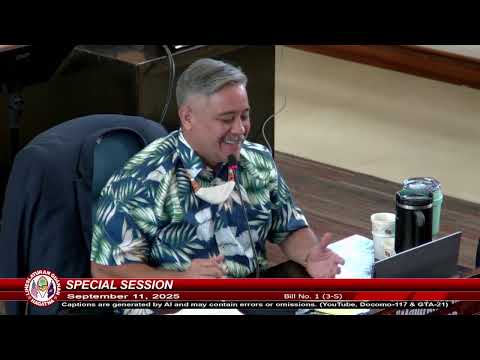
The Committee of the Whole of the Guam Legislature spent its second-round questioning on a governor-backed measure that would make $40 million available to Guam Memorial Hospital Authority (GMH) for vendor payables, supplies and critical capital projects, including electrical and IT upgrades.
The Committee of the Whole of the Guam Legislature spent its second-round questioning on a governor-backed measure that would make $40 million available to Guam Memorial Hospital Authority (GMH) for vendor payables, supplies and critical capital projects, including electrical and IT upgrades.
GMH officials told senators the funding would be split to address immediate vendor payables and supply shortfalls while seeding capital repairs: about $26 million for vendor payables, $3 million for supplies, $5 million for IT network infrastructure, $5 million for the main electrical distribution panel and $1 million for HVAC parts. GMH representatives and treasury officials said the $40 million is not sufficient to cover all identified needs and that final allocations may shift depending on up-to-date payables.
Why it matters: Hospital leaders and lawmakers said GMH is operating with aging systems, recurring supply gaps and outstanding liabilities that jeopardize operations and patient care. Witnesses cited a recent electrical fire at the hospital and repeated network outages to explain urgency. Lawmakers said they want quick payments to suppliers but also want accountability and compliance in how large sums are spent.
Officials and lawmakers discussed specific uses and outstanding balances. GMH told the committee that vendor payables reported in August ran from roughly $26 million (GMH figure) to $30 million (printout referenced to the committee); the difference reflected timing and new invoices. GMH and finance witnesses broke down the payables further: private suppliers that deliver medicines and linens total about $6 million (reported in May and updated to $6 million), travel-nurse agency obligations about $4 million, licensing and maintenance for the hospital's current electronic records system cost roughly $1.2 million annually, and an estimated $10 million represented outstanding medical insurance premiums owed to the government. One witness noted about $12.5 million of the total accounts payable on a 9/2 printout was owed to government entities.
GMH officials described how funds would be used. "So the short answer, yes. It would," said Lillian, a GMH representative, when asked whether the $3 million for supplies would address public complaints that staff lacked basic items for clinicians. She and other panelists explained the $3 million would meet immediate supply needs while $26 million in vendor payments would also restore basic stock such as tubing, catheters and gauze.
On capital projects, GMH said the $5 million requested for the main electrical distribution panel is a partial amount toward a larger project and was included in the FY26 request because the main panel remains a single point of failure. "If we don't address our main electrical distribution panel, there is or we consider it a single point of failure," GMH testified, citing a recent electrical fire as evidence of urgency. The IT infrastructure request was described as separate from the EHR application: the $5 million is for hardware and network hardening (wiring, switches, UPS), while a separate multi-year estimate — described in testimony as $14.5 million to $16 million in different places — covers replacing the EHR application.
Several senators pressed for procurement and oversight detail. Director Byrne of the Department of Administration said the bill gives DOA authority over the funds to manage cash flow and ensure compliance, not to take over GMH procurement decisions. Byrne said DOA is the entity that holds and disburses general fund cash and that it can produce remittance records for vendors: "Our system will respond to the question of what has been paid, when it's been paid." GMH leaders said routing funds through DOA has practical benefits for accounting but makes vendor communication more cumbersome unless notification and coordination improve.
Lawmakers and witnesses raised the emergency-procurement cap as a practical barrier. A GMH or finance witness told senators that existing emergency procurement caps (cited in testimony as around $250,000) make it difficult to address single-ticket items such as the electrical panel, and urged the legislature to lift or match caps to identified cost estimates for specified projects.
Other fiscal context raised at the hearing included a larger GMH funding need: committee staff or witnesses summarized an aggregated shortfall of about $83.9 million when combining the FY26 operating gap (about $28.2 million), estimated accounts payable (about $26.4 million) and CIP requests (about $29.3 million). GMH also reported an operating budget of roughly $213 million with expected net patient revenue of about $133 million, leaving an annual operating gap in the tens of millions.
Panelists described steps already taken: attempts to rebid or refine IFB specifications for a maternal-child health renovation after no bidders responded; a corrective-action process with Health and Human Services following network failures (an earlier administrative penalty of about $25,000 was reported and GMH said it submitted risk and mitigation plans on schedule); and participation in a fiscal review committee created by Executive Order 2023-12 to coordinate financial stabilization and procurement recommendations.
Several senators urged faster, prioritized payments to supply vendors that deliver medicines and essential items so clinical operations are not interrupted. Others emphasized that one-time appropriations will not solve structural issues: members pressed for clearer reporting, stronger procurement specifications, and reforms that would reduce the likelihood GMH will return for emergency appropriations in future years.
Where it stands: The committee recessed with plans to reconvene and vote on the bill that day. Lawmakers discussed amendments including transfer authority and possible additional funding, and requested better documentation of current vendor payables before final action.
'Notes: Direct quotations and attributions in this article are taken from the committee transcript and come from the hearing participants listed in the article's speaker list. The article does not speculate beyond the record presented to the committee.