Get Full Government Meeting Transcripts, Videos, & Alerts Forever!
Get email alerts on the Municipal Finance topic
No spam. Unsubscribe anytime.
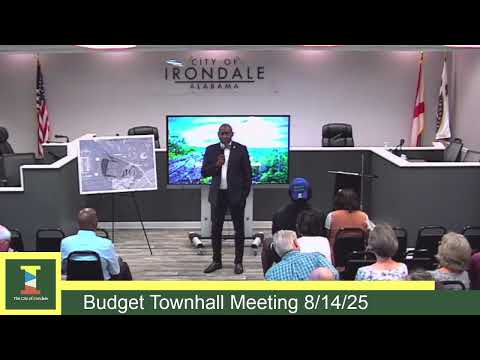
Irondale mayor defends city finances, cites $100 million in bonds and announces retail deal progress
Summary
At a July budget town hall, Mayor Stewart sought to correct what he called misinformation about Irondale’s debt, said the city has strong reserves and 200 days of operating cash, and described negotiations that led to a July announcement that a large retailer chose a site in Irondale. He also reviewed major capital projects funded by bonds.
Mayor Stewart said at a July budget town-hall meeting that Irondale’s outstanding bonded debt is about $100,000,009.45 as of July 25, not the larger figures circulating on social media, and that the city holds roughly $26.5 million in combined restricted and unrestricted bank balances.
The mayor opened the event by addressing residents’ concerns about the city’s fiscal health and the sources of what he called “disinformation.” He said the city has $17 million in reserves, $15 million in the general fund, $2 million in a water reserve and the equivalent of 200 days of operating cash on hand: “If the city did not bring in $1 for the next 7 months, we would still be able to sustain our operations,” he said. He added that the city had paid $6.2 million in bond payments through July, about 16% of the annual budget.
Why it matters: The remarks were presented as an attempt to rebut public claims that Irondale is insolvent and to explain how bond borrowing funded visible capital work. Stewart tied the city’s borrowing to projects voters approved in a property-tax referendum and to the administration’s “Blueprint Irondale.” He said much of the borrowed $60 million has already been spent on capital projects and that about $33 million remains in bond funds to complete them.
Details on debt and accounting
Stewart told attendees that earlier-circulated figures — including totals he cited from the 2024 audit and social posts — can be misleading because audit numbers list long-term liabilities to maturity, which include interest, and do not reflect current callable balances. He said the city’s bonds include general-obligation debt and amounts issued through a public building authority (PBA); the PBA debt represents leased assets (for example the library) rather than standard GO debt, he said.
Stewart gave a line-item breakdown he said was on the slide deck: $59,000,025 in one category, and about $41.92 million associated with the public building authority, adding to his cited $100,000,009.45 total as of July 25. He repeated that bond call provisions mean many issues are callable before maturity and said Irondale’s bonds — issued in 2024 — have a call date around 2034.
Capital projects and assets
The mayor said major projects funded from the 2024 borrowing include Tales by the Rails, the Irondale Public Library, Ruffner Park, the fire station and the new Irondale Civic Center, and he disputed claims that the city borrowed money without producing assets. He listed specific project costs (for example, Tales by the Rails at $851,000 in his handout) and said project work and related assets should be considered alongside liabilities.
Economic development and retail negotiations
Stewart described how the city pursued a national retailer, saying the retail negotiation spanned “4 years, 9 months, 4 locations.” He said the executive group representing the retailer (identified in his remarks as Costco executives and their advisors) visited City Hall in March 2025; the city and retail team worked through site, runoff and cost issues, and Stewart said a public announcement that the retailer had selected an Irondale location was made at a special council meeting on July 29.
He described earlier candidate sites and obstacles: a lease issue at one site, a covenant and gas-station condition at another that would have required a multimillion-dollar purchase or covenant removal, and expensive site work at a final parcel that required moving significant rock and earth. Stewart said the city and partners negotiated value engineering, drainage solutions and right-of-way work with county staff to reduce costs.
Water, environment and other items
On water quality, Stewart said the city had temporarily mitigated elevated PFAS and that water testing now showed non-detect results for the measures he referenced; he said the city has pursued litigation and is drilling for a new well and that crews had reached about 280 feet and expected to drill deeper. He noted the city obtained a $5.3 million award referenced in the meeting and said permanent remediation estimates discussed by consultants had been about $24 million.
Transparency and public records
Stewart encouraged residents to review the city budget, monthly financials and bank statements online and said council members receive monthly financial reports and bank statements. He said Irondale uses ClearGov (a financial transparency platform) and that official bond documents and offering statements are publicly available for residents who want maturity schedules or full bond terms.
Public remarks and tone
Stewart used a mix of humor and blunt language during the roughly 90-minute town hall. He distributed a mock “invoice” to illustrate per-capita debt calculations — a point he said was mathematically accurate on a per-person basis but misleading when presented without context about assets, call provisions and reserves. He invited residents to follow-up office hours and a separate lunch-and-learn session on municipal finances.
What the mayor did not decide at the town hall
The meeting was informational; there were no formal council votes, motions or policy decisions recorded at the town hall. Stewart said bid openings for the municipal complex were scheduled (bids to be opened in mid-September) and outlined upcoming ribbon cuttings, groundbreaking events and community programs but did not present new legislation or ordinance language during the session.
Ending
Stewart closed by urging civic engagement and reminding residents where they can find audit and bond documents, and he invited questions during a brief Q&A. He framed the session as an effort to correct misinformation, explain the city’s capital spending and describe the steps the city is taking on water, infrastructure and economic development.