Get Full Government Meeting Transcripts, Videos, & Alerts Forever!
Get email alerts on the Land And Economic Development topic
No spam. Unsubscribe anytime.
Tulsa councilor warns Greenwood Legacy CDC selections lacked community input; Beyond Apology Commission adds its name to letter of concern
Summary
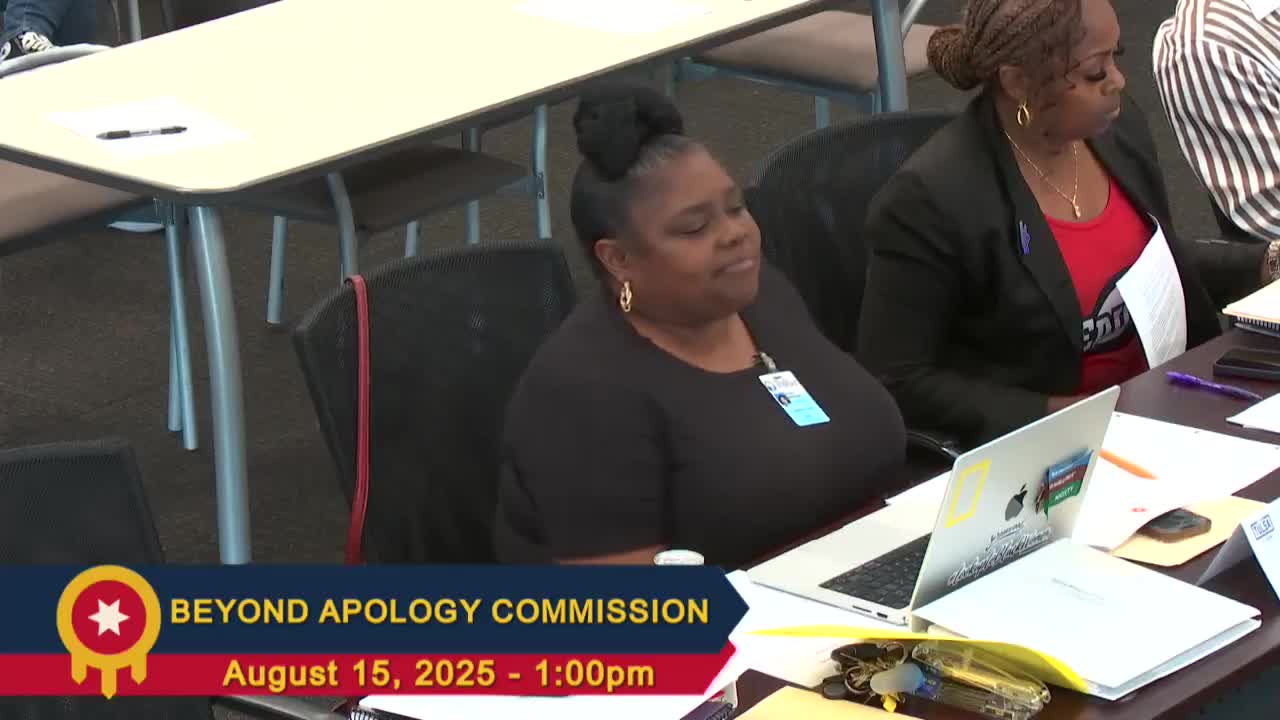
Councilor Hall Harper told the Beyond Apology Commission that the Greenwood Legacy Community Development Corporation board was formed without meaningful community input, urged the land be placed in the mayor's private trust instead, and secured the commission's vote to add its name to a public letter raising concerns.
Councilor Hall Harper, the City Council representative for District 1, told the Beyond Apology Commission on Aug. 15 that she believes the Greenwood Legacy Community Development Corporation's board was formed without adequate transparency or community input and warned the group that the CDC could "serve only as a false front and an extension of local government." She asked the commission to back a public letter urging alternative stewardship of the land.
Harper said the land in question includes 56 acres returned to the Tulsa Development Authority after the closure of the University Center at Tulsa (UCAT) and that the Kirkpatrick Heights master plan called for community-led stewardship of that property. "Partner Tulsa decided that not only we're gonna select 5 [board members] outside of the community's knowledge or input, the city councilor can't be on the board," Harper told the commission, adding she had been unable to verify that decision was voted on by any advisory committee.
Why it matters: Harper said the selection of a majority of the CDC's nine-member board behind closed doors reproduces patterns that have historically disadvantaged Greenwood and North Tulsa. She urged that the 56 acres be placed into the private "road to repair" trust the mayor has been organizing rather than into the CDC. Harper said she had sought to address concerns privately for more than a year and a half before going public.
Meeting discussion and evidence: Harper described the process that led to the Greenwood Legacy CDC, saying five board members were chosen "behind closed doors," that advisory committee members were told they could not serve on the CDC board (a claim Harper said advisory members later contested), and that Partner Tulsa, the nonprofit the city contracts for economic development, had directed selections. She read excerpts of letters from state and local stakeholders included in a packet she circulated to the commission, including a letter from state Representative Ron Stewart and statements from Greg Robinson, the facilitator who led earlier Kirkpatrick Heights planning work.
Multiple commissioners and community guests spoke in support of Harper's call for transparency. Commissioner comments noted concerns about community legitimacy for board members, the risk of replicating past urban renewal harms, and the need to mobilize residents to attend upcoming Tulsa Development Authority (TDA) meetings. Vernon AME Church leaders and other local pastors in the room described the land as adjacent to long-standing neighborhood institutions and supported Harper's demand for community-led control.
Formal action: Commission Chair Vanessa (recorded in the meeting as the commission chair) asked for a motion to add Beyond Apology as a signatory to Harper's public letter "sounding the alarm." A motion was made and seconded; the commission voted in favor. No mover or seconder was recorded in the public transcript. The motion passed with an "Aye" vote on the record.
What was not decided: Harper asked whether the commission or the public could force removal or replacement of the five CDC board members; city staff and deputies present said those appointments and any TDA vote are separate processes and that the commission's immediate action was to add its organizational support to the letter. Harper also said she prefers the land be held in the private trust the mayor is assembling, which she described as more protective of long-term control than a CDC model.
Additional context offered in the meeting: Harper contrasted CDC and trust models, arguing that trusts are better suited for preserving land for descendants because trusts emphasize preservation while CDCs are more easily changed, can buy and sell property, and are therefore more vulnerable to shifts in control. She recounted work on the Kirkpatrick Heights master plan and said community members had expected a community-led institution to manage the master plan outcomes.
Commission next steps: The commission approved adding its name to the letter and discussed monitoring TDA and related agendas (TDA agendas are posted the Tuesday before the fourth-Thursday meeting). Commissioners pledged to alert their networks and attend TDA meetings to register community opposition or oversight comments. Harper said she would continue to pursue the issue at TDA and with the mayor's office.
Ending: Harper closed by urging community members and organizations to watch TDA meeting agendas and to show up, saying, "When a community can come together, we can stop this." The commission then moved to other agenda items.