Get Full Government Meeting Transcripts, Videos, & Alerts Forever!
Get email alerts on the Education Budget topic
No spam. Unsubscribe anytime.
Guam Department of Education warns FY26 ceiling risks layoffs, program cuts
Summary
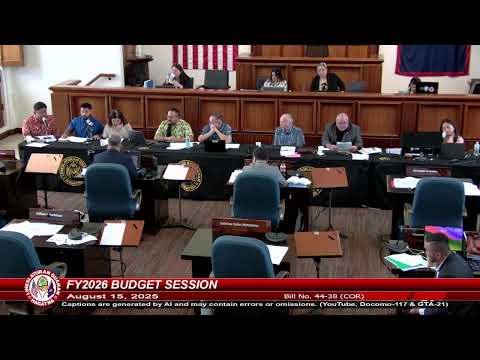
The Guam Department of Education told the Guam Legislature’s Committee of the Whole on Aug. 8 that a proposed FY26 budget ceiling would force staff cuts, reduced services and larger class sizes unless additional funding is restored or other corrections are made.
The Guam Department of Education told the Guam Legislature’s Committee of the Whole on Aug. 8 that a proposed FY26 budget ceiling would force staff cuts, reduced services and larger class sizes unless additional funding is restored or other corrections are made.
Superintendent Eric Swanson told senators the department’s “needs‑based” request totaled about $317.4 million, the department formally submitted $306 million to the executive branch, and the budget ceiling under consideration by the legislature is approximately $266 million. “Passing the budget as is will be disastrous for the department and Guam as a whole,” Swanson said.
The department provided a detailed list of program and operating items that would be reduced under the lower ceiling. The superintendent and his finance team said those cuts would affect teacher and support‑staff hiring, substitute coverage, special‑education case management, IT equipment, utilities, and school maintenance.
Why it matters: GDOE officials said the proposed ceiling would require about $50.9 million in general‑fund reductions from their submitted needs, with only roughly $29.6 million identified in specific cuts; that leaves roughly $20 million to be found elsewhere, which the department says would almost certainly mean layoffs or school closures.
What officials said: Swanson and his finance staff listed potential reductions that together total about $29.6 million in program cuts, and separately explained mandatory increases that raise actual needs to $317.4 million. Chief of Finance Wade Paul and budget officer Jordan Bukakowska delivered line‑by‑line figures during the hearing. Among the items identified by GDOE as at risk or needing correction were:
- Restoring the school lunch reimbursement fund to $12.5 million ($7.7 million increase identified by GDOE); - $7.7 million to expand substitute coverage (GDOE said it currently funds one substitute per school and sought funding to reach four per school); - $3.2 million for network‑switch replacements (GDOE says existing switches were installed in 2012 and are past expected lifespans); - $3.4 million for utility costs at proposed levels; - $359,000 for a case management system for special‑education and other students with disabilities; - Other line items shown in the department schedule F, including custodial, pest control, and food‑service contract corrections.
GDOE also reported it is tracking roughly 54 teacher vacancies that it has not yet filled, plus multiple administrative vacancies. The department said it is currently reporting an enrollment of about 23,500 students (excluding charter schools) and estimated per‑pupil local appropriation at roughly $1,100 based on the $266 million figure.
Lapses and procurement: Department officials estimated they may lapse between $11 million and $15 million this fiscal year because some appropriated projects and contracts have not been executed (for example, a protested food‑services commodities contract and other procurement delays). Senators pressed GDOE on lapsing funds and on a separate category described in testimony as “intentional” lapse accumulation — specifically a limited‑gaming sports‑facility fund that GDOE said had accumulated about $2.4 million because it had not been spent since 2012. Several senators said the limited‑gaming fund is intended for equipment and smaller sports needs and urged GDOE to distribute funds for those purposes rather than allowing the balance to sit unused.
Vacancies and staffing: Senate questions focused on whether the shortfall reflected a cash problem or an internal prioritization and procurement problem. GDOE officials said some lapses reflect the department’s limited procurement capacity — currently a small procurement office with one buyer supervisor and a small number of certified buyer‑2 staff — and contested procurements that delayed spending. The department also said some lapses were deliberate (for example, preserving a small fund to aggregate toward larger capital needs), while many lapses reflected difficulty converting appropriations into executed contracts and purchase orders.
Maintenance, capital and ARP reimbursements: GDOE said it has expanded facilities and maintenance staffing and now employs roughly 90 maintenance staff, up from a much smaller number last year, and is using ARP reimbursement cycles to pay several renovation invoices. Nick Cruz, GDOE capital improvement lead, reported restroom renovations, roof work and other projects are underway and that recent U.S. Department of Education actions have cleared some ARP reimbursements. GDOE said it expects ARP reimbursements to catch up over several cycles and that some vendors remained unpaid during parts of the pause, which delayed work.
Legislative reaction and next steps: Senators repeatedly asked for documentation and for the administration’s fiscal offices to explain differences between the executive budget report (EBR) ceiling and the committee’s ceiling. Committee leadership said staff from the Bureau of Budget and Management Research (BBMR) and the Office of Finance and Budget (OFB) would appear later to explain the roughly $10 million gulf between numbers. Several senators said they planned amendments to restore funding, while others criticized GDOE’s management and urged the department to resolve internal procurement and prioritization issues.
What GDOE asked for: Superintendent Swanson said the department’s needs‑based request reflects statutory requirements, contractual obligations (collective bargaining) and anticipated cost increases such as a higher contribution rate to the government retirement fund. The department asked the legislature to consider restoring specific items and to allow reconciliation with the administration’s fiscal team so that the final appropriation could support operations and required services.
Evidence and documentation: Senators requested copies of the spreadsheet and the testimony documents GDOE referenced during the hearing. Committee leadership said amendments must be submitted in writing before the panels are excused; the chair indicated BBMR and OFB would be invited to the afternoon session to address discrepancies.
Outlook: The hearing ended with the committee planning to continue questioning and to receive BBMR and OFB later in the day. No formal votes were recorded during the transcript excerpt of the hearing.
Ending note: GDOE officials emphasized the combination of required contractual obligations and delayed procurements as drivers of the current financing stress, while senators emphasized accountability and documentation. Both sides signaled follow‑up work — additional data from GDOE and a BBMR/OFB briefing — before the legislature finalizes FY26 ceilings.