Imperial County declares economic emergency after Spreckels sugar plant closure
Loading...
Summary
The Imperial County Board of Supervisors adopted a resolution declaring a state of economic emergency after the Spreckels sugar plant in Brawley announced it will cease processing, citing job losses, large local economic impacts and a request for state and federal aid and a California sugar allocation.
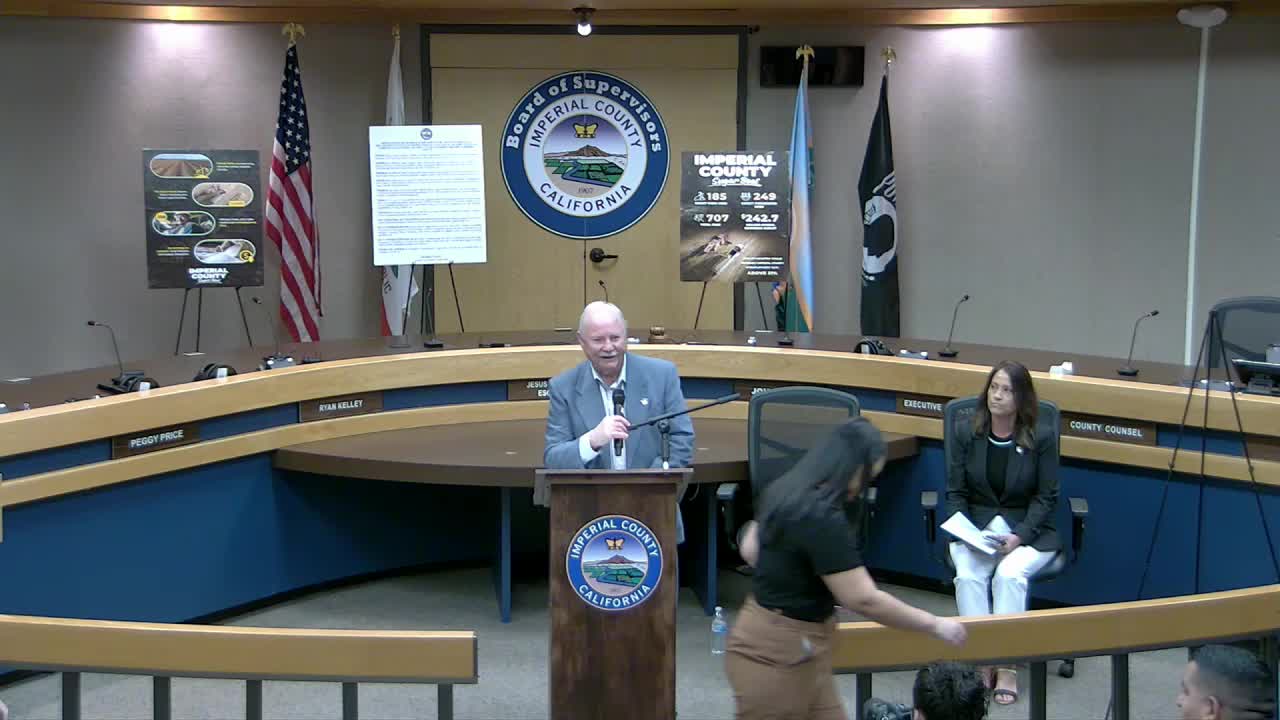
The Imperial County Board of Supervisors on a recorded roll-call vote in September 2025 declared a state of economic emergency after the Spreckels Sugar Company processing plant announced it will close at the end of the processing year, a move county officials said will cost hundreds of jobs and tens of millions of dollars in annual economic activity.
The declaration directs county staff to coordinate with federal and state agencies, workforce partners and industry stakeholders to seek emergency resources and to urge the state of California and the U.S. Department of Agriculture to provide direct support, including consideration of a California-specific sugar allocation (tariff-rate quota) and other measures to stabilize Imperial Valley’s sugar beet industry.
County officials and grower representatives told the board the plant’s closure will ripple across growers, trucking companies, farm labor and local businesses that support the regional agricultural economy. An economic analysis presented to the board estimated a loss of more than 430 direct jobs and over 700 total jobs when related farming, irrigation, trucking and processing are included, $35 million in lost local wages annually and roughly $242 million in annual regional economic activity tied to sugar beet production and processing.
A county resolution read into the record described the Spreckels plant as a longstanding local processing facility and said the closure would "severely impact Imperial Valley sugar beet farming sector," which the resolution says has averaged over 23,000 acres of production and contributed about $57,210,000 in annual crop value. The resolution text also lists an approximate elimination of $16,700,000 in annual payroll tied to the plant and a reduction in property tax revenue (the resolution cites approximately $549,000 annually, of which $127,000 directly supports county services). The resolution as adopted states the board "declares a state of economic emergency resulting from the closure of the Spreckels Sugar Company plant." The resolution text in the record gives its adoption date only as "September 2025" and does not specify the calendar day.
Representatives of state and federal lawmakers, farm organizations and unions addressed the board. Guillermo Hernandez, district representative for Senator Steve Padilla, said the senator "made his support clear" by sending an early letter to the Southern Minnesota Beet Sugar Cooperative and the Sugar Beet Growers Association and pledged continued assistance. Tommy Lawton, field representative for Senator Adam Schiff, said the senator and his staff "stand ready to support Imperial families and businesses" and had been in contact with federal agencies. Staff from Congressman Ruiz’s office described efforts to push for extended negotiations, explore USDA options and organize a job and resource fair to connect affected workers with training and services.
Local agriculture and labor speakers described the human and community impacts. Javier Nunez, introduced as a third-generation laborer, said: "Now with the closure of the Spreckels Sugar plant in Brawley, the way of life is disappearing. Hundreds of jobs are gone." Jason Taylor, introduced as a fourth-generation sugar beet grower, asked trustees to "exhaust all options" to keep processing and work for a solution that preserves local jobs. Alex Cardenas, speaking for the Imperial Irrigation District on behalf of its general manager and board leadership, urged pursuing a California sugar quota and exploring public-private partnerships, saying Imperial Valley yields unusually high per-acre sugar beet production.
The board resolution lists specific directions to staff: continue coordination with federal and state agencies, local jurisdictions, workforce development partners and industry stakeholders to seek emergency resources; urge the state of California and the USDA to recognize the urgent impacts; and request assistance to stabilize the local agricultural economy and workforce. The resolution text was adopted "by affirmative roll call vote"; the roll-call in the record records "Yes" for Districts 1, 2, 3 and 5. The resolution text does not identify District 4’s vote in the portion of the transcript provided.
County leaders and industry representatives also called on Congress to consider changes to trade and allocation rules for sugar (referred to in the meeting as the tariff-rate quota) so that more domestically produced sugar could be processed locally in California. Several speakers asked federal and state partners for emergency resources, targeted investments and policy flexibility to attract a new processor or cooperative buyer and to help affected workers access unemployment benefits, job training and social services.
The meeting concluded with board members and speakers offering to meet with interested parties and with a group photo; the county said staff would continue coordination with federal, state and local partners on recovery and response efforts. The board instructed staff to return with follow-up and to pursue potential avenues for stabilizing the sugar beet supply chain, including outreach to potential processors and discussion of a California allocation for sugar processing.