Get Full Government Meeting Transcripts, Videos, & Alerts Forever!
Get email alerts on the Housing Displacement topic
No spam. Unsubscribe anytime.
Austin Housing presents updated displacement-risk maps; commission urges reopening of ADCAP to return anti-displacement funding to neighborhoods
Summary
Austin Housing presented updated displacement-risk maps on Sept. 9 that show an expanded footprint of tracts identified as vulnerable or at risk, and the Community Development Commission voted to advise reopening the Anti-Displacement Community Acquisition Program at the start of fiscal 2026.
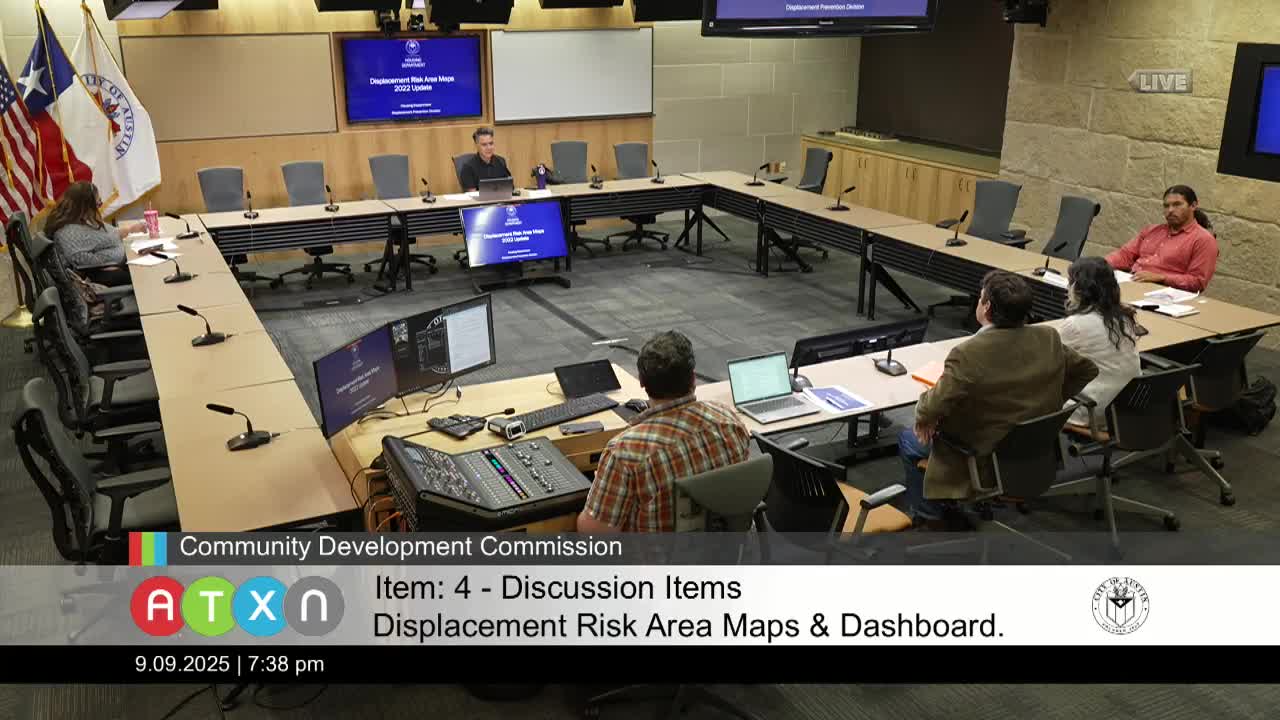
Austin Housing officials presented an updated displacement-risk analysis to the Community Development Commission on Sept. 9 that expands the number of census tracts flagged as vulnerable, actively displacing or chronically displaced, and described an "early warning system" under development to make the analysis more predictive.
Marla Dorado, division manager for the displacement-prevention division, introduced the presentation. Senior planner Will Swinton Ginsberg explained the analysis'which the presenters said derives from the 2018 Uprooted study and was updated using five-year American Community Survey (ACS) data covering 2018'2022'and the data release published in 2024. Ginsberg summarized how the methodology combines demographic vulnerability indicators (percent nonwhite, children in poverty, share without a bachelor's degree, renter share and share below 80% of area median family income) with housing-market trends (median home value, median rent) to place tracts into categories: vulnerable, active displacement, chronic displacement and a separate "historic displacement" category for tracts that have already experienced substantial demographic change.
Ginsberg said the 2022 update shows substantial expansion of displacement-risk tracts, especially on the outskirts of the city, and attribute drivers include rising home values and rents, a shift to a more highly educated population and a post-pandemic increase in children living in poverty. Dorado described next steps that include integrating an early-warning system under development with the University of Texas to combine additional property-level and administrative datasets to identify places at immediate risk and to inform targeted outreach.
During discussion commissioners raised methodological and policy questions. Several commissioners asked about the income threshold used in the analysis; staff said the tract-level threshold for the low-income variable is below 80% of median family income as calculated in the ACS dataset used for this analysis, and staff noted the ACS-derived MFI differs from HUD-calculated MFIs used in many housing programs. Commissioners asked for a list of "historic displacement" tracts and for the staff to provide the data link and dashboard; staff said the dashboard is publicly available and offered to provide links and follow-up materials.
The commission then considered a formal recommendation concerning the Anti-Displacement Community Acquisition Program (ADCAP), a Project Connect anti-displacement program that the presentation said had an $8 million allocation and had been paused by the housing director in October 2024 for review. The commission adopted a recommendation that "the Community Development Commission advises the Austin City Council to adopt the proposed short-term recommendation to improve the program" and specifically advised housing staff to reopen ADCAP applications to coincide with the beginning of fiscal 2026. Commissioners also successfully amended the recommendation on the floor to add a summary of ADCAP impact to date: that approximately $3.6 million of the $8 million had been utilized to acquire properties and that the program had impacted roughly 20-plus units (multifamily and single-family) in its award period.
The motion passed on a voice vote recorded during the meeting; the transcript does not record a roll-call tally. Commissioners directed staff to forward the recommendation and to provide follow-up materials and links to the displacement-risk dashboard and the underlying analysis.
Ending: Housing staff said they will continue updating the displacement risk analysis on a roughly two-year cycle, will share dashboard links and are working with UT on an early-warning system intended to support more responsive outreach and targeting of anti-displacement resources.