Get Full Government Meeting Transcripts, Videos, & Alerts Forever!
Get email alerts on the Detox Services topic
No spam. Unsubscribe anytime.
Pitkin County withdrawal management program reports 140 admits in 2023, seeks expansion to add longer treatment
Summary
A local four‑bed withdrawal management program described clinical procedures, partnerships with telehealth providers and community follow-up, and said funding and residency rules limit who it can serve. Program leaders told the Pitkin County Board of Health they are pursuing grants to expand to a longer treatment model.
Janelle, a withdrawal‑management program representative, told the Pitkin County Board of Health on April 11 that the county’s licensed detox program admitted about 140 people in 2023 and is seeking funding and space to expand from a short‑term detox service into a longer stay treatment facility.
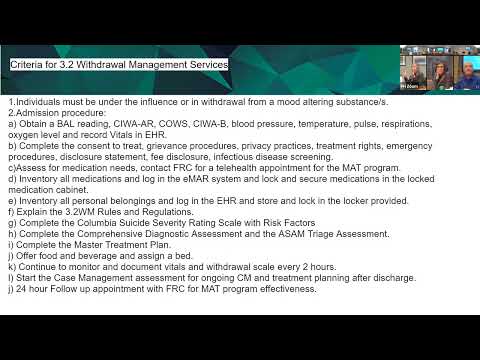
The program operates in a four‑bed unit inside the county Health and Human Services building, Janelle said. Admissions are clinical: clients complete vitals, consent and grievance paperwork, infectious disease screening and a master treatment plan at intake. Staff use a breathalyzer and an on‑site rapid urine panel (15‑ or 18‑panel) to identify substances, she said. ‘‘When we admit someone, if we can admit that person between the hours of 08:30 and 4, Monday through Saturday, Front Range Clinic does a telehealth psychiatric evaluation and prescribes medications as appropriate,’’ Janelle said.
Why it matters: the program is one of only a few local options for people in acute withdrawal and aims to keep clients out of the emergency department while linking them to continuing care.
Program capacity and referrals The facility has four licensed beds (two rooms for men, two for women), and Janelle said staff admitted roughly 140 people during 2023 — below the projected 180 capacity, in part because some people decline admission. She gave monthly average length‑of‑stay figures that ranged widely (example months she cited: January 35 hours; February 14 hours; September 46 hours; November 74 hours), noting lengthy stays often occur when clients wait for an open treatment bed elsewhere.
Referrals come from Aspen Valley Hospital, local law enforcement (Pitkin County Sheriff, Aspen and Basalt police) and self‑referral. Janelle said the program’s funders limit routine out‑of‑county admissions; the program accepts out‑of‑county clients who arrive via hospital transfer or law enforcement but otherwise refers out‑of‑county callers to locations such as the program’s Frisco site or other regional facilities.
Clinical staff, partnerships and aftercare Janelle said staff credentials include QMA training (qualified medication administration), certified addiction technicians and certified addiction specialists; the program also employs case managers and CNAs. The program partners with Front Range Clinic (now referenced as Porchlight in Janelle’s presentation) for telehealth medical evaluations and medication management; Aspen Valley Hospital is used for higher‑acuity medical care.
Discharge planning includes case management, transportation arrangements where needed, release of information agreements with receiving treatment centers and follow‑up contacts at 24 hours, 30, 60 and 90 days and up to a year. Janelle reported outcomes for discharges in 2023: about 27% connected to residential treatment, 42% to outpatient services including IOP (intensive outpatient), MAT (medication‑assisted treatment) and case management; about 10% engaged with 12‑step programs and community services such as Discovery Cafe; roughly 19.5% refused engagement. ‘‘If you take these numbers, we’re about at 80% of clients engaged in treatment after they discharge out of our care,’’ Janelle said.
Client profile and substances Janelle provided a demographic breakdown for 2023: 28 women and 113 men admitted; by age 26 were 18–29, 37 were 30–40, 65 were 41–65 and 13 were 66–85. Reported race/ethnicity numbers in her slides were: 1 Asian, 2 Black or African American, 9 Hispanic/Latino and 129 listed as white. Alcohol accounted for the largest share of admissions; fentanyl and other opioids were present but numerically smaller in last year’s admits, she said.
Licensing, funding and plans to expand Janelle said the program is licensed at a 3.2 withdrawal‑management level of care and is a Medicaid provider. Current funders named were Aspen Valley Hospital, the town of Snowmass, the town of Basalt, the city of Aspen and Pitkin County; that funding structure imposes residency‑related limits on routine admissions. The presenter said the organization is exploring a grant application, with county support, to expand a site that could operate at a 3.1 level — a combined detox and 30‑day treatment model that would accept Medicaid and offer a longer continuum of care.
Board members asked operational questions during the presentation: Dr. Kurt asked how the program manages severe alcohol withdrawal (delirium tremens) and whether benzodiazepines such as lorazepam (Ativan) are used; Janelle said Aspen Valley Hospital prescribes Ativan when clinically necessary and telehealth providers determine medication pathways for clients seen by Front Range Clinic. John Doyle asked why the 41–65 age group comprised the largest cohort; Janelle answered that the service historically sees more middle‑aged white men outside of festival spikes.
Next steps Janelle told the board she is collecting data and working with county staff on potential grant applications and space identification. She said a 9‑bed Mind Springs Health facility is planned in Glenwood Springs that could ease regional capacity pressure, and the organization is exploring licensing and fire‑safety requirements for an expanded treatment campus.
Ending: At the end of her presentation board members thanked Janelle for the detail and engagement; she left her contact information for follow up and agreed to share slides and additional data on referral patterns and outcomes.