Get Full Government Meeting Transcripts, Videos, & Alerts Forever!
Get email alerts on the Municipal Budgeting topic
No spam. Unsubscribe anytime.
Brooksville council adopts FY2026 budget, sets millage at 6.5 mills after split votes
Summary
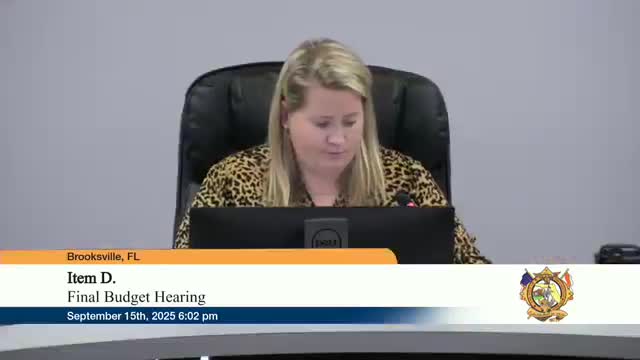
The City Council of Brooksville voted during a special public budget hearing to set the tentative FY2026 ad valorem millage at 6.5 mills and to adopt the fiscal year 2026 budget, actions the council said are intended to rebuild reserves and establish a capital improvement plan.
The City Council of Brooksville voted during a special public budget hearing to set the tentative FY2026 ad valorem millage at 6.5 mills and to adopt the fiscal year 2026 budget, actions the council said are intended to rebuild reserves and establish a capital improvement plan.
City Clerk: The proposed maximum millage was advertised at 6.5 mills, a 13.23% increase over the current rollback rate of 5.7407 mills. The clerk said a 6.5-mill rate produces a budget balanced for the year beginning Oct. 1, 2025. City Manager: The city manager told the council the 6.5-mill rate would allow estimated reserves of about $2,600,000 and roughly $480,000 for a capital improvement program (CIP); by contrast a 6.2-mill rate would leave roughly $2,400,000 in reserves and about $290,000 for CIP. Staff reductions and revenue or fee changes noted in the budget package included roughly $1,500,000 in department budget cuts, a fire assessment estimated at $2,200,000, and an estimated $299,000 reduction in the sheriff’s office contract for FY25–26.
Why it mattered: Council members who supported the increase said the city has drawn on reserves in recent years, lacks a funded capital improvement plan and must restore a stable funding base rather than rely on temporary federal funds such as ARPA. Mayor Tanner said, "This increase is necessary for 2 critical reasons. 1, rebuilding our reserves... And number 2, something this city does not have at this time... We have 0 in the bank for capital improvement funds." Supporters argued the modest increase will allow the city to invest in roads, drainage, parks and fire-department needs.
Public comment and debate: Dozens of residents addressed the council during the public-input period. Chris Kingsley opposed the proposed increase, arguing it would disproportionately affect low-income and elderly residents and urging consolidation of the city fire department with the county: "What about low income residents for these taxes you're proposing? They're gonna be hit the hardest and possibly with the worst consequences. You'll be making them decide between food, medicine, taxes." Several other speakers outside and inside the city echoed concerns about taxes and suggested consolidation or other cost-saving measures. By contrast, resident Lee Johnson — who identified himself as a Brooksville volunteer board member for Brooksville Main Street — said Brooksville has historically run at low millage rates and supported the proposed change, saying the city needs to invest to maintain services and infrastructure. Bob Morgan and others suggested cutting or reducing city support to Brooksville Main Street and exploring fire-department consolidation with the county. Dawn Tricone, executive director of Brooksville Main Street, responded that volunteers do not receive $25 per hour payments and described Main Street as a public–private partnership that uses grants and sponsors.
Council action and outcomes: After discussion the council voted on motions to set the millage and adopt the budget. The council initially recorded a 3–2 vote in favor of levying 6.5 mills; following legal counsel and a request for a revote to ensure compliance with state TRIM thresholds the council retook the vote and the millage was adopted by a 4–1 roll call. The council then took second and final reading of Ordinance No. 1003 to appropriate funds for FY2026 and approved the budget with specific line-item adjustments: the council moved and approved relocating travel/per diem, training/education, and books/publications into the general-government section with new caps (travel/per diem set at $10,000; training and education set at $55,000; books/publications set at $7,000). The ordinance passed on final reading by a 4–1 roll-call vote.
Votes at a glance: - Motion to levy the general fund ad valorem millage rate at 6.5 mills — adopted after revote (final recorded roll call: Hallow Aye; McKeithen Aye; Earhart Nay; Vice Mayor Bronson Aye; Mayor Tanner Aye) — outcome: approved. - Ordinance No. 1003 (FY2026 budget appropriation, second and final reading) — motion to adopt budget with adjustments to travel/per diem/training/books moved and approved (roll call: McKeithen Aye; Earhart Nay; Hallow Aye; Vice Mayor Bronson Aye; Mayor Tanner Aye) — outcome: adopted. - CRA: Resolution 2025-01 (CRA original area budget FY2026) and Resolution 2025-02 (CRA expanded area budget FY2026) — each approved by CRA board vote (unanimous Aye recorded) and adopted as presented.
Clarifying numbers and program details recorded during the hearing: estimated reserves at 6.5 mills ~$2,600,000; at 6.2 mills ~$2,400,000; CIP allocation at 6.5 ~$480,000 vs ~$290,000 at 6.2; approximately $1,500,000 in department budget cuts applied; estimated fire assessment revenue $2,200,000; estimated sheriff's contract reduction $299,000. Travel/per diem current total cited at roughly $21,000 (reduced to $10,000); training and education cited at roughly $91,000 (reduced to $55,000); books and publications about $15,000 (reduced to $7,000).
What’s next: The adopted FY2026 budget and millage are effective for the fiscal year beginning Oct. 1, 2025. Council members who voted for the increase said they intend to review spending and pursue ways to reduce the rate in future budgets; opponents urged more cuts instead of a tax increase. The council adjourned the special budget hearing and reconvened for a scheduled regular meeting and for Community Redevelopment Agency business following the vote.