
Lake Havasu Unified School District board adopts student wireless-device procedure, waiving second reading
Get AI-powered insights, summaries, and transcripts
Subscribe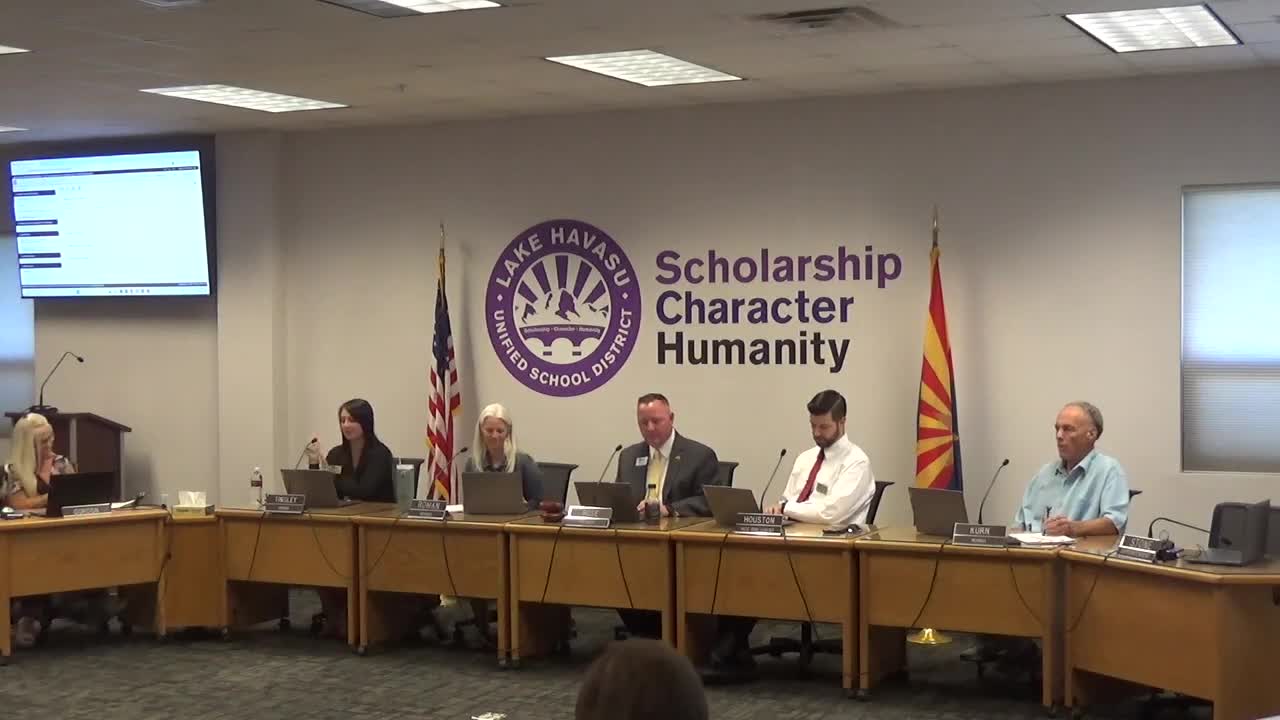
Summary
The Lake Havasu Unified School District Governing Board voted to waive a second reading and approve a proposed procedure restricting student use of cell phones and wireless devices during the school day, with allowances for grade-level differences and documented medical needs.
The Lake Havasu Unified School District Governing Board on July 31 voted to waive a second reading and approve a proposed procedure that restricts student use of cellular telephones and other wireless communication devices during the school day.
During the Item 3.2 presentation, Dr. Stone, representing student services, told the board that the approved district policy references Arizona Revised Statutes 15-128.05 and states "a student shall not use a cellular telephone or other electronic wireless communication device during the school day, including meals, passing periods, and recess, except as expressly permitted by the district." Dr. Stone said the proposed procedure (5-305b) details how the district will implement that authority and was posted for public review.
The procedure maintains a developmentally differentiated approach: students in kindergarten through eighth grade are required to keep phones powered off or silenced and stored out of sight in backpacks for the entire school day unless staff give express permission; ninth through twelfth grade students receive more leniency and may use devices during lunch and passing periods as long as use does not disrupt the learning environment. The presentation noted documented medical needs and Individualized Education Program accommodations will permit exceptions where required and that contacts with parents or legal guardians are allowed for emergencies. The procedure cross-references the student code of conduct for specified consequences.
Board members and administrators described enforcement practices and consequences now used in schools. Mr. Becker said the procedures reflect current practice and that staff would begin the year enforcing the rules. He said, "I absolutely am. That's what we do." A board member concerned about aligning with the statute said the law "felt like the state law was meant to curtail student cell phone use a lot more than our procedure is going to allow," but also noted practical concerns about diverting instructional time to enforcement; that board member said they planned to vote for approval despite reservations.
Administrators outlined typical consequences: at the middle school level, first violations lead to a lunchtime detention where students eat in the library and lose social time; repeated violations escalate to in-school suspension. At the high school level the district increased the first-offense detention from four to six hours, and noncompliance can make a student ineligible for athletic practices or school events; subsequent violations may lead to ISS or suspension and possible referral to a hearing officer. The district said these consequences are established in the student code of conduct, which is referenced by the procedure rather than fully reproduced in the procedure text.
A motion to waive the second reading and approve the procedure passed on a roll-call vote with affirmative responses from Michael Kern, Evelyn Tinsley, Lisa Romand, Matthew Houston and David Groves.