Get Full Government Meeting Transcripts, Videos, & Alerts Forever!
Get email alerts on the Municipal Finance Revenue Measures topic
No spam. Unsubscribe anytime.
San Mateo council studies sales tax, parcel tax and bond options to close budget gap
Summary
San Mateo City Council members on Monday studied a slate of revenue enhancement options intended to reduce a multi‑million‑dollar general fund shortfall and to help fund long‑deferred capital projects.
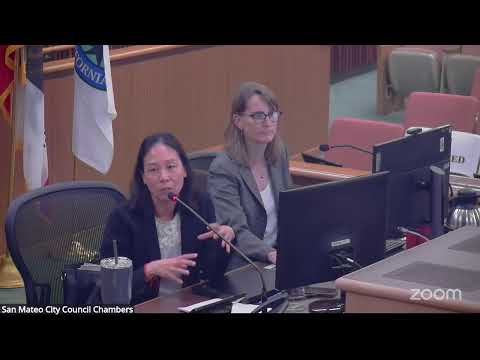
San Mateo City Council members on Monday studied a slate of revenue enhancement options intended to reduce a multi‑million-dollar general fund shortfall and to help fund long‑deferred capital projects. Deputy Finance Director Abby Vesser led the study session and presented estimates for a quarter‑cent transactions‑and‑use tax, parcel taxes, a utility users tax, benefit assessments and general obligation bonds.
Vesser said the city adopted a FY 2025–26 budget in June that included an $11.9 million deficit, and that the shortfall has since widened to about $13.9 million after the state’s vehicle license fee (VLF) backfill came in at roughly 68–70 percent of expectations. “So when we really look at what our historic budget deficits have been and where we think it’s going, it’s usually going to be between $5 million and $7 million,” Vesser said, and staff is “looking for $7 million to help with our operating deficit.”
The city’s consultants and staff outlined tradeoffs for each option and recommended next steps. The ad hoc committee that met August 6 recommended that the council study a quarter‑cent sales (transactions and use) tax for 2026 and explore a general obligation bond for capital needs.
Key proposals and estimates
- Transactions-and-use tax (quarter‑cent): Staff said a one‑quarter cent increase would raise about $7 million annually and would increase San Mateo’s combined sales tax rate from roughly 9.62 percent to about 9.875 percent. Putting such a measure on the ballot requires four‑fifths council approval to submit it to voters and a simple majority at the ballot box. Vesser noted the city still has roughly a 0.25 percent capacity under the state’s local tax cap. Historical passage rates for new or increased transactions‑and‑use taxes have been relatively high in recent decades.
- Parcel tax: Consultant Wing C. Fox of Urban Futures described parcel taxes as “a tax levied on parcels of property within the city boundaries. It is not based on value of the property.” Because a parcel tax is a special tax, it requires two‑thirds voter approval. Urban Futures modeled approaches to generate $7 million or $14 million, showing examples such as a flat charge per parcel (about $242 per parcel to raise $7 million) or tiered or square‑foot approaches that shift higher shares to commercial/industrial parcels.
- Utility Users Tax (UUT): Staff modeled a UUT that would tax consumption of utilities (electricity, gas, telecommunications and cable). A measure with a scope similar to larger nearby cities was estimated to generate roughly $5.9–6.0 million annually. Vesser cautioned that historical passage rates for new UUTs are low and that revenues tied to services such as cable can decline over time.
- Benefit assessments/Prop 218: Staff described benefit assessments as charges on real property for specific public improvements or services and noted they typically proceed under Proposition 218 (mail ballot, weighted voting, protest process) rather than a citywide ballot measure. Because they fund specific capital or service improvements, staff said benefit assessments are not generally usable for the city’s immediate operating deficit but can fund defined capital programs (stormwater, open space, specific facility projects).
- General obligation bonds (GO bonds): Vesser explained GO bonds are ad valorem debt paid from property taxes and may be used only for capital projects, not ongoing operations. Non‑school GO bonds require two‑thirds voter approval. Staff provided examples of potential bond proceeds at different levy rates per $100,000 of assessed value, with illustrative proceeds in the range of roughly $162 million to $325 million depending on structure and rate assumptions.
Council reaction and next steps
Council members who served on the ad hoc subcommittee said they supported further study of a quarter‑cent sales tax for 2026 and exploring a GO bond for later capital needs. Council members asked staff for additional detail on downside scenarios (for example, lowest sales tax receipts during the COVID years, which staff said fell to about $5.4–$5.7 million), equity implications for different tax approaches, and how proposed measures would relate to recently adopted fees such as the stormwater fee.
Staff said next steps include polling and community outreach in September–October, returning to council with polling results at a study session in early November, and, if council elects to proceed, further steps toward placing measures on a future ballot. Staff noted the final deadline to place a measure on the November ballot will come about 88 days before the election (staff estimated the last internal decision point in July/August 2026 to allow time for community education and ballot processing).
There were no public commenters on the item and no formal council votes during the study session; the council provided direction to staff to pursue additional research and polling on the sales tax and to explore a GO bond for capital needs.