Get Full Government Meeting Transcripts, Videos, & Alerts Forever!
Get email alerts on the Historic Preservation Grant topic
No spam. Unsubscribe anytime.
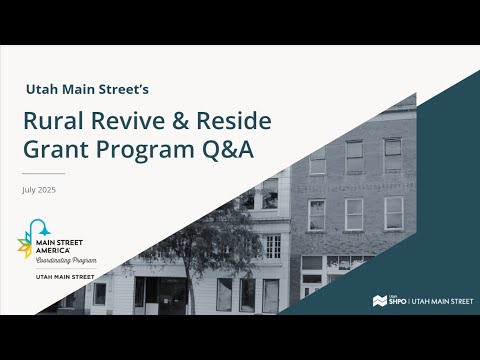
Utah Main Street opens Bridal, Revive & Reside grant window for rural historic buildings
Summary
Utah Main Street and the State Historic Preservation Office detailed the Bridal, Revive & Reside grant on July 9, 2025: applications open July 16 and close Aug. 15; awards range $25,000–$50,000, require 25% match and a five-year preservation agreement; funding is National Park Service money subject to federal oversight.
Carly Stauffer, grants administrator with Utah Main Street and the Utah State Historic Preservation Office, told a July 9 webinar that applications for the Bridal, Revive & Reside grant will open Wednesday, July 16, 2025, and close on Aug. 15, 2025, with an optional early completeness review due Aug. 1.
The grant program, funded through the National Park Service and administered by Utah Main Street in coordination with the State Historic Preservation Office, is intended to fund interior improvements that reactivate ground-floor commercial space and convert or restore upper-floor spaces to housing in eligible rural tier 2 Utah Main Street communities. "We're really looking forward to talking about it, and we think it's a great opportunity for historic buildings throughout Utah to bring some more life to them and get the interiors really contributing to their communities again," Stauffer said.
Why it matters: the program directs federal preservation funding to small Main Street districts to stimulate downtown reuse by covering interior construction costs—work that state staff say complements exterior-focused programs by targeting building interiors and residential conversions that increase downtown activity and housing supply.
What the grant covers and what it does not: Award money is limited to interior construction and rehabilitation. Eligible work focuses on ground-floor commercial fit-out (examples cited include restaurants, bakeries or theaters) and upper-floor residential conversions (long-term apartments or short-term rentals). The presenters emphasized that exterior work, new construction, furniture/fixtures/equipment, and work completed before the grant period are ineligible.
Funding, match and program size: Individual awards range from $25,000 to $50,000, with a 25% match requirement. Stauffer explained, by way of example, that a $50,000 award requires at least $12,500 in matching funds, so a full project seeking the maximum grant must total at least $62,500. The program began with $650,000 in National Park Service funds; webinar presenters said about $450,000 remained available in this second round.
Reimbursement and reporting: Awards are reimbursement-based; grantees must pay project costs up front and submit documentation for reimbursement upon completion of eligible work. Awardees will provide monthly status updates and biannual narrative and financial reports. Stauffer said all work must meet the Secretary of the Interior’s Standards for Rehabilitation and that awardees must sign a five-year preservation agreement that prevents damage to the building’s National Register character-defining features during that period.
Eligibility and application requirements: Properties must be located in a rural tier 2 Utah Main Street program district, as defined by a USDA-based rural map used by the program. Applicants may be property owners (individuals, corporations or nonprofits — corporations/nonprofits must submit a board resolution authorizing the signer) or tenants who provide the property owner’s signed consent to the scope of work. The presenters noted that applicants must supply a Unique Entity Identifier (UEI) and recommended starting the UEI/SAM.gov registration immediately because federal processing can take one to two weeks.
Application materials and technical assistance: The application packet (described as roughly 35 pages) includes a required budget template, a sample score sheet, eligibility guidance and photo requirements; Stauffer warned that submitting any other budget form will render an application ineligible. Applicants also must obtain a letter of support from their local Main Street program director. Utah Main Street staff offered consultation and, subject to availability, site visits with their preservation architect, Jansen Bennett, and directed applicants to Corey Jensen, the National Register and Survey coordinator, for questions about National Register status. Staff said the program website and the Utah Historic Buildings database (the “hub”) can show whether an address is within a Main Street program district, but cautioned the hub may be imperfect and encouraged follow-up with staff for definitive National Register determinations.
Timeline and next steps: Applications submitted during the July 16–Aug. 15 window will undergo state review followed by a National Park Service preliminary eligibility check; Stauffer said applicants should expect award notifications in summer or fall 2025. After awards, staff will conduct site visits, execute contracts, and begin construction; projects were described as varying but generally anticipated to take about one to two years to complete deliverables after contracts are finalized. The early staff review (deadline Aug. 1) is optional and intended only to check application completeness; feedback from that review was expected around Aug. 8.
Speakers encouraged prospective applicants to review the full application packet, start UEI/SAM.gov registration immediately, use the required budget template and contact Utah Main Street staff for consultation. Chelsea Gauthier, Utah Main Street program manager and statewide coordinator, said the program is intended to strengthen the statewide Main Street network: "I work with now 22 of our Utah communities, as we are, you know, really strengthening our network of Main Street revitalization across the state." The webinar then moved to a question-and-answer period.
Ending: Utah Main Street posted the application packet, the required budget template, UEI and SAM.gov instructions, and contact information on its website; presenters urged applicants to consult staff early to confirm National Register status and to ensure project proposals comply with the Secretary of the Interior’s Standards before applying.