Get Full Government Meeting Transcripts, Videos, & Alerts Forever!
Get email alerts on the Disaster Recovery Housing topic
No spam. Unsubscribe anytime.
Residents and advocates urge Houston council to boost disaster-recovery housing funding to $100 million
Summary
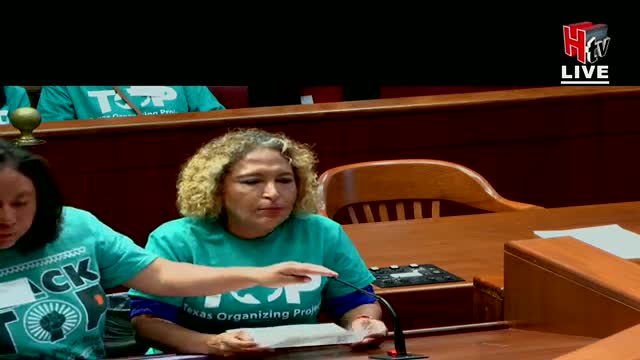
During public comment at the July 29 Houston City Council meeting, numerous residents and community groups urged the council to increase the city's allocation of federal disaster-recovery funds for home repair and housing from $50 million to $100 million and opposed diverting those funds to emergency infrastructure or other uses.
Dozens of residents and community groups urged the City Council of Houston on July 29 to increase the city's disaster-recovery housing allocation from $50,000,000 to $100,000,000, arguing current funding is insufficient to repair storm-damaged homes and prevent displacement.
Why it matters: speakers said more housing funds would help families still displaced after recent storms and prevent homelessness, while opponents warned of harms if mitigation and critical infrastructure funds are cut.
At the meeting, Patricia Morales, who identified herself as a member of TOP, said she and her son remain displaced after storm damage and directly asked the council for more housing funding: "I'm asking you to invest at least 100,000,000 in housing. We do not need more patrol cars. We need homes." Jorge Martinez, speaking for his grandmother, echoed that request and said families are living with the fear of becoming unhoused.
Neighborhood leaders and nonprofit representatives pressed the same point. Fred Woods, president of the Northwood Manor Civic Club, told the council, "We can't keep robbing Peter to pay the police or fire department or any other gaps... These funds are meant to repair damaged homes. So we must prioritize repairing damaged single family homes, especially in our most vulnerable areas of Houston." Members of the Northeast Action Collective, Pure Justice, and other community organizations urged the council to protect single-family homeowners and prioritize repairs for the most vulnerable neighborhoods.
Speakers also warned about trade-offs. Richard Payne, who spoke earlier about power-generation resilience, and others emphasized that funds for emergency backup power and mitigation are also necessary; a commenter who identified themself as Bomber Danson warned that "Redirecting funds from critical infrastructure and emergency preparedness to expand a program with a shaky track record is not just risky, it's reckless." Doris Brown of Northeast Action asked the council to both increase housing funding and secure generators for multipurpose centers.
Advocates cited unmet needs across neighborhoods including Northeast Houston, Kingwood, Huffman, the Fifth Ward and other historically underserved areas. Several speakers said FEMA assistance exhausted quickly and local recovery dollars have not reached all households. Courtney Revels, speaking from Northeast Houston, said community members who have organized recovery work "are the experts" and urged a larger, properly targeted investment so the city can "actually heal all of Houston."
Council members and staff did not announce a decision on reallocating the federal disaster recovery funds during the public-comment period. Multiple speakers asked the council to adopt amendments proposed by council members (including references to amendments by Council Member Thomas and Council Member Plummer in public comments), but the transcript shows no final vote on changing the allocation at the July 29 session.
The public discussion also included requests that funding be prioritized for single-family home repairs rather than multifamily development; speakers argued multifamily developers already have access to tax credits and other incentives and that single-family homes represent the largest share of damaged housing stock.
Ending: Community advocates requested a formal response from the council and urged staff to provide clearer timelines and spending plans for federal recovery dollars; no formal reallocation was recorded in the July 29 proceedings.