Get Full Government Meeting Transcripts, Videos, & Alerts Forever!
Get email alerts on the Palestine Recognition topic
No spam. Unsubscribe anytime.
U.K. Says It Will Move Toward Recognizing Palestinian State in September, Calls for Ceasefire and More Aid to Gaza
Summary
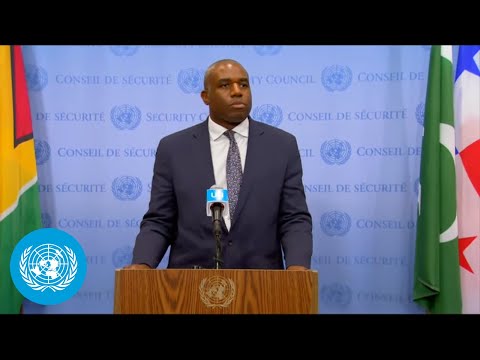
At a U.N. press briefing, the Foreign Secretary announced a U.K. pathway to recognize a Palestinian state next month, urged a ceasefire, described humanitarian steps the government has taken and cited sanctions and arms-sale limits aimed at reducing violence.
The United Kingdom is on a “pathway to recognition” of a Palestinian state in September, the Foreign Secretary said at a press briefing at the United Nations General Assembly, adding that the move aims to help secure a ceasefire and greater humanitarian access in Gaza.
The announcement followed the Foreign Secretary’s statement to the General Assembly and came as he urged the international community to act to end what he described as horrific scenes of civilian suffering. “The time has come for a ceasefire,” he said, and said it was his “sincere hope that the decision that we have taken today affects the situation on the ground.”
The Foreign Secretary described a package of U.K. actions intended to reduce suffering and influence the situation, including restoring funding to the U.N. Relief and Works Agency for Palestine Refugees (UNRWA), suspending arms sales to Israel that could be used in Gaza, and steps to sanction violent settlers and individual Israeli figures. He also emphasized steps to get humanitarian aid into Gaza and to protect aid workers and journalists.
“The United Kingdom has restored funding to UNRWA,” the Foreign Secretary said. “It was important that we took a sober decision to suspend arms sales to Israel that could be used in Gaza. And, of course, working with our partners, we've done everything possible to get the humanitarian aid into Gaza, to get those trucks in.” He added that U.K.-funded medical support has treated 24,000 Palestinians in the recent period.
When pressed by Tom Beighton of the BBC about whether the U.K. bore responsibility for the shrinking territory available to establish a viable Palestinian state, and why the government acted only after conditions such as starvation, the Foreign Secretary pointed to recent humanitarian steps and to the announcement at the General Assembly. He said the U.K. would assess conditions over the next eight weeks leading up to formal recognition.
On sanctions and other measures, the Foreign Secretary said the U.K. had already sanctioned violent settlers and specific individuals, and that those steps went further than some other countries. “We also took decisions to sanction Ben Gvir and Smotrich,” he said, adding that he and 27 foreign ministers had recently signaled willingness to take further measures to affect conditions on the ground.
The Foreign Secretary described U.K. deliveries of aid by land and air alongside partners. He said about 25 trucks — possibly up to 35 in a recent period — had been allowed in, and that the U.K. had airdropped about 20 tons of aid into northern Gaza with Jordanian partners. He said the global community is “deeply offended by children being shot and killed as they reach out for aid.”
On press access to Gaza, he said journalists must be allowed to report without “fear or favor.” He also declined to comment on private conversations between the U.K. prime minister and the U.S. president, saying only that the U.K. has a “most special of relationships” with the United States and that no country has a veto on the U.K.'s solemn decisions.
The Foreign Secretary framed the pathway to recognition as conditional on developments over the coming weeks, saying the U.K. would assess whether the decision contributed to a ceasefire, the release of hostages and a reduction in civilian suffering. He expressed hope that the steps would help produce both an immediate abatement of suffering and a diplomatic process toward lasting peace.
Reported questions at the briefing came from Tom Beighton of the BBC, an Al Jazeera reporter, and an AP reporter, among others. The Foreign Secretary closed by thanking attendees and reiterating the U.K. position that aid, protection for aid workers and independent reporting are essential.
Looking ahead, the Foreign Secretary said the U.K. intends to follow the eight-week timetable announced at the General Assembly and to assess progress on ceasefire, hostage releases and humanitarian access before formally completing recognition.