Get Full Government Meeting Transcripts, Videos, & Alerts Forever!
Get email alerts on the Public Comment Safety Equity topic
No spam. Unsubscribe anytime.
Riders and local officials tell CapMetro board they face safety, equity and service gaps
Summary
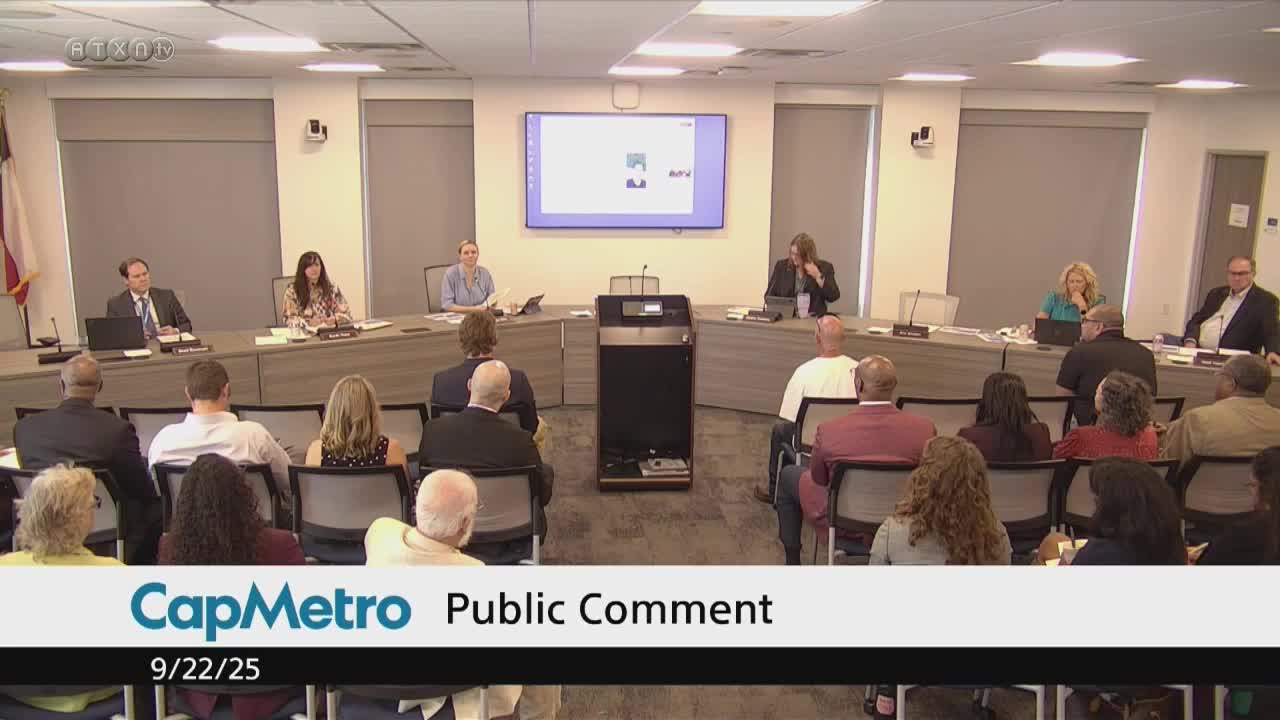
Public commenters at the Sept. 22 CapMetro board meeting described harassment and safety concerns on buses, urged equity in service coverage and opposed certain interlocal agreements; Lago Vista’s mayor asked the board to approve expanded pickup service.
Multiple members of the public used the Sept. 22 board meeting’s public‑comment period to raise safety concerns, to ask for service restorations in Northeast Austin, and to thank staff for planned expansions to Laguna Vista (Lago Vista) pickup service.
Stephanie (no last name given), who identified herself as a daily Metro rider, described repeated incidents that left her feeling unsafe and said she was not given clear reporting options after a recent incident on the 801. She told the board: “When I spoke to a bus driver about it the following day, instead of being given any safe reporting options, I was told that I should have reported it right then and there... It left me feeling blamed instead of protected.” She described an incident of alleged indecent exposure on a crowded 801 bus and other episodes of disorder, and said such conditions jeopardized her employment because of lateness and unpredictability in transit service.
Michelle Moe, Travis County transportation and natural resources long‑range planning manager, thanked CapMetro and the board “for the continued partnership in providing service to the urbanized unincorporated areas of Travis County” and noted successful interlocal coordination since 2015. Lua Salam echoed those remarks in support of continued service for Georgetown.
Zenobia Joseph spoke in opposition to an interlocal agreement with Travis County (as stated in her remarks) and asked the board to avoid conflating ridership‑oriented and coverage‑oriented policy, citing Title VI equity obligations and urging restoration of multiple routes she listed in her materials. She said the proposed plan “specifies building ridership” while the interlocal agreement “specifies the coverage, which is the minority transit dependent riders,” and urged the board to prioritize equitable access.
Kevin Sullivan, mayor of Lago Vista, submitted written remarks read into the record by CapMetro staff and urged the board to approve expanded pickup service in Lago Vista, praising CapMetro staff for developing the proposal quickly and with analysis.
Carlos Leon used the public‑comment period to allege discrimination, harassment and retaliation by CapMetro staff and to urge board action related to personnel matters he described; his comments included allegations that staff created a “fraudulent unwarranted suspension” and asked the board to intervene. The board did not take personnel action during the meeting.
Zenobia Joseph and another commenter (a resident from Mueller whose name was recorded as Miss Taylor) asked staff to restore service segments and reconsider route alignments to better serve neighborhoods, students and workers. The Miss Taylor comment asked that a detour alignment used during construction be considered as a regular alignment to serve a Mueller middle school and Dell Children’s Hospital staff; she described the current route as sitting for 22 minutes each hour and urged adopting a routing that would serve apartment residents and school staff.
Board members and staff acknowledged the comments and told speakers staff would follow up where appropriate and that board items — including the Transit Plan 2035 and the January 2026 service changes — include additional public engagement opportunities.
The public‑comment record in the meeting transcript contains both specific allegations about staff conduct and a range of service requests, including Title VI/equity concerns, safety reporting procedures for harassment and requests for localized routing changes.