Get Full Government Meeting Transcripts, Videos, & Alerts Forever!
Get email alerts on the Transit Plan 2035 topic
No spam. Unsubscribe anytime.
CapMetro presents Transit Plan 2035: staff recommends phased, community‑driven roadmap for next 5‑10 years
Summary
CapMetro staff presented the Transit Plan 2035, a data‑driven and community‑informed roadmap that staff says will guide phased service changes over the next 5–10 years; the board will consider adoption on Oct. 20 after additional outreach.
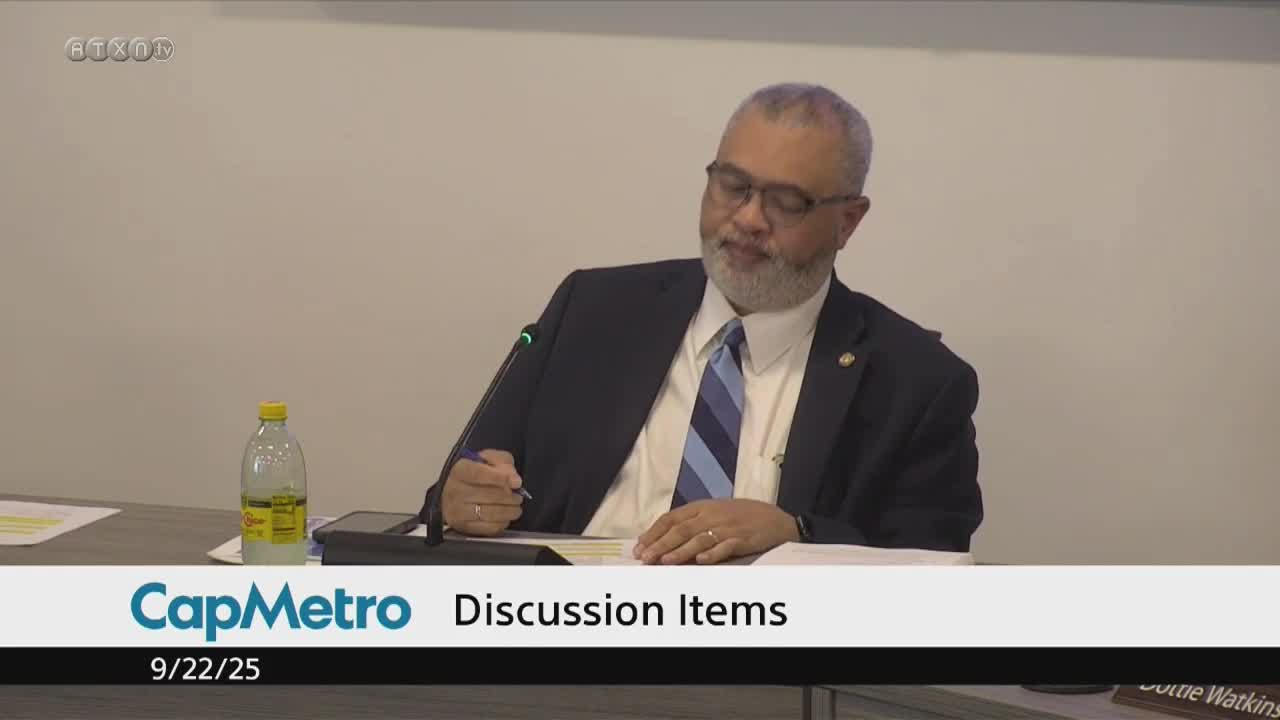
CapMetro staff on Sept. 22 presented Transit Plan 2035, a multi‑year network and policy roadmap that staff said is grounded in location and ridership data and shaped by more than 10,000 public comments. Staff described the plan as a phased set of recommendations to be implemented over the next 5 to 10 years, with board consideration scheduled for Oct. 20 and implementation proposals proceeding through the agency’s regular service‑change process.
Lawrence Dieter, CapMetro planner, said the plan is “data driven” and a “road map and vision for CapMetro’s transit service over the next 5 to 10 years.” Dieter told the board the plan reflected a broad public engagement program and that the team revised about 40% of the initially proposed route changes after community feedback.
Dieter and Rose Liska, principal planner, described three implementation phases: near‑term (first five years) focused on growing ridership and aligning services with Project Connect openings such as Broadmoor Station and two park‑and‑ride facilities; a 5‑plus‑year phase that integrates with the launch of Austin light rail and expands regional connectivity; and a 10‑plus‑year concept list for longer‑term system growth. Jordan McGee, senior planner, explained that the January 2026 service changes now approved by the board were separate from the longer Transit Plan and would follow existing Title VI and service‑change rules.
Key features staff highlighted: - Public engagement: staff reported reaching more than 10,000 people and convening 30+ focus groups, and said front‑line operators’ input directly shaped some route recommendations. Dieter said staff adjusted 26 of 60 proposed routes after the draft public comment, an update staff described as driven by community feedback. - Phasing: near‑term changes focus on aligning routes with current demand, including opening Rapid lines to full frequencies and adding hours at rail stations; mid‑term changes are structured around Austin light rail integration; longer‑term concepts would require additional partnerships or funding. - Regional and equity focus: staff said they used population, employment and location‑based travel data to identify areas with unmet transit needs and recommended pickup‑zone expansions and targeted frequency improvements (examples cited include Airport Boulevard and segments serving Montopolis and Del Valle).
Dieter and staff emphasized the plan is not itself a service change; each recommendation will return to the board through the standard service-change process with additional outreach and implementation timelines. Board members asked about the accessibility of raw comment data, east‑west cross‑town connectivity north of State Highway 183, and the plan’s responsiveness to growth corridors such as Palmer Lane; staff said summary engagement results are on the project website and more detailed comments can be provided on request.
Dottie Watkins, CapMetro president and CEO, praised the engagement and framed the plan as the first step toward implementing future service changes, noting prior capital and service improvements that began as planning efforts. The board will hold a public open house on Oct. 6 and is scheduled to vote on adoption Oct. 20, 2025.