Get Full Government Meeting Transcripts, Videos, & Alerts Forever!
Get email alerts on the Coal Ash Corrective Measures topic
No spam. Unsubscribe anytime.
AES Indiana presents updated corrective measures assessment for Harding Street ash ponds; opens 30-day comment period
Summary
AES Indiana presented an updated corrective measures assessment (CMA) for the Harding Street ash pond system in Indianapolis, reporting detection of arsenic, lithium and molybdenum above groundwater protection standards, describing five remedial alternatives, and opening a 30-day public comment period before selecting a final remedy.
AES Indiana on Tuesday presented an updated corrective measures assessment for the Harding Street generating station ash pond system and opened a 30-day public comment period on the report and proposed remedies.
Brandy Davis Handy, president of AES Indiana, introduced the presentation and said the company was committed to transparency as it works through corrective measures for coal combustion residuals (CCR) at the Harding Street facility. "Safety is our number 1 value at AES Indiana," Handy said.
The presentation, led by Pilar Cuadra, environmental manager, and Steve Petrich, the engineer of record, summarized a multi‑year groundwater monitoring program and a site‑specific risk evaluation conducted under the U.S. Environmental Protection Agency (EPA) CCR rule. Cuadra described CCR as the byproduct of burning coal and said federal CCR requirements—first issued in 2015 and supplemented by a legacy CCR rule in 2024—call for groundwater monitoring, closure of CCR units, and public posting of compliance data.
Petrich said AES began compliance monitoring at Harding Street in February 2016 and expanded the network during a nature‑and‑extent investigation. AES now monitors roughly 80 wells at 23 locations around the former pond footprint. Petrich said three constituents—arsenic, lithium and molybdenum—were identified at statistically significant levels above groundwater protection standards and that the impacted groundwater footprint is approximately 235 acres, mostly downgradient and off‑site to the south. "The main takeaway...there are no adverse impacts to human health or the environment from groundwater affected by the Harding Street ash pond system," Petrich said, summarizing the site risk evaluation.
Petrich described the vertical extent of impact as limited by a low‑permeability shale layer about 100 feet below ground and said long‑term monitoring shows concentrations are generally stable or declining. He also explained that groundwater near the site flows predominantly southwest toward the adjacent Harding Street Quarry rather than toward the White River because quarry dewatering alters the local gradient.
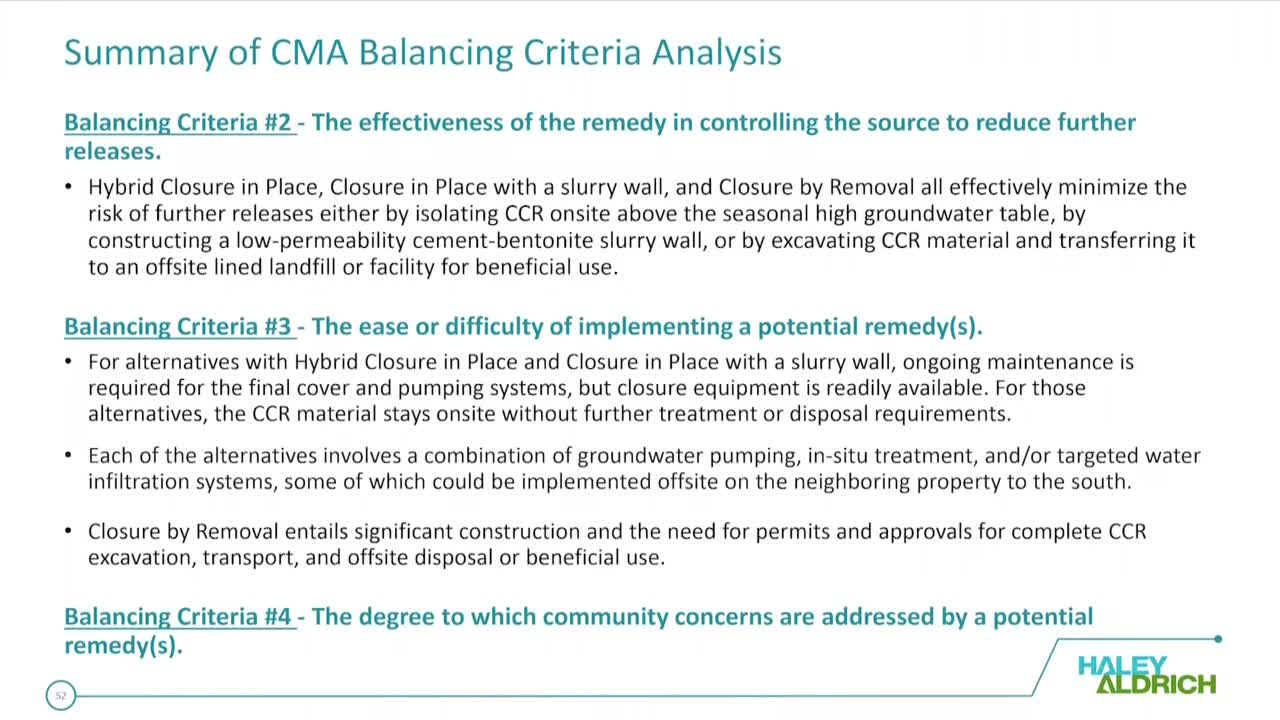
Despite the risk evaluation findings, the CCR rule requires a corrective measures assessment (CMA) when constituents exceed protection standards. AES presented an updated CMA that evaluated five remedial alternatives, each combining source‑control measures and groundwater treatment. Source‑control options considered include hybrid closure in place (removing CCR in direct contact with groundwater, capping remaining material), closure in place with a keyed slurry wall, and closure by removal (excavation and off‑site disposal or beneficial reuse). Groundwater treatment options include in‑ground (in situ) treatments and above‑ground (ex situ) pump‑and‑treat systems such as reverse osmosis.
The five remedial alternatives presented—labeled 1a, 1b, 2, 3a and 3b in the CMA—apply different combinations of source control and groundwater treatment across four areas of interest mapped for the site. AES said all five alternatives meet the CCR rule’s threshold criteria for protectiveness and feasibility; they were then evaluated against balancing criteria such as short‑ and long‑term effectiveness, source‑control performance, and implementability. Petrich said alternatives involving excavation and off‑site transport could carry greater short‑term community impacts due to truck traffic and permitting complexity.
AES posted the updated CMA to the Harding Street public CCR website in August 2025 and invited public input. Pilar Cuadra said the comment period will be open for 30 days and that attendees may submit comments using an online form (linked via a QR code on the meeting fact sheet), comment cards available at the meeting, or the CCR website. "We will review and address the comments that the public is providing today and during the period, and then we'll analyze and evaluate any additional data...to select the remedy," Cuadra said.
Chad Rogers, who directs AES’s regulatory team, said cost estimates for remediation are included in ongoing rate proceedings and that cost recovery is overseen by the Indiana Utility Regulatory Commission. "The company will pay for it, but it is in the recovery of those costs...in company rates," Rogers said, describing how AES incorporates decommissioning and remediation costs into utility rate cases and subsequent true‑ups before the regulator.
During the public Q&A AES staff addressed questions about monitoring intensity, connectivity to surface water, flood protections, monitoring of Lick Creek and the White River, and the potential for beneficial reuse of excavated ash (for example, processed ash as a cement additive). AES said the risk analysis modeled the mixing of groundwater and river water at the point of discharge and concluded concentrations would remain below EPA screening thresholds for human health and ecological receptors. AES also said the slurry‑wall design would be keyed into bedrock to limit flow around the wall and that remedies will be designed to account for 100‑year flood protection and typical erosion controls.
Next steps: AES will accept comments through the 30‑day period, address public input and any additional data needs, and then select and post a final remedy selection report on the Harding Street CCR website. Long‑term monitoring and compliance with the CCR rule will continue until groundwater protection standards are achieved, AES said.
Questions and supporting materials from the meeting, including the updated CMA, monitoring data and site maps, are available on AES’s Harding Street CCR website; the company encouraged members of the public to use the online comment form or submit written comment cards during the comment period.