Get Full Government Meeting Transcripts, Videos, & Alerts Forever!
Get email alerts on the Council Travel Policy topic
No spam. Unsubscribe anytime.
Santa Clara committee approves updated council travel rules, expands per-diem options
Summary
The Governance and Ethics Committee on Sept. 8 approved revisions to the city's council travel policy to clarify travel types, procedures and reimbursements and amended staff'recommended language to change first/last-day meal reimbursement and non-itemized-receipt options.
The Santa Clara Governance and Ethics Committee voted unanimously Sept. 8 to approve amendments to council policy 043 on official travel by city council members, adopting staff'proposed clarifications and adding committee amendments on per-diem and overnight lodging exceptions.
Assistant to the city manager Maria Lehi, presenting the staff recommendations, said the policy revisions were intended "to establish guidelines for official travel by city council members" and to provide "clear direction on travel, reimbursable expenses, and the procedures for consistency and accountability." Lehi told the committee staff is also updating the City Manager Directive CMD 28 (employee travel) and the city's purchase-card procedures to support the revised policy.
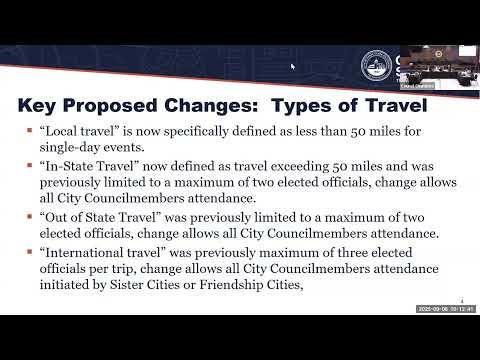
The packet presented to the committee defined local travel as less than 50 miles or single-day events, clarified in-state and international travel, and removed prior numerical caps that limited the number of elected officials who could attend the same out-of-state or international event. The proposed policy also moved priority for conference attendance away from seniority toward committee or legislative assignment, the date of request and budget availability. Procedures added by staff require a written request to the executive assistant, verification of available funds, a preauthorization form, and city manager or designee approval of travel preauthorization. The policy sets a 30-day deadline (up from 15) for returning itemized receipts after a trip and lists typical reimbursable items (lodging, airfare, bridge tolls, taxis, ride-shares) and non-reimbursable items (personal expenses, entertainment, alcohol, guest meals).
During committee discussion members raised several implementation questions. Member Park said she supported the changes but asked that the committee alter the staff'proposed rule that limited meal reimbursement on travel days to 75% of the GSA rate. "I would like to make the GSA 75 percent first and last day of travel. I'd like to make that 100%," Park said during the motion that amended staff'language. Other members described practical concerns about long travel days, late arrivals and receipts from taxis or local providers.
The committee amended the staff recommendation before approving it unanimously. The committee's amendments, recorded in the motion, (1) change the first-and-last-day meal allowance from 75% of the GSA per-diem to 100% of the GSA per-diem; (2) allow members to be reimbursed up to the GSA per-diem when itemized receipts are not provided (staff retained the option to accept itemized receipts when provided); and (3) add a limited exception for overnight lodging for some local trips when extensive commuting would otherwise be required, subject to city manager or designee approval and consistent with Brown Act considerations.
Maria Lehi told the committee that staff will prepare the final cleaned-up policy incorporating the committee's amendments and will bring the revised policy to the full City Council for final review and approval at a future meeting.
The committee also discussed operational details including p-card usage (staff said a separate purchase-card policy will define allowed p-card purchases for council travel), handling of shared receipts, refundable airfares, and whether frequent-flyer points or hotel rewards may be retained by the traveler. Lehi said the policy follows common practice in nearby cities and that staff can return with additional options if the committee wants further changes.
The motion to adopt the amended policy passed unanimously.
Less-critical implementation items and next steps include staff finalizing the policy text, updating the city manager directive and p-card rules, and training council members on the revised procedures.