Get Full Government Meeting Transcripts, Videos, & Alerts Forever!
Get email alerts on the Budget And Legislative Request 2026 27 topic
No spam. Unsubscribe anytime.
Board of Governors approves $700 million-plus budget and legislative request focused on AI, veterans, Umoja and workforce
Summary
The California Community Colleges Board of Governors on Sept. 16 approved a broad 2026–27 budget and legislative request that seeks roughly $700 million in one-time and ongoing funds for priorities including AI literacy and infrastructure, veterans services, Umoja expansion, dual enrollment and workforce programs.
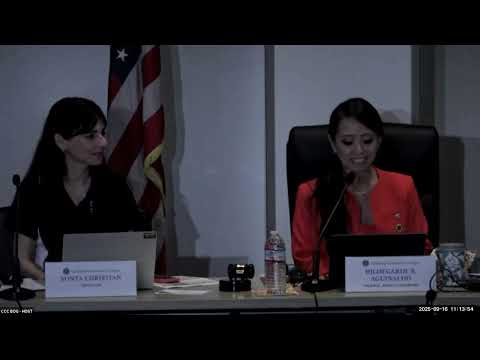
The California Community Colleges Board of Governors on Sept. 16 approved the Chancellor’s Office’s 2026–27 budget and legislative request, a package the office described as “roughly $700,000,000 in 1 time and ongoing requests.” The board voted to adopt the package after a presentation from Executive Vice Chancellor Christopher (Chris) Ferguson and follow-up remarks from Chancellor Sonia Christian.
The request asks the Legislature and the governor for a combination of one-time and ongoing investments across the system’s Vision 2030 priorities: equitable baccalaureate attainment, workforce and economic development, and the future of learning and artificial intelligence. Key line items in the presentation included funding for AI professional development and infrastructure, an ask to expand credit-for-prior-learning supports, proposals for veterans’ resource center expansion, new Umoja program funding and an allocation to scale dual-enrollment partnerships.
Why it matters: The package sets the system’s statewide advocacy priorities heading into the 2026–27 budget cycle and signals the chancellor’s office intent to pursue both one-time infrastructure investments and ongoing programmatic support. Many of the items address immediate operational needs — technology, student supports and career-aligned training — while others are intended to shape longer-term equity and workforce goals.
What the board heard: Executive Vice Chancellor Chris Ferguson framed the request as a single advocacy document aligned to Vision 2030. “The budget and legislative request reflects roughly 700,000,000 in 1 time and ongoing requests,” Ferguson told the board. Ferguson also asked the board to add a previously omitted $1,000,000 ongoing allocation to support expansion of Umoja programs systemwide; the board indicated support for adding that item.
Chancellor Sonia Christian highlighted federal developments affecting the system, including Department of Education changes to discretionary funding for minority-serving institutions and the system’s response. “Eliminating these funds undermines that commitment,” Christian said in remarks about proposed federal cuts to MSI/HSI funding and the system’s reliance on state mitigations.
Policy priorities and dollar examples: Board and staff presentations itemized a long list of priorities with dollar figures (as presented): one-time and ongoing requests totaling roughly $700 million; requests for common-cloud data platform infrastructure ($36,000,000 one-time and $9,000,000 ongoing); one-time funding for a college- and career-access dual enrollment grant ($24,200,000 one-time); ongoing investments for student services and categorical programs (example: $62,300,000 ongoing cited for student services programs); expansion of Veterans Resource Center staffing and services (examples in the presentation included $11,500,000 ongoing and other figures); $1,000,000 ongoing added for Umoja program expansion; and multiple asks tied to apprenticeship, climate/sustainability microgrids and deferred maintenance. Presenters said final technical edits would be made before transmittal to state leaders.
Board discussion and public comment: Board members praised the level of detail and equity focus in the request. Several members singled out AI literacy, noncredit pathways, Umoja, veterans supports and workforce investments as priorities. Student and advocacy organizations offered public comment in support of Umoja expansion, dual enrollment, financial aid administration supports and veteran funding. Jerry Reyes, president of the Student Senate for California Community Colleges, urged the board to back the Umoja proposal, citing system evaluation data showing positive outcomes for Umoja participants.
Vote and immediate outcome: Member Pamela Haynes moved the item; Member Jennifer L. Perry seconded. The motion passed on the roll call with the board recording unanimous ayes in the formal roll call (see action record). With the vote, the chancellor’s office was authorized to finalize the 2026–27 budget and legislative package for advocacy and follow-up with the Legislature and governor’s office.
Next steps: Staff said they will incorporate the board’s technical edits, add the agreed $1,000,000 Umoja ongoing allocation to the formal document, and proceed with legislative and budget advocacy in Sacramento.
Ending: The budget request sets the system’s priorities for the coming advocacy season and ties infrastructure investments (common cloud, AI, data) to student-facing programs (veterans, Umoja, dual enrollment, apprenticeships). The chancellor’s office and board agreed on an aggressive outreach strategy to press for those priorities during the 2026–27 budget process.