Get Full Government Meeting Transcripts, Videos, & Alerts Forever!
Get email alerts on the Municipal Budget topic
No spam. Unsubscribe anytime.
Santa Barbara City finance committee hears FY2025 fourth-quarter review; forwards budget adjustments to council
Summary
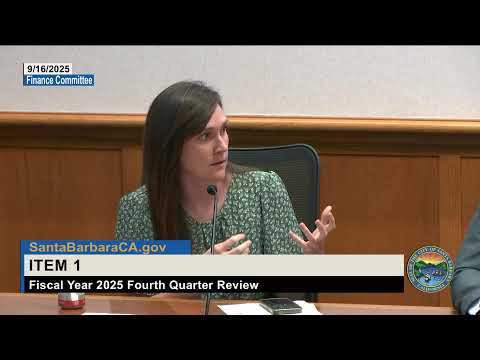
On Sept. 16, the Santa Barbara City Finance Committee received staff's fourth-quarter financial review for fiscal year 2025 and voted to forward staff budget-adjustment recommendations to the City Council.
SANTA BARBARA, Calif. — On Sept. 16, the Santa Barbara City Finance Committee received staff's fourth-quarter financial review for fiscal year 2025 and voted to forward staff recommendations on budget adjustments to the City Council. Finance Director Keith DeMartini presented the report with Natalie Locoli, the city's controller, and described the city's fiscal position and proposed adjustments.
DeMartini told the committee the city is working with a structural gap in the general fund as expenditures have grown faster than revenues. "we continue to to have some challenges in the general fund with our expenditures increasing at a greater rate than our revenues are increasing," he said. The adopted fiscal-year 2026 budget previously assumed an $8,000,000 deficit target tied to a required contribution to reserves; staff reported a pre-audit fourth-quarter deficit of about $6,800,000 and said the final audited deficit is likely to be lower once Measure I receipts are posted.
The presentation said Measure I, the newly approved sales tax that took effect April 1, generated receipts after the fiscal year closed; staff said accruals for those receipts should reduce the year's deficit to an estimated $3,000,000 to $4,000,000. DeMartini explained that timing — not missing revenue — accounted for much of the difference: the city received Measure I money in July rather than June and will reflect it in audited statements.
The report also separated Measure C (a sales-tax-funded capital program) from the general fund. Staff warned that Measure C often shows multi-year spending patterns because capital projects receive money one year but spend it across subsequent years. The police station project was highlighted as a multi-year commitment: bond proceeds will cover the primary construction contractor (ProWest) and related construction costs, while Measure C appropriations will be used for other project costs such as IT and insurance over the next three fiscal years.
Locoli summarized enterprise-fund results and several departmental outcomes. Key figures from staff's presentation included: - General fund expenditures: $231,400,000 (about 99% of revised budget); encumbrances of $2,800,000 were noted. Staff said a $6,000,000 cost-reduction allocation was budgeted in a non-departmental line. - Short-term rental (STR) program: $2,200,000 in revenue in the first 12 months, with $430,000 set aside for a Creek restoration project identified in staff materials as "Meusebi." Locoli said an additional $1,200,000 came from enforcement actions. - Property tax was near budget; sales tax trailed budget by about $1.0 million. Staff said roughly half of local sales tax comes from tourism and half from residents, and early FY26 transient occupancy tax trends were described as "a little bit soft." - Police department expenditures totaled approximately $56,800,000; the Fire Department spent about $39,500,000 and received a multi-year CAL FIRE grant (staff cited approximately $2,900,000 over five years) that reduced personnel costs tied to wildland mitigation work. - Enterprise funds: Water closed the year with a net positive of about $4,700,000 (driven by rate increases and higher treatment-joint-operations revenue), wastewater finished near neutral with revenue about $700,000 above budget, solid waste posted a $1,600,000 net profit, and the airport posted higher revenue (about $3,000,000 above the prior year) but an operating loss of about $1,900,000. The clean-energy program showed a FY25 loss of about $11,100,000; staff advised reviewing a two-year trend, noting FY24 timing issues in invoice recognition and reporting a combined two-year profit of $9,700,000.
Staff presented a list of proposed fourth-quarter budget adjustments and transfers, including an increase in estimated Measure C revenue of $1,800,000 and an FAA-approved $5,100,000 transfer from the airport PFC fund to buy an aircraft rescue and firefighting vehicle. DeMartini noted a clerical error in the council agenda report (exhibit 1) and directed the committee to use attachment 3 for the correct budget-adjustment detail.
The committee voted to forward staff recommendations to the City Council with the reclassification requests held for separate consideration. Roll call on the staff recommendations (excluding reclassifications) recorded Committee Member Santa Maria: yes; Committee Member Harmon: yes; Chair Friedman: yes.
Why it matters: the fourth-quarter review frames planning for the FY26 budgeting cycle and highlights where one-time timing differences (Measure I receipts) and ongoing structural pressures (personnel and capital costs) will affect policy choices the council must make in coming months.
Provenance: the committee heard the staff presentation and Q&A from 09/16/2025; the discussion and slide details are recorded in the committee transcript beginning with DeMartini's presentation on the fourth-quarter review and continuing through the committee's motion to forward staff recommendations.