Get Full Government Meeting Transcripts, Videos, & Alerts Forever!
Get email alerts on the Stormwater Water Quality topic
No spam. Unsubscribe anytime.
Stormwater advisory committee: Polk County spends $27 million this year, lake trends mixed
Summary
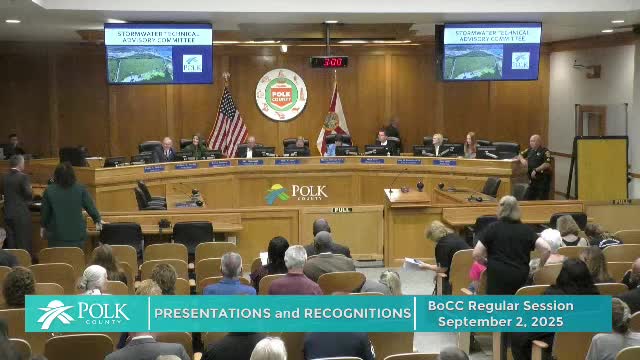
At the Sept. 2 Polk County Commission meeting, Dave Carter, chair of the county Stormwater Technical Advisory Committee, reviewed a 10-year program that includes $27 million of projects this year, ongoing maintenance, and mixed water-quality trends across sampled lakes.
Dave Carter, chairman of the Polk County Stormwater Technical Advisory Committee, told the Board of County Commissioners on Sept. 2 that the county is spending an unusually large amount on stormwater this year — about $27 million — driven by accumulated project carryover and federal ARP funds.
Carter said the committee was formed about 10 years ago to help Polk County meet state and federal drainage permits, particularly its NPDES (National Pollutant Discharge Elimination System) permit, and to provide project oversight and cost effectiveness. “I am serving as Chairman of the County Stormwater technical advisory committee, and we typically give a, annual report to the board,” Carter said.
The committee reported that the county’s stormwater municipal service taxing unit (MSTU) generates roughly $2.5 million a year, with some years of carryover. County staff and the advisory committee rely heavily on grant funding; Carter estimated the county has brought in “north of $50,000,000 in grant money over the last…10 years.” The MSTU, county matching dollars and grants have supported design, construction and maintenance of lakes, wetlands and stormwater facilities.
Why this matters: Polk County’s stormwater work feeds into regulatory compliance (NPDES), water-quality outcomes and public-safety considerations tied to flooding and critical facilities. Carter told commissioners that about 100 lakes are sampled roughly four times a year and that, based on the most recent data, roughly twice as many lakes show long-term improvement as show decline; a “trend” requires four consecutive quarters in one direction.
Most important details
- Funding and projects: The advisory committee reported roughly $27 million of stormwater spending this year, reflecting accumulated project funds and ARP money; MSTU revenue is approximately $2.5 million annually. Carter said most project construction is funded by grants with county matching dollars. He estimated Polk County has secured over $50 million in grant funds during the last decade.
- Maintenance and monitoring: County staff inspect about 100 major projects annually, review 400 outfall projects on a five‑year cycle, and currently track about 38 items under study or repair. Street-sweeping is a major prevention tactic; the county plans to sweep about 9,000 miles of streets next year and estimated that effort removes about 1,000 pounds of nitrogen and phosphorus from the system.
- Capital and site work: Carter presented ongoing and planned projects including Lake Lulu (wetland reconnection), Lake Gwyn, Saddle Creek, Crystal Lake, Walker Road Park treatment work, Lake Annie restoration (a former peat mine), Tiger Lake eelgrass plantings, Peace Creek Canal control-structure work, Simmers Young Park wetland treatment, and a list of stack-approved projects dating back to 2017.
- Project timing and constraints: Some projects can take three to five years from conception to construction because of grant cycles, permitting and property acquisition costs. Carter noted that projects that require acquisition — for example, to re‑establish wetlands or backwater canals — can be costly because landowners and the Water Management District limit uncontrolled flooding onto private property.
Questions from commissioners and staff
Commissioner Bridal asked for confirmation of annual MSTU revenue; Carter and the chair clarified the figure as about $2.5 million. Parks and Natural Resources staff Tabitha Beal described a “water goat” device used in canal systems to capture floatable trash before it reaches lakes: “It has floating items and basically a net and it catches the floatables rather than it just spreading throughout,” Beal said. Staff also said many of the committee’s completed projects and summaries are posted to the Polk County Water Atlas, maintained in partnership with the University of South Florida and local cities.
Committee recommendation and next steps
Carter told the commission the advisory committee voted to recommend the current project list to county staff for continued work and grant‑funding pursuit. Several projects remain in design and permitting; staff said they will continue to seek state and federal grants and advance shovel‑ready designs where feasible.
Ending
The advisory committee’s report emphasized maintenance and monitoring as ongoing costs after construction, and highlighted the role of grant funding and the MSTU in allowing Polk County to move several long‑planned capital projects into construction this year.